GluN2C antibody; Glutamate [NMDA] receptor subunit epsilon-3 antibody; Glutamate Receptor Ionotropic N Methyl D Aspartate 2C antibody; Glutamate receptor ionotropic, NMDA 2C antibody; Glutamate receptor, ionotropic, N methyl D aspartate 2C antibody; Grin2c antibody; N Methly D Aspartate Receptor Channel Subunit Epsilon 3 antibody; N Methyl D Aspartate Receptor Subtype 2C antibody; N methyl D aspartate receptor subunit 2C antibody; N-methyl D-aspartate receptor subtype 2C antibody; NMDAR2C antibody; NMDE3_HUMAN antibody; NR2C antibody; OTTHUMP00000041930 antibody
Raised in
Rabbit
Species Reactivity
Human
Immunogen
Synthetic peptide of Human GRIN2C
Immunogen Species
Homo sapiens (Human)
Conjugate
Non-conjugated
Isotype
IgG
Purification Method
Antigen affinity purification
Concentration
It differs from different batches. Please contact us to confirm it.
Buffer
-20°C, pH7.4 PBS, 0.05% NaN3, 40% Glycerol
Form
Liquid
Note: We will preferentially ship the format that we have in stock, however, if you have any special requirement for the format, please remark your requirement when placing the order, we will prepare according to your demand.
Upon receipt, store at -20°C or -80°C. Avoid repeated freeze.
Lead Time
Basically, we can dispatch the products out in 1-3 working days after receiving your orders. Delivery time maybe differs from different purchasing way or location, please kindly consult your local distributors for specific delivery time.
Note: All of our proteins are default shipped with normal blue ice packs, if you request to ship with dry ice, please communicate with us in advance and extra fees will be charged.
Usage
For Research Use Only. Not for use in diagnostic or therapeutic procedures.
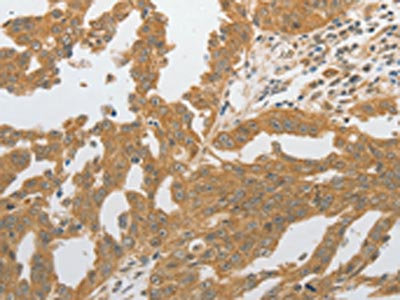
The image on the left is immunohistochemistry of paraffin-embedded Human ovarian cancer tissue using CSB-PA583461(GRIN2C Antibody) at dilution 1/80, on the right is treated with synthetic peptide. (Original magnification: ×200)
Component of NMDA receptor complexes that function as heterotetrameric, ligand-gated ion channels with high calcium permeability and voltage-dependent sensitivity to magnesium. Channel activation requires binding of the neurotransmitter glutamate to the epsilon subunit, glycine binding to the zeta subunit, plus membrane depolarization to eliminate channel inhibition by Mg(2+). Sensitivity to glutamate and channel kinetics depend on the subunit composition (Probable). Plays a role in regulating the balance between excitatory and inhibitory activity of pyramidal neurons in the prefrontal cortex. Contributes to the slow phase of excitatory postsynaptic current, long-term synaptic potentiation, and learning.
Gene References into Functions
ultra-rare variants with loss of function (frameshift, nonsense or splice site) in NMDARs genes like GRIN2C and GRIN2D may contribute to possible risk of schizophreniaPMID:29317596
Findings indicate that SNPs in the GRIN2C gene is associated with altered cue-induced brain activation that is related to craving for alcohol and relapse risk.PMID:26289945
these findings highlight the isoform-specific structural and functional differences within the 14-3-3 family of proteins, which determine GluN2C binding and its essential role in targeting the receptor to the cell surfacePMID:26229101
The major depression subjects exhibited significantly higher expression levels of the NMDA receptor subunit genes GRIN2C.PMID:24925192
TNFalpha significantly upregulates NMDA-R2C mRNA expression, in differentiated, confluent, normal keratinocytes but not in involved or uninvolved psoriatic keratinocyte monolayersPMID:24102971
The authors identified and cloned sequences of NMDA receptor subunits 2A, 2B, and 2C from rat. They characterized the properties of the receptors composed of heteromeric 1-2A and heteromeric 1-2C and found that the latter had reduced sensitivity to magnesium and smaller conductance compared to the former.PMID:1350383
Functional compensation could occur to counteract the loss of one allele in GRIN2C and GRIN3 family genes.PMID:22833210
Glutamate-gated ion channel (TC 1.A.10.1) family, NR2C/GRIN2C subfamily
Tissue Specificity
Mainly expressed in brain with predominant expression is in the cerebellum, also present in the hippocampus, amygdala, caudate nucleus, corpus callosum, subthalamic nuclei and thalamus. Detected in the heart, skeletal muscle and pancreas.