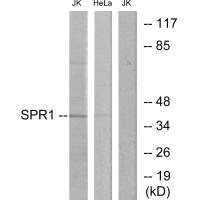
Synthesized peptide derived from internal of Human SPR1.
Immunogen Species
Homo sapiens (Human)
Purification Method
The antibody was affinity-purified from rabbit antiserum by affinity-chromatography using epitope-specific immunogen.
Concentration
It differs from different batches. Please contact us to confirm it.
Tested Applications
ELISA,WB
Storage
Upon receipt, store at -20°C or -80°C. Avoid repeated freeze.
Lead Time
Basically, we can dispatch the products out in 1-3 working days after receiving your orders. Delivery time maybe differs from different purchasing way or location, please kindly consult your local distributors for specific delivery time.
Usage
For Research Use Only. Not for use in diagnostic or therapeutic procedures.
Proton-sensing receptor involved in pH homeostasis. May represents an osteoblastic pH sensor regulating cell-mediated responses to acidosis in bone. Mediates its action by association with G proteins that stimulates inositol phosphate (IP) production or Ca(2+) mobilization. The receptor is almost silent at pH 7.8 but fully activated at pH 6.8. Also functions as a metastasis suppressor gene in prostate cancer.
Gene References into Functions
High GPR68 expression is associated with pancreatic ductal adenocarcinoma.PMID:29092903
different benzodiazepines exhibit a range of biases for OGR1, with sulazepam selectively activating the canonical Gs of the G protein signaling pathway, in heterologous expression systems, as well as in several primary cell types.PMID:29042451
Our results suggest that OGR1-dependent increases in TRPC4 expression may favour formation of highly Ca(2+) -permeable TRPC4-containing channels that promote transformed granule cell migration. Increased motility of cancer cells is a prerequisite for cancer invasion and metastasis, and our findings may point towards a key role for TRPC4 in progression of certain types of medullablastoma.PMID:28627017
Blocking of GPR68 or NF-small ka, CyrillicB activity severely attenuated acidification induced IL-8 production.PMID:27166427
These results suggest that zOGR1, but not GPR4, is also a metal-sensing G-protein-coupled receptor in addition to a proton-sensing G-protein-coupled receptor, although not all metals that activate hOGR1 activated zOGR1.PMID:28270026
data identify a role for GPR68 as a proton sensor that is required for proper enamel formationPMID:27693231
coexpression of OGR1- and G2A-enhanced proton sensitivity and proton-induced calcium signals. This alteration is attributed to oligomerization of OGR1 and G2A. The oligomeric potential locates receptors at a specific site, which leads to enhancedPMID:27049592
The deconstruction of OGR1-dependent signaling may aid our understanding of mucosal inflammation mechanismsPMID:26206859
Provide evidence for the roles of OGR1 and ASIC1a in the regulation of intestinal passive Mg(2+) absorption.PMID:24375028
the expression of OGR1 in myeloid-derived cells, especially in double positive cells, was required for prostate tumor cell-induced immunosuppression.PMID:23222714
The involvement of ovarian cancer G-protein-coupled receptor 1 in acidic extracellular environment may be an underlying mechanism responsible for bone pain in osteoporosis or bone metastasis without clinically proved fractures.PMID:22835475
OGR1 activation increased intracellular calcium in transfected HEK293 cells.PMID:22508039
It indicated that OGR1 may be a tumor suppressor gene for ovarian cancer.PMID:21740742
extracellular acidification induces CTGF production through the OGR1/G(q/11) protein and inositol-1,4,5-trisphosphate-induced Ca(2+) mobilization in human airway smooth muscle cells.PMID:21907704
acidic pH-induced vascular actions of aortic smooth muscle cells can be dissected to OGR1-dependent and -independent pathways: COX-2 expression, PGI(2) production, and MKP-1 expression are mediated by OGR1, but PAI-1 expression is not.PMID:20622109
ovarian cancer G-protein-coupled receptor 1 (OGR1), previously described as a receptor for sphingosylphosphorylcholine, acts as a proton-sensing receptor stimulating inositol phosphate formationPMID:12955148
OGR1 was found to evoke strong pH-dependent responses as measured by inositol phosphate accumulation.PMID:15665078
cAMP accumulation may occur through OGR1-mediated stimulation of the phospholipase C/cyclooxygenase/PGI(2) pathwayPMID:16087674
OGR1 is a novel metastasis suppressor gene for prostate cancer. OGR1's constitutive activity via G alpha(i) contributes to its inhibitory effect on cell migration in vitro.PMID:17728215
OGR1/G(q/11)/phospholipase C/protein kinase C pathway regulates osteoblastic COX-2 induction and subsequent PGE(2) production in response to acidic circumstancesPMID:18302504
Show
More
Hide
All
Subcellular Location
Cell membrane; Multi-pass membrane protein.
Protein Families
G-protein coupled receptor 1 family
Tissue Specificity
Found at low level in a wide range of tissues, but significantly expressed in lung, kidney, bone and nervous system.