GFAP antibody; GFAP Epsilon antibody; GFAP_HUMAN antibody; GFAPdelta antibody; GFAPepsilon antibody; Glial fibrillary acidic protein antibody; Intermediate filament protein antibody
Raised in
Rabbit
Species Reactivity
Human,Mouse,Rat
Immunogen
Fusion protein of Human GFAP
Immunogen Species
Homo sapiens (Human)
Conjugate
Non-conjugated
Isotype
IgG
Purification Method
Antigen affinity purification
Concentration
It differs from different batches. Please contact us to confirm it.
Buffer
-20°C, pH7.4 PBS, 0.05% NaN3, 40% Glycerol
Tested Applications
ELISA,IHC
Storage
Upon receipt, store at -20°C or -80°C. Avoid repeated freeze.
Lead Time
Basically, we can dispatch the products out in 1-3 working days after receiving your orders. Delivery time maybe differs from different purchasing way or location, please kindly consult your local distributors for specific delivery time.
Note: All of our proteins are default shipped with normal blue ice packs, if you request to ship with dry ice, please communicate with us in advance and extra fees will be charged.
Usage
For Research Use Only. Not for use in diagnostic or therapeutic procedures.
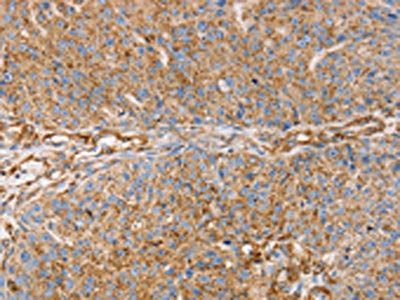
The image on the left is immunohistochemistry of paraffin-embedded Human breast cancer tissue using CSB-PA289722(GFAP Antibody) at dilution 1/25, on the right is treated with fusion protein. (Original magnification: ×200)
GFAP, a class-III intermediate filament, is a cell-specific marker that, during the development of the central nervous system, distinguishes astrocytes from other glial cells.
Gene References into Functions
The features of the neuropathology and immunopathology of GFAP astrocytopathies were perivascular inflammation and loss of astrocytes and neuronsPMID:29193473
amniotic fluid -GFAP levels differentiate between myelomeningocele and myeloschisis, and raise interesting questions regarding the clinical significance between the 2 types of defects.PMID:28768252
Desmin, Glial Fibrillary Acidic Protein, Vimentin, and Peripherin are type III intermediate filaments that have roles in health and disease [review]PMID:29196434
Plasma concentration of GFAP demonstrated associations with stroke occurrence in a West African cohort but was not associated with stroke severity or mortality.PMID:29074065
This study demonstrated that Concentrations of microparticles expressing GFAP and AQP4 were significantly higher in the traumatic brain injury group compared with healthy controls.PMID:28972406
The authors observed higher serum levels of GFAP and UCH-L1 in brain-injured children compared with controls and also demonstrated a step-wise increase of biomarker concentrations over the continuum of severity from mild to severe traumatic brain injury. Serum UCH-L1 and GFAP concentrations also strongly predicted poor outcome.PMID:27319802
Study examined if QKI6B expression can predict the outcome of GFAP, and several oligodendrocyte-related genes, in the prefrontal cortex of brain samples of schizophrenic individuals. QKI6B significantly predicts the expression of GFAP, but does not predict oligodendrocyte-related gene outcome, as previously seen with other QKI isoforms.PMID:28552414
GFAP, along with tau and AmyloidBeta42, were increased in plasma up to 90 days after traumatic brain injury compared with controls.PMID:27312416
Results show that the positive rates and expression levels of nestin, tyrosine hydroxylase (TH), GFAP and IL-17 were significantly decreased while Foxp3 and the ratio of Foxp3/IL-17 were statistically elevated in BM of AML patients.PMID:27016413
GFAP levels >0.29 ng/ml were seen only in intracerebral hemorrhage, thus confirming the diagnosis of ICH during prehospital care.PMID:27951536
These results indicate that autoantibodies against GFAP could serve as a predictive marker for the development of overt autoimmune diabetes.PMID:28546444
Higher median plasma GFAP values were documented in intracerebral hemorrhage compared with acute ischemic stroke, stroke mimics, and controls.PMID:28751552
GFAP is specifically expressed in the auricular chondrocytes, and assumes a pivotal role in resistance against mechanical stress.PMID:28063220
Bevacizumab treatment was also associated with structural protein abnormalities, with decreased GFAP and vimentin content and upregulated GFAP and vimentin mRNA expression.PMID:28419863
the exchange of GFP-GFAPdelta was significantly slower than the exchange of GFP-GFAPalpha with the intermediate filament-network.PMID:27141937
Tat expression or GFAP expression led to formation of GFAP aggregates and induction of unfolded protein response (UPR) and endoplasmic reticulum (ER) stress in astrocytes.PMID:27609520
This study demonstrated that GFAP exhibited distinct temporal profiles over the course of 7 days in patient with traumatic brain injury.PMID:27018834
e data indicates that serum GFAP levels may be associated with severity of autism spectrum disorders among Chinese children.PMID:28088366
High GFAP expression is associated with retinoblastoma.PMID:27488116
Overall, glial fibrillary acidic protein reflected no evidence for significant peripartum brain injury in neonates with congenital heart defects, but there was a trend for elevation by postnatal day 4 in neonates with left heart obstruction.PMID:26786018
serum levels of GFAP were significantly lower in autism spectrum disorders than controlsPMID:27097671
We found downregulation of GFAP mRNA and protein in the mediodorsal thalamus and caudate nucleus of depressed suicides compared with controls, whereas GFAP expression in other brain regions was similar between groups. Furthermore, a regional comparison including all samples revealed that GFAP expression in both subcortical regions was, on average, between 11- and 15-fold greater than in cerebellum and neocortex.PMID:26033239
No difference in cord blood concentration found between hypoxic-ischemic encephalopathy neonates and controlsPMID:26135781
GFAP is upregulated following an insult or injury to the brain, additionally making it an indicator of CNS pathology.PMID:25846779
This study demonistrated that the density of GFAP-immunoreactive astrocytes is decreased in left hippocampi in major depressive disorderPMID:26742791
This study demonstrated that GFAP as a promising biomarker to distinguish ischemic stroke from intracerebral hemorrhage.PMID:26526443
The levels of GFAP in Alzheimer's disease, dementia with Lewy bodies, and frontotemporal lobar degeneration patients were significantly higher than those in the healthy control subjects.PMID:26485083
GFAP is significantly associated with outcome, but it does not add predictive power to commonly used prognostic variables in a population of patients with TBI of varying severities.PMID:26547005
Neither duplications nor deletions of GFAP were found, suggesting that GFAP coding-region rearrangements may not be involved in Alexander disease or Alexanderrelated leukoencephalopathies.PMID:26208460
The data suggest that human vitreous body GFAP is a protein biomarker for glial activation in response to retinal pathologies.PMID:26279003
Studied diagnostic Value of Serum Levels of GFAP, pNF-H, and NSE Compared With Clinical Findings in Severity Assessment of Human Traumatic Spinal Cord Injury.PMID:25341992
GFAP peaks early during haemorrhagic brain lesions (at significantly higher levels), and late in ischaemic events, whereas antibodies against NR2 RNMDA have significantly higher levels during ischemic stroke at all time-points.PMID:26081945
There was an absence of GFAP in astrocytes during early fetal spinal cord development until 9 months of gestation , and the appearance of GFAP-positive reactivity was later than that of neurons.PMID:25904356
It could be a clinically relevant marker associated with tumor invasiveness in cerebral astrocytomas.PMID:25178519
These data imply that a tight regulation of histone acetylation in astrocytes is essential, because dysregulation of gene expression causes the aggregation of GFAP, a hallmark of human diseases like Alexander's disease.PMID:25128567
Identification of a novel nonsense mutation in the rod domain of GFAP that is associated with Alexander disease.PMID:24755947
The role of S100B protein, neuron-specific enolase, and glial fibrillary acidic protein in the evaluation of hypoxic brain injury in acute carbon monoxide poisoningPMID:24505052
GFAP, the principal intermediate filament protein of astrocytes, is involved in physiological, but in particular, in pathophysiological functions of astrocytes, the latter ones being connected with astrocyte activation and reactive gliosis. [Review]PMID:25726916
The data on the changes in expression of GFAP in Alexander disease caused by the primary pathology of astrocytes are presented.PMID:25859599
A combined profile of preoperative IGFBP-2, GFAP, and YKL-40 plasma levels could serve as an additional diagnostic tool for patients with inoperable brain lesions suggestive of Glioblastoma multiforme.PMID:25139333
There are significant increases in glial fibrillary acidic protein levels in children undergoing cardiopulmonary bypass for repair of congenital heart disease. The highest values were seen during the re-warming phase.PMID:23845562
This stuidy demonistrated that Fibrillary astrocytes are decreased in the subgenual cingulate in schizophrenia.PMID:24374936
TBI patients showed an average 3.77 fold increase in anti-GFAP autoantibody levels from early (0-1 days) to late (7-10 days) times post injury.PMID:24667434
We showed that GFAP is over-expressed and hypophosphorylated in the enteric glial cells of Parkinson's disease patients as compared to healthy subjectsPMID:24749759
Its expression is associated with plaque load related astrogliosis in Alzheimer's disease.PMID:24269023
The findings of this study that caspase-mediated GFAP proteolysis may be a common event in the context of both the GFAP mutation and excess.PMID:24102621
This study demonistratedt hat Increased expression of glial fibrillary acidic protein in prefrontal cortex in psychotic illnessPMID:23911257
Data indicate that Gfapdelta is expressed in the in developing mouse brain sub-ventricular zones in accordance with the described localization in the developing and adult human brain.PMID:23991052
GFAP-breakdown products blood levels reliably distinguished severity of injury in traumatic brain injury patients.PMID:23489259
The C/C genotype at rs2070935 of the GFAP promoter in late-onset AxD was associated with an earlier onset and a more rapid progression of ambulatory disability compared with the other genotypes.PMID:23903069