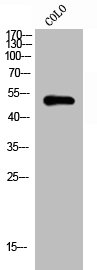
Synthesized peptide derived from Human GATA-4 around the non-phosphorylation site of S262.
Immunogen Species
Homo sapiens (Human)
Conjugate
Non-conjugated
Isotype
IgG
Purification Method
The antibody was affinity-purified from rabbit antiserum by affinity-chromatography using epitope-specific immunogen.
Concentration
It differs from different batches. Please contact us to confirm it.
Buffer
Liquid in PBS containing 50% glycerol, 0.5% BSA and 0.02% sodium azide.
Tested Applications
WB, IF, ELISA
Storage
Upon receipt, store at -20°C or -80°C. Avoid repeated freeze.
Lead Time
Basically, we can dispatch the products out in 1-3 working days after receiving your orders. Delivery time maybe differs from different purchasing way or location, please kindly consult your local distributors for specific delivery time.
Note: All of our proteins are default shipped with normal blue ice packs, if you request to ship with dry ice, please communicate with us in advance and extra fees will be charged.
Usage
For Research Use Only. Not for use in diagnostic or therapeutic procedures.
Transcriptional activator that binds to the consensus sequence 5'-AGATAG-3' and plays a key role in cardiac development and function. In cooperation with TBX5, it binds to cardiac super-enhancers and promotes cardiomyocyte gene expression, while it downregulates endocardial and endothelial gene expression. Involved in bone morphogenetic protein (BMP)-mediated induction of cardiac-specific gene expression. Binds to BMP response element (BMPRE) DNA sequences within cardiac activating regions. Acts as a transcriptional activator of ANF in cooperation with NKX2-5. Promotes cardiac myocyte enlargement. Required during testicular development. May play a role in sphingolipid signaling by regulating the expression of sphingosine-1-phosphate degrading enzyme, sphingosine-1-phosphate lyase.
Gene References into Functions
The single nucleotide polymorphisms (SNPs) of NKX2.5, GATA4, and TBX5 are highly associated with congenital heart diseases in the Chinese population, but not significant in the SNPs of FOG2.PMID:29972125
direct binding of GATA4 to the GNAI3 promoter, both in vitro and in vivo, is reported.PMID:28484278
Report a genome-wide association scan of 466 bicuspid aortic valve cases and 4,660 age, sex and ethnicity-matched controls with replication in up to 1,326 cases and 8,103 controls. We identify association with a noncoding variant 151 kb from the gene encoding the cardiac-specific transcription factor, GATA4, and near-significance for p.Ser377Gly in GATA4.PMID:28541271
GATA4 variants were not associated with Alcohol Use Disorder (AUD) in either the European ancestry or African ancestry groups after correcting for multiple comparisons. Rs10112596 demonstrated a significant relationship with an anxiety measure among the African ancestry group with AUD.PMID:29415147
High GATA4 expression is associated with mesenchymal and migratory phenotype of hepatoblastoma cells.PMID:30074440
GATA4 may inhibit diabetesinduced endothelial dysfunction by acting as a transcription factor for NOX4 expression.PMID:29138836
GATA4 acetylation activated CCND2 transcription, and mutation of GATA4 on K-313 reduced cell viability and increased a mitochondria-dependent apoptosis.PMID:29590644
we found two nucleotide deletions which one of them was novel and one new indel mutation resulting in frame shift mutation, and 4 synonymous variations or polymorphism in 6 of patients and 3 of normal individualsPMID:29377543
the mutation significantly diminished the synergistic activation between MEF2C and GATA4, another cardiac core transcription factor that has been causally linked to Congenital heart disease (CHD).PMID:29104469
GATA4 was a transcription factor that activated mouse double minute 2 homolog (MDM2) and B cell lymphoma 2 (BCL2) expression in ALL cells.PMID:28849107
This report demonstrates that GATA4 promotes oncogenesis by inhibiting miR125b-dependent suppression of DKK3 expression. This GATA4/miR125b/DKK3 axis may be a major regulator of growth, migration, invasion, and survival in hepatoma cells.PMID:27788486
study found that the formation of pancreatic progenitors cells is highly sensitive to the GATA6 and GATA4 gene dosagePMID:28196600
when ZFPM2R698Q was co-transfected with GATA4, BNP promoter activity increased significantly, whereas co-transfection with ZFPM2R736L and GATA4 did not significantly increase BNP promoter activity. This suggests that the R698Q mutation may affect the ability of ZFPM2 to bind GATA4.PMID:29018978
GATA4 is a regulator of osteoblastic differentiation via the p38 signaling pathways.PMID:28393293
miR-126 inhibits the migration and invasion of glioma cells, which may be linked to GATA4 as a target gene.PMID:27598297
Study identified effects of GATA4 variant [(SNP) rs13273672] on regional gray matter (GM) volume in alcohol dependence: higher GM volume in the hypothalamus and caudate in the AA genotype group compared to the AG/GG group. GM volume specific to GATA4 variant predicted heavy relapse risk within 60 d following discharge for both caudate and amygdala and within 90 d for the amygdala only.PMID:27397865
The role of GATA4 was elucidated in alcohol dependence susceptibility by identifying rare genetic variants.PMID:27374936
disruption of GATA4-mediated transactivation in hepatocellular carcinoma suppresses hepatocyte epithelial differentiation to sustain replicative precursor phenotypePMID:28758902
This study attempts to correlate the pattern of intronic variants of GATA4 gene which might provide new insights to unravel the possible molecular etiology of congenital heart disease.PMID:28843068
GATA4 induces autocrine BMP2 signaling in endothelial cellsPMID:28669928
study identified a novel mutation in GATA4 that likely contributed to the Congenital Heart Disease in this family. This finding expanded the spectrum of GATA4 mutations and underscored the pathogenic correlation between GATA4 mutations and Congenital Heart Disease.PMID:27391137
Hence, the variant distribution of NKX2-5, GATA4 and TBX5 are tightly associated with particular Congenital heart disease subtypes. Further structure-modelling analysis revealed that these mutated amino acid residuals maintain their DNA-binding ability and structural stabilityPMID:27426723
Findings suggest that a single introduction of the three cardiomyogenic transcription factor (GATA4, cand TBX5)genes using polyethyleneimine (PEI)-based transfection is sufficient for transdifferentiation of adipose-derived stem cells (hADSCs) towards the cardiomyogenic lineage.PMID:27553283
Meta-analysis suggested that GATA4 99 G>T and 487 C>T mutations may not be related to the incidence of congenital heart disease (CHD). However, GATA4 354 A>C mutation was significantly associated with CHD risk.PMID:28471988
common variants in 3'UTR of the GATA4 gene jointly interact, affecting the congenital heart disease susceptibility, probably by altering microRNA posttranscriptional regulationPMID:27118528
Our studies suggest that GATA5 but especially GATA4 are main contributors to SCN5A gene expression, thus providing a new paradigm of SCN5A expression regulation that may shed new light into the understanding of cardiac disease.PMID:27894866
GATA4-G296S mutation led to failure of GATA4 and TBX5-mediated repression at non-cardiac genes and enhanced open chromatin states at endothelial/endocardial promoters. These results reveal how disease-causing missense mutations can disrupt transcriptional cooperativity, leading to aberrant chromatin states and cellular dysfunction, including those related to morphogenetic defects.PMID:27984724
We confirmed the significance of the HNF1B and GATA4 hypermethylation with emphasis on the need of selecting the most relevant sites for analysis. We suggest selected CpGs to be further examined as a potential positive prognostic factor.PMID:28241454
our results indicate that since high endogenous levels of transcription factor GATA4 likely protect hepatoblastoma cells from doxorubicin-induced apoptosis, these cells can be rendered more sensitive to the drug by downregulation of GATA4.PMID:28349834
Subsequent functional analyses revealed that the transcriptional activity and Western blot of A167D mutant GATA4 protein were not altered in a Chinese Han population. These variants may be involved in other mechanisms underlying Conotruncal heart defect (CTD) or may be unrelated to CTD occurrence.PMID:28161810
Study demonstrated downregulation of expression of pancreatic master genes SOX9, FOXA2, and GATA4 (2-, 5-, and 4-fold, respectively) and in PANC1 pancreatic cancer cell line stimulated with TGFbeta1PMID:27599506
Mutations of GATA4 appear to be responsible for some cardiac septal defects. The aim of this work was to screen for mutations in the GATA4 gene in sample of Egyptian patients affected by isolated and non-isolated cardiac septal defects. Identified are two coding variants and four non-coding ones of GATA4 gene, but further confirmation study for familial segregation detection was recommended.PMID:27064867
The definitive endoderm and foregut endoderm differentiation capabilities of Wnt pathway-modulated cells were determined based on the expression levels of the endodermal transcription factors SOX17 and FOXA2 and those of the transcription activator GATA4 and the alpha-fetoprotein (AFP) gene, respectively.PMID:26861571
NKX2.5 and GATA4 gene mutations might participate in the development of congenital heart disease and can promote bone marrow derived stroma cell differentiate into cardiomyocytes.PMID:27154817
There was no evidence of a role for NKX2-5 and GATA4 CNV in fetal CHD; therefore, these CNV may not be common in fetal CHD in ChinaPMID:25203927
results demonstrate that cGMP-PKG signaling mediates transcriptional activity of GATA4 and links defective GATA4 and PKG-1alpha mutations to the development of human heart disease.PMID:26946174
This study showed that GATA4 gene involved in neuronal growth and cerebellum development and associated with neurological and psychological disorders.PMID:26381449
Kaplan-Meier survival analysis revealed significantly shorter overall survival in pediatric Acute myeloid leukemia with GATA4 promoter methylation but multivariate analysis shows that it is not an independent factor.PMID:26490736
Data show that the combination of GATA binding protein 4 (Gata4), T-box transcription factor 5 (Tbx5) and BRG1-associated factor 60C protein (Baf60c) is sufficient for inducing adipose tissue-derived mesenchymal stem cells (ADMSCs) to form cardiomyocytes.PMID:26071180
we identified a mutation in the GATA4 Kozak sequence that likely contributes to the pathogenesis of Atrial septal defect.PMID:25099673
Whole exome sequencing results on four-generation Chinese family with atrial septal defect (ASD) identified a novel mutation in GATA4 gene at the methylation position associated with ASD.PMID:26376067
this study confirms that GATA4 M310V mutation may lead to the development of the congenital heart defect, ASD.PMID:25873328
Germline mutations in the NKX2-5, GATA4, and CRELD1 genes do not appear to be associated with CHD in Mexican DS patients.PMID:25524324
No copy number variations of the gene were detected. GST pull-down assays demonstrated that all potentially deleterious variants, including those previously reported, did not impair the interaction with GATA4PMID:25025186
The present study is the first to suggest that GATA-4 gene methylation status may independently predict health status in individuals with COPD.PMID:24973415
GATA4 accumulates in multiple tissues, including the aging brain, and could contribute to aging and its associated inflammation.PMID:26404840
GATA4 genetic variations are associated with congenital heart diseasePMID:25928801
KLF5/GATA4/GATA6 may promote gastric cancer development by engaging in mutual crosstalk, collaborating to maintain a pro-oncogenic transcriptional regulatory network in gastric cancer cells.PMID:25053715
NEXN as a novel gene for ASD and its function to inhibit GATA4 established a critical regulation of an F-actin binding protein on a transcription factor in cardiac developmentPMID:24866383
Early cardiac marker gene GATA4 levels in peripheral blood mononuclear cells reflect severity in stable coronary artery disease.PMID:24681789