FGF5 Antibody

Code: CSB-PA005108
Size:
50μg
50μg100μg
US$119
Quantity:
Species Reactivity: Human
Raised in: Rabbit
Application: WB, ELISA
For inquiries on large quantities or another requirements
Send an Inquiry
Start an on-line Chat
Online ordering is currently available for U.S. customers only. For orders outside the U.S., please kindly submit an inquiry or start a chat with us.

Product Details

Uniprot NO.
Target Names
FGF5
Alternative Names
FGF 5 antibody; FGF-5 antibody; FGF5 antibody; FGF5_HUMAN antibody; Fibroblast growth factor 5 antibody; HBGF 5 antibody; HBGF-5 antibody; heparin binding growth factor 5 antibody; Heparin-binding growth factor 5 antibody; Smag 82 antibody; Smag-82 antibody; TCMGLY antibody
Raised in
Rabbit
Species Reactivity
Human
Immunogen
Synthesized peptide derived from the C-terminal region of Human FGF-5.
Immunogen Species
Homo sapiens (Human)
Conjugate
Non-conjugated
Isotype
IgG
Purification Method
The antibody was affinity-purified from rabbit antiserum by affinity-chromatography using epitope-specific immunogen.
Concentration
It differs from different batches. Please contact us to confirm it.
Buffer
Liquid in PBS containing 50% glycerol, 0.5% BSA and 0.02% sodium azide.
Tested Applications
WB, ELISA
Storage
Upon receipt, store at -20°C or -80°C. Avoid repeated freeze.
Lead Time
Basically, we can dispatch the products out in 1-3 working days after receiving your orders. Delivery time maybe differs from different purchasing way or location, please kindly consult your local distributors for specific delivery time.
Note: All of our proteins are default shipped with normal blue ice packs, if you request to ship with dry ice, please communicate with us in advance and extra fees will be charged.
Usage
For Research Use Only. Not for use in diagnostic or therapeutic procedures.
Datasheet & COA
Images
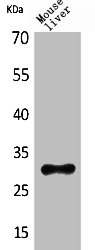
  • Western Blot analysis of mouse liver cells using FGF-5 Polyclonal Antibody

Customer Reviews and Q&A

 Customer Reviews

Target Background

Function(From Uniprot)
Plays an important role in the regulation of cell proliferation and cell differentiation. Required for normal regulation of the hair growth cycle. Functions as an inhibitor of hair elongation by promoting progression from anagen, the growth phase of the hair follicle, into catagen the apoptosis-induced regression phase.
Gene References into Functions
  1. Study indicated that MTHFR rs1801133, FGF5 rs16998073 and CSK rs1378942 were associated with increased the risk of obesity in the Chinese children. PMID:30217759
  2. FGF5 is an independent protective factor for breast cancer patients. PMID:29804124
  3. These results provide new insight into the functions of miR-9-3p and HBGF-5 in HCC and identify miR-9-3p as a potential therapeutic target for HCC PMID:28750499
  4. FGF5 facilitates cell proliferation through ERK1/2 activation, and it influences the osteogenic differentiation of tonsil-derived mesenchymal stem cells. PMID:27224250
  5. These findings collectively demonstrate a tumor suppressor role of miR-188-5p in HCC progression via targeting FGF5 PMID:25998163
  6. High BMI increases the effect of the blood pressure-increasing allele at rs1458038 near FGF5 in a Chinese population. PMID:25618516
  7. In Chinese children, no association of CSK rs1378942, MTHFR rs1801133, CYP17A1 rs1004467, STK39 rs3754777 and FGF5 rs16998073 with BP/risk of hypertension. PMID:23759979
  8. FGF5 is a crucial regulator of hair growth in humans. PMID:24989505
  9. Meta-analysis indicated significant associations of both CYP17A1 rs11191548 and FGF5 rs16998073 polymorphisms with hypertension susceptibility in East Asians. PMID:22959498
  10. Variants in or near FGF5, CYP17A1 and MTHFR contributed to variation in BP and hypertension risk. Effect sizes of these three loci tended to be larger in Chinese than in white Europeans PMID:20852445
  11. variation in FGF5 and ZNF652 gene upstream regions with altered susceptibility to hypertension in Han Chinese PMID:20542020
  12. The role of the proteasome is confirmed when a spliced FGF-5 peptide is produced in vitro after incubation of proteasomes with a 49-amino-acid precursor peptide in a transpeptidation splicing model. PMID:20154207
  13. FGF5 contributes to the malignant progression of human astrocytic brain tumours by both autocrine and paracrine effects. PMID:18362893

Show More

Hide All

Subcellular Location
Secreted.
Protein Families
Heparin-binding growth factors family
Tissue Specificity
Expressed in neonatal brain.
Database Links

HGNC: 3683

UNIGENE: Hs.37055

KEGG: hsa:2250

STRING: 9606.ENSP00000311697

OMIM: 165190

icon of phone
Call us
301-363-4651 (Available 9 a.m. to 5 p.m. CST from Monday to Friday)

icon of address
Address
No. 269, Shendun 5th Road, Donghu Hi-Tech Development Area, Hubei Province, 430206, P.R.China
icon of social media
Join us with

Subscribe newsletter

Leave a message

* To protect against spam, please pass the CAPTCHA test below.
CAPTCHA verification
© 2007-2025 CUSABIO TECHNOLOGY LLC All rights reserved. 鄂ICP备15011166号-1
Select 0 Products