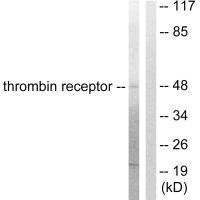
Synthesized peptide derived from internal of Human Thrombin Receptor.
Immunogen Species
Homo sapiens (Human)
Purification Method
The antibody was affinity-purified from rabbit antiserum by affinity-chromatography using epitope-specific immunogen.
Concentration
It differs from different batches. Please contact us to confirm it.
Tested Applications
ELISA,WB
Storage
Upon receipt, store at -20°C or -80°C. Avoid repeated freeze.
Lead Time
Basically, we can dispatch the products out in 1-3 working days after receiving your orders. Delivery time maybe differs from different purchasing way or location, please kindly consult your local distributors for specific delivery time.
Note: All of our proteins are default shipped with normal blue ice packs, if you request to ship with dry ice, please communicate with us in advance and extra fees will be charged.
Usage
For Research Use Only. Not for use in diagnostic or therapeutic procedures.
High affinity receptor for activated thrombin coupled to G proteins that stimulate phosphoinositide hydrolysis. May play a role in platelets activation and in vascular development.
Gene References into Functions
The activation of PAR-1 on the cell surface of SGC7901 and AGS cells was significantly reduced after the knockdown of EPCR. By contrast, blockade of PAR-1 reduced the proliferation and migration of gastric cells in vitroPMID:29484413
Our structural data showed subtle changes in the binding pose between Vorapaxar and F16357. Transmembrane helices 1, 2, 5, and 7 were most significantly affected; most notably a large kink at F279(5.47) in TM helix 5 of the Vorapaxar complex was completely absent in the F16357 complex. The results of this study facilitate the future development of other therapeutic PAR1 antagonists.PMID:28881236
Using protein C-factor VII chimera demonstrate that APC light chain amino acid residues outside the EPCR-binding site enable cytoprotective PAR1 signaling.PMID:28834159
Study demonstrated that nerve activation by mucosal biopsy supernatants depends on proteases. This is a common feature of quiescent ulcerative colitis and irritable bowel syndrome (IBS) and may relate to some common gastrointestinal symptoms. However, only proteases in IBS supernatants signal through PAR1.PMID:29529042
Data show there was no significant correlation of autoantibodies to coagulation factor II thrombin receptor (F2R; protease-activated receptor 1, PAR1) (PAR1-AB) level with , progression-free (PFS) and overall (OS) survival.PMID:29848718
we found that activation of the protease-activated receptor 1 (PAR1) induced secretion of TSLP by the corneal stromal cells... we proposed that TSLP might function as the link between increased protease activity and inflammatory responses or itch sensation in thePMID:28631887
PAR-1 in non-small-cell lung cancer is mainly expressed on cells that constitute the pulmonary tumor microenvironment, including vascular endothelial cells, macrophages and stromal fibroblasts.PMID:28173772
thrombin binding to PAR-1 receptor activated Gi-protein/c-Src/Pyk2/EGFR/PI3K/Akt/p42/p44 MAPK cascade, which in turn elicited AP-1 activation and ultimately evoked MMP-9 expression and cell migration in SK-N-SH cells.PMID:27181591
this study demonstrates that TGFbeta is a positive regulator of PAR-1 expression in A549 lung adenocarcinoma cells, which in turn increases the sensitivity of these cells to thrombin signallingPMID:27566553
Taken together, these results indicated that PAR1 signalingmediated cJun activation promotes early apoptosis of HUVEC cells induced by heat stress.PMID:28447716
The DHA - naringenin hybrid presented triple antiplatelet activity simultaneously targeting PAR-1, P2Y12 and COX-1 platelet activation pathwaysPMID:28844979
Dabigatran increases platelet reactivity by enhancing the thrombin receptor density on plateletsPMID:27992120
Data suggest that the abrogation of protease-activated receptor 1 (PAR1)-dependent signaling pathways may prove a promising strategy for gliomas.PMID:26616854
these data indicate that KLKB1 induces inflammatory reactions in human dental tissues via protease-activated receptor 1PMID:26566265
In this study, we found upregulation of several hemostasis-related genes, including the thrombin-activatable receptor PAR-1 (protease-activated receptor-1), in Runx1/Cbfb-deleted MLL-AF9 cells. Similar to the effect of Runx1/Cbfb deletion, PAR-1 overexpression induced CDKN1A/p21 expression and attenuated proliferation in MLL-AF9 cellsPMID:27819671
Data highlight functional differences in proliferation and barrier integrity between dark keratinocytes and fair keratinocytes that are partly associated with their differential expression of PAR1 and PAR2.PMID:27979585
the contribution of PAR1 and PAR4 to thrombin-mediated activation of the platelet fibrin receptor (GPIIbIIIa), is reported.PMID:27784794
In a Cox regression model, fully adjusted for age, race, sex, BMI, and smoking status, carrying a T allele was not associated with MACE (HR 1.19, 95 % CI 0.89-1.59, P = 0.23) or bleeding (HR 0.73, 95 % CI 0.37-1.4, P = 0.34). In conclusion, in our population, F2R IVS-14 PAR1 variability does not affect risk of MACE or bleeding following PCI.PMID:26446588
These results suggest that stabilization of microtubule-unbound tau by phosphorylation at Ser262/356 via the PAR-1/MARK may act in the initial steps of tau mismetabolism in AD pathogenesisPMID:27023670
The serum levels of PAR1 might have a diagnostic value in lung cancer patientsPMID:26875892
identified HMGA2 (high mobility group A2) as an important regulator of PAR1-mediated invasion. Inhibition of PAR1 signaling suppresses HMGA2-driven invasion in breast cancer cellsPMID:26165842
Thrombin and the PAR-1 activating peptide, TFLLR, lead to the phosphorylation of eNOS-Ser-1177 in human coronary artery endothelial cells, which was blocked by SCH-79797 (SCH), a PAR-1 inhibitor.PMID:26729042
Rab11A and Rab11B differentially regulate intracellular trafficking of PAR1 through distinct endosomal sorting mechanismsPMID:26635365
Establish FXa as a potentially important asthma mediator, stimulating airway smooth muscle function through actions requiring PAR-1 and annexin A2 and involving integrin coactivation.PMID:26120939
we show that the rs2227744A allele signi fi cantly associates with protection from sarcoidosis (P = 0.003, OR = 0.68 (0.52-0.88)PMID:26278396
Binding of the PH domain of PAR-1 enables breast cancer growth and extravillous trophoblast invasion.PMID:26600192
PZ-128 is a promising antiplatelet agent that provides rapid, specific, dose dependent, and reversible inhibition of platelet protease-activated receptor-1 through a novel intracellular mechanism.PMID:26681756
Bladder PAR activation elicits urothelial MIF release and urothelial MIF receptor signaling at least partly through CXCR4 to result in abdominal hypersensitivity without overt bladder inflammationPMID:26020638
PAR1-platelet releasate enhances vasculogenesis more potently than PAR4-platelet releasate, and the enhancements require a cooperation of multiple platelet-derived angiogenic regulators.PMID:25495701
conjugation of a peptide fragment derived from the third intracellular loop (i3) of the protease-activated receptor 1 (PAR1) to a peptide that can selectively target tumoursPMID:26424552
Platelet activation with a PAR1 agonist triggered TGF-beta secretion, which induced EMT of via the downregulation of miR-200b expression, and activated platelets had a chemotactic effect on colon cancer cells mediated by the upregulation of CXCR4PMID:25846512
The data reveal a new proprotein convertases -PAR-1-interaction pathway, which offsets the effects of HIV-induced neuroinflammation, viral infection, and potentially the development of HIV-Associated Neurocognitive Disorder.PMID:26283733
Proteases found in dust derived from animal feed play an important role in eliciting the dust-mediated inflammatory responses at least partially through activation of PAR1 AND PAR2.PMID:26092994
Data show that N-linked glycosylation of protease-activated receptor-1 (PAR1) at extracellular loop 2 (ECL2) controls G12/13 versus Gq G-proteins coupling specificity in response to thrombin stimulation.PMID:26100877
low levels impact placenta establishment and consequently pregnancy outcomePMID:25496845
The i3 pepducin enhances PAR1/Galpha subunit interactions and induces a conformational change in fluorescently labeled PAR1 in a very similar manner to that induced by thrombin.PMID:25934391
Apixaban exerts anti-inflammatory effects in mesangial cells by blocking thrombin/protease-activated receptor-1 system.PMID:25294586
Human PAR1, expressed at low levels in mouse platelets, is unresponsive to agonist peptides.PMID:24830314
provide evidence against the hypothesis that PAR-1 and PAR-4 stimulation of platelets trigger differential release of alpha-granulesPMID:24776597
The upregulation of MMP-1 protein combined with the overexpression of PAR-1 protein may contribute to the malignant progression of prostate cancer.PMID:24805876
High protease-activated receptor-1 expression is associated with colorectal cancer.PMID:25119598
Tissue vascularization was found to be significantly increased in the compact tumor mass of glioblastomas compared to their invasion zone and specific overexpression of PAR-1 within tumor cells and within tumor blood vessels depending upon the tumor area.PMID:24620969
Data indicate that proteinase-activated receptor 1 (PAR1) was prominently expressed in hematopoietic stem cells.PMID:24740120
analysis of a P2Y12 receptor mutation and a function-reducing polymorphism in protease-activated receptor 1 in a patient with chronic bleeding [case report]PMID:24612435
PAR-1 is post-transcriptionally regulated by miR-20b microRNA in human melanoma cells. PAR-1 was found to be expressed in metastatic melanoma cells but was barely detectable in primary melanoma.PMID:24405508
PAR-1 may play an important role in the metastasis of lung giant cell carcinoma cells by up-regulating intracellular calcium.PMID:20388375
Activation of PAR-1 stimulates MMP-2 secretion, inhibits rheumatoid arthritis synovial fibroblasts growth and invasion, and decreases production of IL-17 and TNFalpha by them.PMID:21905006
PAR-1 plays a key role in melanoma progression. PAR-1 & its activating factors on tumor cells & the surrounding stroma induce coagulation & cell signaling promotoing the metastatic phenotype. Review.PMID:22009534
Our results also show that platelet PAI-1 is increased if incubated for 24 hours, both with addition of PAR1-activating peptide and without activation, which could indicate de novo synthesis.PMID:22283974