DDIT4 antibody; DDIT4_HUMAN antibody; Dig2 antibody; DNA damage inducible transcript 4 antibody; DNA damage inducible transcript 4 protein antibody; DNA damage-inducible transcript 4 protein antibody; FLJ20500 antibody; HIF 1 responsive protein RTP801 antibody; HIF 1 responsive RTP801 antibody; HIF-1 responsive protein RTP801 antibody; Protein regulated in development and DNA damage response 1 antibody; REDD-1 antibody; REDD1 antibody; RTP801 antibody
Raised in
Rabbit
Species Reactivity
Human,Mouse,Rat
Immunogen
Fusion protein of Human DDIT4
Immunogen Species
Homo sapiens (Human)
Conjugate
Non-conjugated
Isotype
IgG
Purification Method
Antigen affinity purification
Concentration
It differs from different batches. Please contact us to confirm it.
Buffer
-20°C, pH7.4 PBS, 0.05% NaN3, 40% Glycerol
Tested Applications
ELISA,IHC
Storage
Upon receipt, store at -20°C or -80°C. Avoid repeated freeze.
Lead Time
Basically, we can dispatch the products out in 1-3 working days after receiving your orders. Delivery time maybe differs from different purchasing way or location, please kindly consult your local distributors for specific delivery time.
Note: All of our proteins are default shipped with normal blue ice packs, if you request to ship with dry ice, please communicate with us in advance and extra fees will be charged.
Usage
For Research Use Only. Not for use in diagnostic or therapeutic procedures.
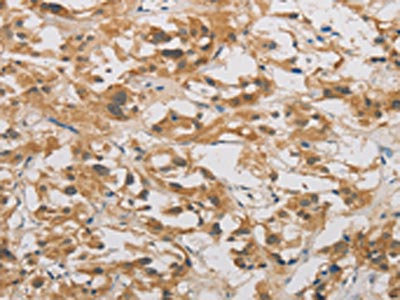
The image on the left is immunohistochemistry of paraffin-embedded Human thyroid cancer tissue using CSB-PA794556(DDIT4 Antibody) at dilution 1/20, on the right is treated with fusion protein. (Original magnification: ×200)
Regulates cell growth, proliferation and survival via inhibition of the activity of the mammalian target of rapamycin complex 1 (mTORC1). Inhibition of mTORC1 is mediated by a pathway that involves DDIT4/REDD1, AKT1, the TSC1-TSC2 complex and the GTPase RHEB. Plays an important role in responses to cellular energy levels and cellular stress, including responses to hypoxia and DNA damage. Regulates p53/TP53-mediated apoptosis in response to DNA damage via its effect on mTORC1 activity. Its role in the response to hypoxia depends on the cell type; it mediates mTORC1 inhibition in fibroblasts and thymocytes, but not in hepatocytes. Required for mTORC1-mediated defense against viral protein synthesis and virus replication. Inhibits neuronal differentiation and neurite outgrowth mediated by NGF via its effect on mTORC1 activity. Required for normal neuron migration during embryonic brain development. Plays a role in neuronal cell death.
Gene References into Functions
DDIT4 might serve as a novel prognostic biomarker in several malignancies.PMID:28484222
Cellular metabolism constrains innate immune responses in preterm infants due to perturbations in the expression of PPARgamma, MALT1, DDIT4, and most of the cytokines.PMID:30446641
these findings uncover a novel mechanism by which PML loss may contribute to mTOR activation and cancer progression via dysregulation of basal DDIT4 gene expression.PMID:28332630
A microarray analysis revealed that in A3G-transduced Vero cells, several cellular transcripts were differentially expressed, suggesting that A3G regulates the expression of host factors. One of the most upregulated host cell factors, REDD1 (regulated in development and DNA damage response-1, also called DDIT4), reduced MV replication approximately 10-fold upon overexpression in Vero cells.PMID:29925665
This is concurrent with an increase in the expression level of DDIT4, which is an inhibitor of the mammalian target of rapamycin (mTOR) signaling pathway. these results provided a novel insight on miR1243p involvement in the biological alterations of male patients with major depressive disorder and suggested that this miRNA may also serve as a malespeci fi c target for antidepressant treatmentPMID:29115444
DDIT4 activity is directly linked to regulation of mTOR signallingPMID:27876894
The HIF-1alpha-REDD1-mTOR pathway was involved in the response to hypoxia in BeWo cells. Hypoxia-induced REDD1 upregulation is mediated by a HIF-1alpha-dependent pathway. Disruption of REDD1 blocked the effects of hypoxia on suppressing mTOR and resulted in additional accumulation of HIF-1alpha in BeWo cells.PMID:27577706
REDD1 is overexpressed during Familial Mediterranean fever inflammatory attacks induced by physical or psychological stressPMID:28342915
Expression of key autophagy markers (microtubule-associated protein 1A/1B light chain 3 and autophagy protein 5) was markedly reduced in cultured human chondrocytes with REDD1 depletion.PMID:28334504
The production of superoxide anion in nockout-Rtp801 mouse lung fibroblasts (MLF) was lower than that in Rtp801 Wt cells after cigarette smoke extract treatment, and it was inhibited in Wt MLF by silencing nicotinamide adenine dinucleotide phosphate oxidase-4 (Nox4) expression with small interfering Nox4 RNA.PMID:27556956
Changes in REDD1 mRNA and protein have been observed in skeletal muscle under various physiological conditions (e.g., nutrient consumption and resistance exercise) and pathological conditions (e.g., sepsis, alcoholism, diabetes, obesity) suggesting a role for REDD1 in regulating mTORC1-dependent skeletal muscle protein metabolism. [Review]PMID:27189933
a novel STAT3-dependent mechanism of both IL-6-induced activation of mTOR and IL-6-dependent reversion of stress-induced inhibition of mTOR activity, is reported.PMID:27094713
findings implicate REDD1 as a crucial regulator of mTORC1 activity in iron-depleted cellsPMID:26827808
C/EBPbeta promotes autophagy in PC3 cells by augmenting REDD1 expression.PMID:26968249
These data highlight the central role of REDD1 in regulating both protein synthesis and autophagy in skeletal muscle during sepsis.PMID:26487002
Findings from this study propose a REDD1-regulated mechanism in T2D skeletal muscle that may contribute to whole body insulin resistance and may be a target to improve insulin action in insulin-resistant individuals.PMID:26269521
REDD1 knockout (KO) mice, all skin compartments, epidermal stem, and progenitor cells were protected from atrophic effects of glucocorticoids.PMID:25504525
MiR-630 reduced apoptosis by downregulating several apoptotic modulators, PARP3, DDIT4, and EP300.PMID:25255219
REDD1 and p-AKT over-expression may serve as a prognostic biomarker in ovarian cancer, but KRAS mutations and REDD1 protein over-expression were not correlated in OC.PMID:25337238
Caspase 3 cleaved REDD1 during apoptotic activation.PMID:25058423
the results demonstrate that REDD1 acts not only as a repressor of mTORC1 but also as a constant modulator of the phosphorylation of Akt in response to growth factors and nutrients.PMID:25056877
analysis of ubiquitin-mediated proteolysis of DNA damage-inducible transcript 4 (DDIT4) by the E3 ligase HUWE1PMID:25147182
Translocation to the plasma membrane appears to be an inactivation mechanism of REDD1 by G-protein coupled receptors.PMID:24338366
these postmortem and preclinical findings identify REDD1 as a critical mediator of the atrophy of neurons and depressive behavior caused by chronic stress exposurePMID:24728411
REDD1 expression plays a role in maintaining normal function of placenta, while the increase of REDD1 is related to the pathogenesis of pre-eclampsia.PMID:22527987
mTORC1 regulates REDD1 protein stability in a 26S proteasome dependent manner.PMID:23717519
The sustained overexpression of Redd1 leads to mTORC1 inhibition and to consequent Akt activation that is involved in cell survival.PMID:23528835
An immobilization-induced attenuation of mTORC1 signaling mediated by induction of REDD1/2 and defective p70S6K1 phosphorylation.PMID:23193052
mechanisms have evolved in tumors to escape growth suppressive signals resulting from VHL loss and REDD1 upregulationPMID:21798997
REDD1 is a new host defense factor, and chemical activation of REDD1 expression represents a potent antiviral intervention strategyPMID:21909097
these results collectively demonstrate that TXNIP stabilizes Redd1 protein induced by ATF4 in response to 2-DG, resulting in potentiation of mTOR suppression.PMID:21460850
Metformin increases REDD1 expression in a p53-dependent manner. REDD1 invalidation, using siRNA or REDD1(-/-) cells, abrogates metformin inhibition of mTOR.PMID:21540236
Data show that miR-495 expression was directly modulated by transcription factor E12/E47, and promotes oncogenesis via downregulation of E-cadherin and REDD1.PMID:21258409
these results provide preliminary evidence that Redd1 inhibits the invasive activity of NSCLC cells via suppression of the mTOR downstream pathway.PMID:21414293
DDIT4, an inhibitor of mTOR signaling, is a direct target for 1,25(OH)(2)D(3) and VDRE-BP, and functions to suppress cell proliferation in response to vitamin DPMID:21123297
In the HER2 overexpression type and triple-negative breast carcer, tumor cell proliferation and survival in the hypoxic tumor environment could possibly be due to disinhibition of the mTOR pathway and HIF-1alpha stabilization by downregulation of REDD1.PMID:21266827
Our data support the notion that Rtp801 may represent a major molecular sensor and mediator of cigarette smoke-induced lung injury.PMID:20473305
PKR represents a cognitive decline biomarker able to dysregulate translation via two consecutive targets p53 and Redd1 in Alzheimer disease lymphocytesPMID:19210572
that expression of RTP801 was lower in oral lichen planus than in controlsPMID:20374513
sertraline exerts antiproliferative activity by targeting the mTOR signaling pathway in a REDD1-dependent mannerPMID:20354178
Structure/function analyses have led us to identify two segments in REDD1 that are essential for mTORC1 inhibition.PMID:20166753
Insulin induces REDD1 expression through hypoxia-inducible factor 1 activation in adipocytes.PMID:19996311
RTP801 might play important roles in Abeta toxicity and the pathogenesis of Alzheimer's diseasePMID:14646594
co-transfection with antisense Sp1 oligonucleotide suggests that hypoxia induction of the RTP801 promoter is mediated by Sp1PMID:15180327
REDD1 (RTP801) can act as a transcriptional downstream target of PI 3-kinase signaling in human prostate cancer cells.PMID:15592522
RTP801 and RTP801L work downstream of AKT and upstream of TSC2 to inhibit mTOR functionsPMID:15632201
REDD1 as a critical transducer of the cellular response to energy depletion through the TSC-mTOR pathway.PMID:15988001
Stress response gene REDD1 is identified in this review as an essential regulator of checkpoint kinase mTOR activity through the tuberous sclerosis tumor suppressors TSC1/2 complex.PMID:16258273
The elevation of RTP801 we detect in PD substantia nigral neurons may mediate their degeneration.PMID:17005863
These results demonstrate that hypoxic condition-and high cell density-induced expression of Redd1 is mediated by coactivation of Sp1 and HIF-1alpha downstream of the PI3K/Akt signaling pathway.PMID:17307335
Show
More
Hide
All
Subcellular Location
Mitochondrion. Cytoplasm, cytosol.
Protein Families
DDIT4 family
Tissue Specificity
Broadly expressed, with lowest levels in brain, skeletal muscle and intestine. Up-regulated in substantia nigra neurons from Parkinson disease patients (at protein level).