Synthesized peptide derived from the Internal region of Human Plasma Kallikrein HC.
Immunogen Species
Homo sapiens (Human)
Conjugate
Non-conjugated
Isotype
IgG
Purification Method
The antibody was affinity-purified from rabbit antiserum by affinity-chromatography using epitope-specific immunogen.
Concentration
It differs from different batches. Please contact us to confirm it.
Buffer
Liquid in PBS containing 50% glycerol, 0.5% BSA and 0.02% sodium azide.
Tested Applications
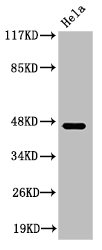
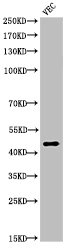
WB, IHC, ELISA
Storage
Upon receipt, store at -20°C or -80°C. Avoid repeated freeze.
Lead Time
Basically, we can dispatch the products out in 1-3 working days after receiving your orders. Delivery time maybe differs from different purchasing way or location, please kindly consult your local distributors for specific delivery time.
Note: All of our proteins are default shipped with normal blue ice packs, if you request to ship with dry ice, please communicate with us in advance and extra fees will be charged.
Usage
For Research Use Only. Not for use in diagnostic or therapeutic procedures.
The enzyme cleaves Lys-Arg and Arg-Ser bonds. It activates, in a reciprocal reaction, factor XII after its binding to a negatively charged surface. It also releases bradykinin from HMW kininogen and may also play a role in the renin-angiotensin system by converting prorenin into renin.
Gene References into Functions
We further define the interactions of keratinocyte PKK with TP63 and NF-kappaB signaling, highlighting the importance of this protein as a tumor suppressor in skin squamous cell carcinoma development.PMID:29186361
Plasma kallikrein (PLK)-dependent transforming growth factor-beta (TGF-beta) activation could be detected in isolated pancreatic stellate cells (PSCs) from chronic pancreatitis (CP) and pancreatic cancer.PMID:28187111
High molecular weight kinin functions as a cofactor for PK activation in the presence of nucleic acids in a manner consistent with classic models of contact activation.PMID:28124063
genetic polymorphism is associated with C1 Inhibitor deficiency angioedema age of onset in European familiesPMID:29130992
these data indicate that KLKB1 induces inflammatory reactions in human dental tissues via protease-activated receptor 1PMID:26566265
von Willebrand factor activity and concentration of prekallikrein may both be of importance regarding the evolution of thrombus in abdominal aortic aneurysm and possible biomarkers for aneurysm growth.PMID:27581227
KLKB1 mRNA expression is a putative molecular biomarker in chronic lymphocytic leukemia.PMID:25891023
Genotyping these subjects revealed that the carriers of the minor alleles at the two loci- F12 and KLKB1 had a significant association with reduced levels of active plasma renin.PMID:26969407
2 genetic loci (kininogen 1 and kallikrein B) influencing key components of the RAAS, consistent with the close interrelation between the kallikrein-kinin system and the RAAS.PMID:25477429
PRCP1 interacts with plasma kallikrein (PK) at multiple sites for PK activation.PMID:25324000
Prekallikrein deficiency in a family is due to a new mutation (Arg541Gln) in exon 14.PMID:25075649
FXI may have a role in risk of ischemic stroke, but not myocardial infarct; FXII and prekallikrein may not have a role in eitherPMID:24977287
The acquisition of an active site in prekallikrein as a result of binding to high-molecular-weight kininogen (HK) is a new concept for bradykinin formation and might be relevant in the pathogenesis of hereditary angiodema types I and II.PMID:23672780
Investigate the relationship between circulating PK levels in children with metabolic syndrome and CVD risk factors because PK may be involved in the progression of the disease state.PMID:20725119
Case Report: Fresh frozen plasma transfusion before coronary artery bypass corrects prekallikrein deficiency.PMID:20135073
plasma kallikrein and FXIa activate pro-HGF in vitroPMID:12372819
the effect of kininogen degradation by human neutrophil elastase (HNE) on kinin generation by tissue and plasma kallikreins.PMID:12887060
prekallikrein preferential binding to endothelial cells contributes to their anticoagulant naturePMID:12944405
Crystallization and x-ray crystal structure determination have yielded the first three-dimensional views of the catalytic domain of plasma kallikreinPMID:16199530
Our findings suggested that common genetic variation in the KLKB1 gene might contribute to the risk of hypertension in the northern Han Chinese population.PMID:17318641
study demonstrates by immunohistochemistry that plasma kallikrein (PK) is localised in cells of different embryologically derived human tissuesPMID:17696780
three-dimensional structural data for prekallikrein (PK); interaction between PK and high-molecular-weight kininogen is mediated by two discrete surfaces formed by the PK A1, A2 and A4 domains with charge likely to be a critical component of the bindingPMID:17922805
Kallikrein can directly activate prothrombin; there is a shortcut in the intrinsic hemostasis system that generates catalytic amounts of thrombin without following the known intrinsic clotting pathwayPMID:18160576
Kallikrein is responsible for the cleavage of factor H.PMID:18413232
prekallikrein is an enzyme that can cleave high-molecular-weight kininogen to release bradykinin, and this reaction is inhibited by C1 inhibitor.PMID:19342086
NPY3-35 is a new peptide generated by plasma kallikreinPMID:19620246