Liquid
Note: We will preferentially ship the format that we have in stock, however, if you have any special requirement for the format, please remark your requirement when placing the order, we will prepare according to your demand.
Upon receipt, store at -20°C or -80°C. Avoid repeated freeze.
Lead Time
Basically, we can dispatch the products out in 1-3 working days after receiving your orders. Delivery time maybe differs from different purchasing way or location, please kindly consult your local distributors for specific delivery time.
Note: All of our proteins are default shipped with normal blue ice packs, if you request to ship with dry ice, please communicate with us in advance and extra fees will be charged.
Usage
For Research Use Only. Not for use in diagnostic or therapeutic procedures.
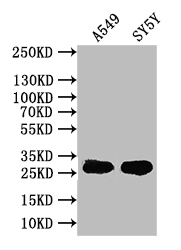
Western Blot
Positive WB detected in: A549 whole cell lysate, SY5Y whole cell lysate
All lanes: CXCL16 antibody at 1:1000
Secondary
Goat polyclonal to rabbit IgG at 1/50000 dilution
Predicted band size: 28 kDa
Observed band size: 28 kDa
Acts as a scavenger receptor on macrophages, which specifically binds to OxLDL (oxidized low density lipoprotein), suggesting that it may be involved in pathophysiology such as atherogenesis. Induces a strong chemotactic response. Induces calcium mobilization. Binds to CXCR6/Bonzo.
Gene References into Functions
demonstrate that macrophages can promote the migration and invasion of ovarian carcinoma cells by affecting the CXCL16/CXCR6 pathwayPMID:30049511
activation of cancer-associated fibroblasts and expression of CXCL16, shown to be a monocyte chemoattractant.PMID:27725631
Enhanced CXCL16 expression in lung cancer tissue promoted the proliferation and invasion of lung cancer cells. CXCL16 might promote proliferation and invasion of lung cancer by regulating the NF-kappaB pathway.PMID:29353287
increased plasma sCXCL16 might be implicated in the pathogenesis of immune thrombocytopenia and have a relationship with Th1/Th2 imbalance.PMID:28886489
Serum CXCL16 levels are significantly increased in patients with gallstone, and are independently associated with liver injury in Chinese population, suggesting that CXCL16 may be a biomarker of liver injury in subjects with gallstone or NAFLD. Hepatic CXCL16 mRNA and protein levels were also significantly increased in gallstone patientsPMID:28722105
IFN-gamma, CXCL16 and uPAR are promising as effective biomarkers of disease activity, renal damage, and the activity of pathological lesions in systemic lupus erythematosus.PMID:28628472
Data showed that reverse signaling via CXCL16 promotes migration in CXCL16-expressing melanoma and glioblastoma cells, but does not affect proliferation or protection from chemically-induced apoptosis.PMID:28698473
Study showed, for the first time, highly significant relationships of circulating CXCL16 level with cardiac injury markers in dialysis patients.PMID:28633141
Women with gestational diabetes mellitus and preeclampsia had a dysregulated CXC chemokine ligand 16 during pregnancy, and in gestational diabetes mellitus, the increase in CXC chemokine ligand 16 early in pregnancy and after 5 years was strongly associated with their lipid profile.PMID:28856928
Data suggest that primary cells from papillary renal cell carcinoma secrete the chemokines IL8, CXCL16, and chemerin; these chemokines attract primary human monocytes and induce shift/transdifferentiation in monocytes toward M2 macrophage/foam cell phenotype. (IL8 = interleukin-8; CXCL16 = C-X-C motif chemokine ligand 16)PMID:28759013
Our study demonstrated that CXCL16-CXCR6 mediates CD8(+) T-cell skin trafficking under oxidative stress in patients with vitiligo, and CXCL16 expression in human keratinocytes induced by ROS is, at least in part, caused by unfolded protein response activationPMID:27826097
eGFR and serum albumin had an independent and significant negative correlation with plasma CXCL16 in diabetic kidney disease.PMID:27665581
The expression of CXCL16 and and its receptor, CXCR6, their immunolocalization in disc tissue and their presence following exposure of cultured human annulus fibrosus cells to proinflammatory cytokines are reported.PMID:27869573
Inflammation contributed to foam cell formation in the radial arteries of ESRD patients via activation of the CXCL16/CXCR6 pathway, which may be regulated by P2X7R.PMID:27877078
CXCL16 single nucleotide polymorphisms significantly impacted myocardial infarction risk in a Chinese Han population.PMID:28286356
Transmembrane-CXCL16 specifically acts as a receptor for soluble-CXCL16 in human meningioma cells.PMID:27784296
Higher levels CXCL16 may be a biomarker for predicting stroke incidence and might contribute to plaque destabilization.PMID:27355560
CXCL16 is released into the circulation as a result of cardiac surgery and that high post-operative CXCL16 levels are associated with an increased severity of post-operative organ dysfunctions.PMID:26499307
Serum CXCL16 may be a novel biomarker for the diagnosis of patients with diabetic coronary artery disease.PMID:27098626
High CXCL16 expression is associated with prostate cancer.PMID:26799186
In conclusion, rheumatoid arthritis synovial fibroblasts were activated by CXCL16 to produce RANKL via pathways involving JAK2/STAT3 and p38/MAPKPMID:26621504
Our data suggest that CXCL16 induces angiogenesis in autocrine manner via ERK, Akt, p38 pathways and HIF-1alpha modulationPMID:26707275
Cell proliferation enhancing and anti-apoptosis activity requires the intracellular domain and apparently the dimerization of the transmembrane chemokine ligand.PMID:26796342
Wnt5a-Ror2 signaling enhances expression and secretion of CXCL16 in mesenchymal stem cells thereby activating CXCR6 expressed on tumor cells to promote proliferation.PMID:26708384
Endothelial CXCL16's action on platelets is not limited to platelet activation. Immobilised CXCL16 also acts as a potent novel platelet adhesion ligand, inducing platelet adhesion to the human vessel wall.PMID:25904061
HMGB-1, CXCL16, miRNA-30a, and urinary TGF-ss1 were highly expressed in PNS patients and may play important roles in the pathogenesis and development of PNS.PMID:26345917
high protein expression of CXCL16 and high protein co-expression of CXCL16/CXCR6 in prostate cancer were independent predictors for a worse clinical outcomePMID:26272362
PPARG rs1152002, AGTR1 rs5186, CXCL16 rs3744700 and LGALS2 rs7291467 polymorphisms may be closely related to the development of coronary heart diseasePMID:26045830
These results indicate that MEK inhibitor diminishes Nasopharyngeal carcinoma cell proliferation and NPC-induced osteoclastogenesis via modulating CCL2 and CXCL16 expressions.PMID:26058873
we examined the expression of CXCL16 and CXCR6 and their relations to prognosis in 335 unselected patients with NSCLC, and investigated possible relationships with our previously studied immunologic and angiogenic markersPMID:26021984
CXCL16 T123V181 haplotype is a moderate genetic risk factor for the development of carotid plaque.PMID:25142184
Serum CXCL16 is increased in severe pancreatitis with infected pancreatic necrosis and identifies patients who benefit from surgical necrosectomyPMID:25661686
injured hepatocytes up-regulated CXCL16 expression, indicating that scavenging functions of CXCL16 might be additionally involved in the pathogenesis of NAFLD.PMID:25372401
CXCL16 and CXCR6 coexpression is associated with invasiveness of lung cancer.PMID:24897301
No significant association of the CXCL16 polymorphism was established either with soluble CXCL16 plasma levels or with clinical parameters and course of multiple sclerosis.PMID:24854635
CXCL16 expression is enhanced in inflammatory cardiomyopathy and is an independent predictor of death in patients with heart failure.PMID:25223819
Elevated serum sCXCL16 levels were discovered in the systemic lupus erythematosus patients with cutaneous and renal involvement.PMID:25015061
Silencing CXCL16 could phenocopy the effects of miR-451 on phenotypes of osteosarcoma cells.PMID:25391425
High circulating CXCL16 levels are associated to human kidney and cardiovascular disease and urinary CXCL16 may increase in kidney injury.PMID:24861945
Serum CXCL16 may be an indicator of renal injury in subjects with type 2 diabetes mellitus.PMID:24489966
Serum CXCL16 was increased in patients with active Primary nephrotic syndrome and correlated with blood lipids, urine protein and immune and inflammation responsesPMID:24460887
High serum sCXCL16 is a prognostic marker for poor survival of OC patients, possibly reflecting ADAM-10 and ADAM-17 pro-metastatic activity.PMID:24518602
CXCL16, iNKT cell-associated cell marker Valpha24, and CD1d were significantly upregulated in esophageal biopsies from EoE patients and correlated with the expression of inflammatory mediators associated with allergy.PMID:24513807
CXCL16 could be a novel biomarker and potential predictor of disease activity in MS.PMID:24069377
CXCL16/CXCR6 interaction may play an important role in modifying the response of pDCs to environmental danger signalsPMID:24302814
Our results suggest that the CXCL16/CXCR6 axis appears to be important in the progression of Ewing sarcoma family tumorPMID:24507753
Data suggest that plasma level of CXCL16 is up-regulated in subjects with metabolic syndrome and correlates with severity of carotid atherosclerosis (i.e., intima-media thickness and plaque index).PMID:23398954
Erythrocyte adhesion to immobilized platelets requires phosphatidylserine at the erythrocyte surface and CXCL16 as well as CD36 expression on platelets.PMID:24284794
CXCL16, inversely correlated with CD99 expression in Hodgkin Reed-Sternberg (H/RS) cells.PMID:23743627
Suggest that expression of transmembrane CXCL16 on surface of plasmacytoid dendritic cell might contribute to high serum IFN-alpha levels seen in patients with Behcet's disease.PMID:24064021
Show
More
Hide
All
Subcellular Location
Cell membrane; Single-pass type I membrane protein. Secreted. Note=Also exists as a soluble form.
Protein Families
Intercrine alpha (chemokine CxC) family
Tissue Specificity
Expressed in T-cell areas. Expressed in spleen, lymph nodes, lung, kidney, small intestine and thymus. Weak expression in heart and liver and no expression in brain and bone marrow.