Liquid
Note: We will preferentially ship the format that we have in stock, however, if you have any special requirement for the format, please remark your requirement when placing the order, we will prepare according to your demand.
Upon receipt, store at -20°C or -80°C. Avoid repeated freeze.
Lead Time
Basically, we can dispatch the products out in 1-4 working days after receiving your orders. Delivery time maybe differs from different purchasing way or location, please kindly consult your local distributors for specific delivery time.
Note: All of our proteins are default shipped with normal blue ice packs, if you request to ship with dry ice, please communicate with us in advance and extra fees will be charged.
Usage
For Research Use Only. Not for use in diagnostic or therapeutic procedures.
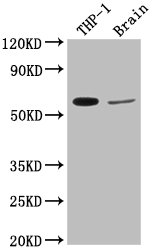
Western Blot
Positive WB detected in: THP-1 whole cell lysate, Rat brain tissue
All lanes: COL9A2 antibody at 1:2000
Secondary
Goat polyclonal to rabbit IgG at 1/50000 dilution
Predicted band size: 66 kDa
Observed band size: 66 kDa
Structural component of hyaline cartilage and vitreous of the eye.
Gene References into Functions
rs12077871, rs12722877, and rs7533552 variants in COL9A2 were not significantly associated with a predisposition to lumbar disc degeneration.PMID:29506578
Study provides evidence that the COL9A2 Gln326Arg polymorphism contributes to the development of intervertebral disc disease in the Chinese population.PMID:28002589
Meta-analysis. Our results suggest that the COL9A2 rs12077871, rs12722877, and rs7533552 polymorphisms may not be associated with lumbar disc disease.PMID:24983932
Two novel mutations, c.143G>C in exon 2 and c.884G>A in exon 17 of the COL9A2 gene, may contribute to the development of pathological myopia.PMID:24711017
The allelic variants in the collagen IX genes - COL9A2 and COL9A3 have been identified as genetic risk factors for intervertebral disc disease--{review}PMID:24636772
Studies indicate that two SNPs that introduce tryptophan polymorphisms in COL9A2 and COL9A3 are independently linked to an increased risk of lumbar disc disease.PMID:21311409
Data indicate that no causal SNPs in COL9A2 were significantly associated with LSS, but Haplotype Analysis showed that the "GCAGCG" haplotype (HAP2) was overrepresented in LSS patients.PMID:21228751
loss of function mutation in the COL9A2 gene causes autosomal recessive Stickler syndromePMID:21671392
Data show that the associating G allele in COL9A2 changes a glutamine to arginine or to tryptophan and may predispose to both hip osteoarthritis and lumbar disc degeneration, making it a candidate for degenerative connective tissue diseases.PMID:21159828
mutations leading to skipping of exon 3 within the COL3 domain of the alpha2-chain of collagen type IX may be relatively common in patients with a special subtype of multiple epiphyseal dysplasiaPMID:12244547
Both Trp2 and Trp3 allelic products are incorporated into cross-linked fibrillar network of developing human cartilage apparently normally. Any pathological consequences are likely to be long-term and indirect rather than from overt misassembly of matrix.PMID:12782139
The collagen IX is cartilage specific, and expressed in hypertrophic chondrocytes and bone.PMID:15625128
A population study using magnetic resonance imaging to define degenerative disc disease demonstrates that the TRP2 allele (Gln326Trp)of COL9A2 is a significant risk factor for development and severity of degeneration.PMID:16371896
A Japanese family with an autosomal dominant multiple epiphyseal dysplasia (MED EDM2) was studied; genomic analysis for COL9A2 identified an Ex3-1A>G heterozygous mutation, which has been proved to result in skipping of exon 3.PMID:16440132
Association of a COL9A2 specific haplotype with lumbar disc disease in the Japanese population.PMID:17024315
Homozygosity for the Arg allele of Col9A2 seems to be more frequent in the patient group with early recurrence although the differences in the allele frequencies were statistically not significant.PMID:18080148
COL9A2 polymorphisms were associated with intervertebral disc mechanics, relating genetic variations and debilitating mechanical alterations that may ultimately result in intervertebral disc degeneration.PMID:18246003