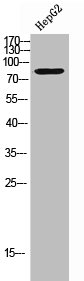
Synthesized peptide derived from the Internal region of Human CNG-1.
Immunogen Species
Homo sapiens (Human)
Conjugate
Non-conjugated
Isotype
IgG
Purification Method
The antibody was affinity-purified from rabbit antiserum by affinity-chromatography using epitope-specific immunogen.
Concentration
It differs from different batches. Please contact us to confirm it.
Buffer
Liquid in PBS containing 50% glycerol, 0.5% BSA and 0.02% sodium azide.
Form
Liquid
Note: We will preferentially ship the format that we have in stock, however, if you have any special requirement for the format, please remark your requirement when placing the order, we will prepare according to your demand.
Upon receipt, store at -20°C or -80°C. Avoid repeated freeze.
Lead Time
Basically, we can dispatch the products out in 1-3 working days after receiving your orders. Delivery time maybe differs from different purchasing way or location, please kindly consult your local distributors for specific delivery time.
Note: All of our proteins are default shipped with normal blue ice packs, if you request to ship with dry ice, please communicate with us in advance and extra fees will be charged.
Usage
For Research Use Only. Not for use in diagnostic or therapeutic procedures.
Subunit of the rod cyclic GMP-gated cation channel, which is involved in the final stage of the phototransduction pathway. When light hits rod photoreceptors, cGMP concentrations decrease causing rapid closure of CNGA1/CNGB1 channels and, therefore, hyperpolarization of the membrane potential.
Gene References into Functions
Compound heterozygous mutations (NM000087, p.Y82X and p.L89fs) in exon 6 of CNGA1are pathogenic mutations in this Chinese family affected with autosomal recessive retinitis pigmentosa. Of which, p.Y82X is firstly reported in patient with autosomal recessive retinitis pigmentosa.PMID:27391953
The mut CNGA1 p.(G513R) protein was largely retained inside the cell rather than being targeted to the plasma membrane, suggesting the absence of cGMP-gated cation channels in the plasma membranePMID:26802146
CNGA1 mutations are one of the most frequent autosomal recessive retinitis pigmentosa-causing mutations in the Japanese patients.PMID:25268133
Insulin receptor (IR), an integral membrane protein, directly phosphorylates the CNGA1 subunit of CNG channels that in turn affects the function of these channels negatively. CNGA1 is a direct substrate of IR.PMID:23032687
Novel homozygous mutation R28X truncates CNGA1 very prematurely in patients with autosomal recessive retinitis pigmentosa.PMID:12362048
isolated an endogenous transcript (anti-CNG1) that is antisense to CNG1 mRNA; data suggest the suppression of CNG(alpha)1 expression by anti-CNG1 may play an important role in neuronal functions, especially in synaptic plasticity and cortical developmentPMID:12388767
The heteromeric cyclic nucleotide-gated channel adopts a 3A:1B stoichiometryPMID:12432397
The autosomal recessive retinitis pigmentosa in this family is caused by a mutation in CNGA1 gene.PMID:15570217
Expressed in a stage- and cell-specific manner in the rat testis.PMID:15713832