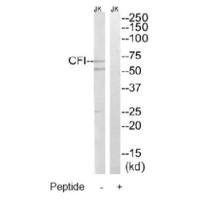
AHUS3 antibody; ARMD13 antibody; C3b INA antibody; C3b inactivator antibody; C3B/C4B inactivator antibody; C3BINA antibody; CFAI_HUMAN antibody; Cfi antibody; Complement component I antibody; Complement control protein factor I antibody; Complement factor I antibody; Complement factor I heavy chain antibody; Complement factor I light chain antibody; F1 antibody; factor I antibody; FactorI antibody; FI antibody; I factor antibody; IF antibody; KAF antibody; Konglutinogen activating factor antibody; Light chain of factor I antibody; OTTHUMP00000219728 antibody; OTTHUMP00000221928 antibody
Raised in
Rabbit
Species Reactivity
Human
Immunogen
Synthesized peptide derived from internal of Human CFI.
Immunogen Species
Homo sapiens (Human)
Purification Method
The antibody was affinity-purified from rabbit antiserum by affinity-chromatography using epitope-specific immunogen.
Concentration
It differs from different batches. Please contact us to confirm it.
Tested Applications
ELISA,WB
Storage
Upon receipt, store at -20°C or -80°C. Avoid repeated freeze.
Lead Time
Basically, we can dispatch the products out in 1-3 working days after receiving your orders. Delivery time maybe differs from different purchasing way or location, please kindly consult your local distributors for specific delivery time.
Note: All of our proteins are default shipped with normal blue ice packs, if you request to ship with dry ice, please communicate with us in advance and extra fees will be charged.
Usage
For Research Use Only. Not for use in diagnostic or therapeutic procedures.
Trypsin-like serine protease that plays an essential role in regulating the immune response by controlling all complement pathways. Inhibits these pathways by cleaving three peptide bonds in the alpha-chain of C3b and two bonds in the alpha-chain of C4b thereby inactivating these proteins. Essential cofactors for these reactions include factor H and C4BP in the fluid phase and membrane cofactor protein/CD46 and CR1 on cell surfaces. The presence of these cofactors on healthy cells allows degradation of deposited C3b by CFI in order to prevent undesired complement activation, while in apoptotic cells or microbes, the absence of such cofactors leads to C3b-mediated complement activation and subsequent opsonization.
Gene References into Functions
This study has revealed a significant genetic role for CFI-rs13104777 in acute anterior uveitis. This influence may be dependent on human leukocyte antigen (HLA)-B27 and disease laterality.PMID:27380463
An extremely rare, heterozygous mutation in the gene encoding CFI likely affecting splicing was associated for the first time with atypical hemolytic uremic syndrome.PMID:28455885
this study illustrates the importance of early versus late diagnosis of CFI deficiencyPMID:28942469
This finding although rare does suggest that screening for chromosomal rearrangements affecting CFI should be undertaken in all aHUS patients particularly if the factor I level is unexplainably low.PMID:27268256
Factor I binds C3b-Factor H between Factor H domains 2 and 3 and a reoriented C3b C-terminal domain and docks onto the first scissile bond, while stabilizing its catalytic domain for proteolytic activity.PMID:28671664
Taken together, our data argue that multiple rare and ultra-rare alleles in CFI contribute to AMD pathogenesis; they improve the precision of the assessment of the contribution of CFI to AMDPMID:28282489
Case Report: thrombotic microangiopathy with mutations in complement factor I and thrombomodulin.PMID:26613809
Our results indicate that CFI polymorphisms are not significantly associated with VKH syndrome.PMID:26900322
Patients with advanced atrophic AMD carried these rare variants more frequently than patients with neovascular AMD (11 of 93 [11.8%] vs 40 of 835 [4.8%]; P = .04).PMID:26767664
Low FI levels are strongly associated with rare CFI variants and age-related macular degeneration.PMID:25788521
A missense variant (p.V412M) in CFI was discovered in two Tunisian Jewish families with early-onset age-related macular degeneration.PMID:25986072
Regulatory components of the alternative complement pathway in endothelial cell cytoplasm, factor H and factor I, are not packaged in Weibel-Palade bodies.PMID:25803806
In this study, the odds of AMD were highest in those with deficient vitamin D status and 2 risk alleles for the CFH and CFI genotypes, suggesting a synergistic effect between vitamin D status and complement cascade protein function.PMID:26312598
iC3b level, a proteolytically inactive form of C3b, was lower in HCV infected patient sera, reflecting impairment of both C3 convertase and Factor I activity.PMID:24983375
association between rs10033900 and age-related macular degeneration risk in Han Chinese populationPMID:24642830
The mutations in the regulators CFH, CFI and MCP involve loss-of-function, whereas those for C3 involve gain-of-function.PMID:25188723
The CFI p.Gly119Arg mutation was identified in 7/521 age-related macular degeneration cases compared to 1/627 age-matched controls; this mutation confers a high risk of disease.PMID:25352734
CFI genetic variants played an important role in the development of NSCLC in Chinese population.PMID:25394898
High expression of complement factor I is associated with recurrence in breast cancer.PMID:25618258
results provide evidence for the role of CFI in the progression of cSCC and identify it as a potential therapeutic target in this nonmelanoma skin cancerPMID:25184960
This study has revealed a significant association between acute anterior uveitis (AAU) and CFI-rs7356506, suggesting that CFI is involved in the pathogenesis of AAUPMID:25075123
Neither of the two SNPs most studied (rs10033900 or rs2285714) in the CFI gene was a risk factor for developing neovascular age-related macular degeneration or polypoidal choroidal vasculopathy in a Chinese population.PMID:24732209
Recurrent aseptic meningo-encephalitis is a rare clinical presentation of complete FI deficiency.PMID:24142231
An STR polymorphism in intron 7 of human CFI gene on chromosome 4q in 11 Asian populations indicated that Group H alleles in exon 11 of the CFI gene were almost entirely confined to East Asian populations, making it useful in forensic anthropology.PMID:23688582
We found that 7.8% of advanced age-related macular degeneration cases compared to 2.3% of controls are carriers of rare missense CFI variants.PMID:24036952
Case Report: patient with atypical haemolytic uremic syndrome with combined membrane cofactor protein CD46 and complement factor I mutations undergoing successful kidney transplantation.PMID:23519521
Mutations in complement factor I protein is associated with end-stage renal disease in a patient with hemolytic uremic syndrome caused by infections by Escherichia coli strains producing Shiga-like toxins.PMID:23731345
these findings demonstrate that rare, highly penetrant mutations in CFI contribute to the genetic burden of age-related macular degeneration.PMID:23685748
rs1136287 in CFI is less likely to be associated in in extremely myopic Japanese individuals.PMID:23722394
The alternative pathway of complement may play a role in the pathogenesis of HELLP syndrome.PMID:22594569
Acute hemorrhagic leukoencephalitis (AHLE) is an unreported, rare phenotype for partial complement factor I deficiency.PMID:22926405
we report four novel mutations and the first large gene deletion in the CFI locus.PMID:22710145
One SNP (rs10033900) in the CFI gene, which encodes a protein involved in the inflammatory pathway, was significantly associated with myopic choroidal neovascularization in multivariate analysis after correction for multiple testing.PMID:22678500
Since FI requires cofactors for its activity we also investigated the binding of purified cofactors C4BP and FH and found acquisition of both proteins, which retained their activity in FI mediated degradation of C3b and C4b.PMID:22514678
factor I were significantly diminished early after trauma.PMID:22258234
all analyzed cofactors form similar trimolecular complexes with FI and C3b/C4b, and the accessibility of FIMAC and SP domains is crucial for the function of FIPMID:22393059
Results question whether complement factor I autoantibodies per se predispose to atypical hemolytic uremic syndrome.PMID:22223611
Forster resonance energy transfer was used to investigate the 10 muM K(D) (210 kD) complex between the N-terminal region of the soluble complement regulator, factor H (FH1-4), and the key activation-specific complement fragment, C3b.PMID:21936007
Data show that FI is in a proteolytically inactive form, demonstrating that it circulates in a zymogen-like state.PMID:21768352
Study describes the molecular and functional consequences of two novel mutations of FI.PMID:21316765
Study identified novel mutations in CFH, CFHR5, CFI, CFB and C3 in American patients with atypical hemolytic uremic syndrome.PMID:20513133
Role of a common variant near the complement factor I gene in susceptibility to age-related macular degeneration.PMID:20087399
In a large cohort of 202 patients with aHUS, we identified 23 patients carrying exonic mutations in CFIPMID:20016463
the FIMAC domain appears to harbor the main binding sites important for the ability of FI to degrade C4b and C3bPMID:20044478
mutations in complement factor I affect both secretion and function of factor I, which leads to impaired regulation of the complement system in atypical hemolytic uremic syndrome.PMID:19877009
the last 45 amino acid of the heavy chain, including a disulfide bridge area, did not participate in the serine protease function of factor IPMID:14967308
Human complement factor I does not require cofactors for cleavage of synthetic substrates.PMID:15210795
fI and the serine protease domain were found to have similar amidolytic activities but strikingly different proteolytic activities on C3(NH(3)).PMID:15835912
Mutations in the complement regulators factor H, membrane cofactor protein (MCP), and factor I are associated with atypical hemolytic uremic syndrome.PMID:16386793
factor I in concert with CR1 on E and factor H in serum due to their cofactor activity are likely to be important contributorsPMID:16920989
Show
More
Hide
All
Subcellular Location
Secreted, extracellular space. Secreted.
Protein Families
Peptidase S1 family
Tissue Specificity
Expressed in the liver by hepatocytes. Also present in other cells such as monocytes, fibroblasts or keratinocytes.