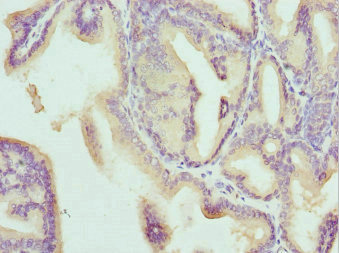
CD1B; T-cell surface glycoprotein CD1b; CD antigen CD1b
Raised in
Rabbit
Species Reactivity
Human
Immunogen
Recombinant Human T-cell surface glycoprotein CD1b protein (18-303AA)
Immunogen Species
Homo sapiens (Human)
Conjugate
Non-conjugated
Clonality
Polyclonal
Isotype
IgG
Purification Method
Antigen Affinity Purified
Concentration
It differs from different batches. Please contact us to confirm it.
Buffer
PBS with 0.02% sodium azide, 50% glycerol, pH7.3.
Form
Liquid
Note: We will preferentially ship the format that we have in stock, however, if you have any special requirement for the format, please remark your requirement when placing the order, we will prepare according to your demand.
Upon receipt, store at -20°C or -80°C. Avoid repeated freeze.
Lead Time
Basically, we can dispatch the products out in 1-3 working days after receiving your orders. Delivery time maybe differs from different purchasing way or location, please kindly consult your local distributors for specific delivery time.
Note: All of our proteins are default shipped with normal blue ice packs, if you request to ship with dry ice, please communicate with us in advance and extra fees will be charged.
Usage
For Research Use Only. Not for use in diagnostic or therapeutic procedures.
Antigen-presenting protein that binds self and non-self lipid and glycolipid antigens and presents them to T-cell receptors on natural killer T-cells.
Gene References into Functions
polyclonal germline-encoded mycolyl lipid-reactive T cell receptors that recognize CD1b-glucose-6-O-monomycolate use relatively conserved molecular mechanismsPMID:27807341
the development of polyvalent complexes of CD1b proteins and carbohydrate backbones (dextramers) and their use in identifying CD1b autoreactive T cells from human donors.PMID:26621732
for isoforms CD1b through CD1e, our simulations show the near-complete collapse of the hydrophobic cavities in the absence of the antigen. This event results from the spontaneous closure of the binding domain entrance, flanked by two alpha-helices.PMID:23677998
Molecular mechanisms by which CD1b captures distinct classes of self- and mycobacterial antigens are reviewed. Review.PMID:23468110
Deciphering the role of CD1e protein in mycobacterial phosphatidyl-myo-inositol mannosides (PIM) processing for presentation by CD1b to T lymphocytesPMID:22782895
CD1b has a mechanism for presenting either two small or one large lipid, allowing presentation of antigens with an unusually broad range of chain lengths.PMID:22087000
a cognate mechanism whereby CD1b-glycolipid complexes bind to TCRs.PMID:21807869
The DC-SIGNlow/CD86high population is characterized by a reduced CD1b expression that correlates with a reduced iMtb-specific lymphocyte proliferation together with an enhanced mixed leukocyte reaction.PMID:20212510
gammadelta T cells recognize lipid A (LA) in a CD1b- or CD1c-restricted manner in first response against Gram-bacteria, while the interaction between TLR4 on gammadelta T cells and LA might strengthen the subsequent response of gammadelta T cells.PMID:19948070
Lipid length controls antigen entry into endosomal and nonendosomal pathways for CD1b presentation.PMID:11938350
Failure of trafficking and antigen presentation by CD1b in AP-3-deficient cellsPMID:12049721
CD1b and CD1c show strong binding of nitrobenzoxadiazole (NBD)-labeled dialkyl-based ligands.PMID:14551186
model proposed in which saposin C exposes lipid antigens from intralysosomal membranes for loading onto CD1bPMID:14716313
Current crystal structure illustrates for the first time the binding of a natural bacterial lipid antigen to CD1b and shows how its novel structural features fit the CD1b molecule for its role in the immune response to intracellular bacteria.PMID:14764708
CD1b expression was detected on monocytes in the majority of sickle cell anemia patients, and was highly expressed in Sbeta thalassemia patients.PMID:15556687
Expression of DC-SIGN and CD1b in human leprosy.PMID:15880118
Endosomal acidification acts directly, rather than through enzymatic trimming, to insert lipids into CD1b.PMID:16794581
The data presented herein explain how the CD1b groove is preserved, and provide a rationale for the in vivo antigen-binding properties of CD1b.PMID:16874306
study proposes that ionic tethers act as molecular switches that respond to pH fluxes during endosomal recycling and regulate the conformation of the CD1 heavy chain to control the size and rate of antigens capturedPMID:18538591
The crystal structure of an avian CD1 (chCD1-2) that shares common ancestry with mammalian CD1 from approximately 310 million years ago, was determined.PMID:19004781
mycobacterial lipids structural constraints governing binding to CD1b and generation of antigenic CD1b:lipidPMID:19454700
Group 1 CD1-restricted T cells participate in adaptive immune responses upon mycobacterial infection.PMID:19808251
Show
More
Hide
All
Subcellular Location
Cell membrane; Single-pass type I membrane protein. Endosome membrane; Single-pass type I membrane protein. Lysosome membrane; Single-pass type I membrane protein.
Tissue Specificity
Expressed on cortical thymocytes, on certain T-cell leukemias, and in various other tissues.