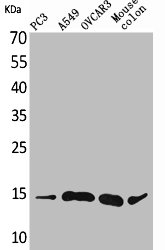
C-C motif chemokine 26 antibody; CC chemokine IMAC antibody; CCL 26 antibody; CCL26 antibody; CCL26_HUMAN antibody; Chemokine (C C motif) ligand 26 antibody; chemokine N1 antibody; Eotaxin 3 antibody; Eotaxin-3 antibody; IMAC antibody; Macrophage inflammatory protein 4-alpha antibody; MIP 4a antibody; MIP 4alpha antibody; MIP-4-alpha antibody; MIP4a antibody; MIP4alpha antibody; SCYA 26 antibody; SCYA26 antibody; Small inducible cytokine A26 antibody; Small inducible cytokine subfamily A (Cys Cys) member 26 antibody; Small inducible cytokine subfamily A member 26 antibody; Small-inducible cytokine A26 antibody; Thymic stroma chemokine 1 antibody; Thymic stroma chemokine-1 antibody; TSC 1 antibody; TSC-1 antibody; TSC1 antibody
Raised in
Rabbit
Species Reactivity
Human
Immunogen
Synthesized peptide derived from the Internal region of Human Eotaxin-3.
Immunogen Species
Homo sapiens (Human)
Conjugate
Non-conjugated
Isotype
IgG
Purification Method
The antibody was affinity-purified from rabbit antiserum by affinity-chromatography using epitope-specific immunogen.
Concentration
It differs from different batches. Please contact us to confirm it.
Buffer
Liquid in PBS containing 50% glycerol, 0.5% BSA and 0.02% sodium azide.
Tested Applications
WB, ELISA
Storage
Upon receipt, store at -20°C or -80°C. Avoid repeated freeze.
Lead Time
Basically, we can dispatch the products out in 1-3 working days after receiving your orders. Delivery time maybe differs from different purchasing way or location, please kindly consult your local distributors for specific delivery time.
Note: All of our proteins are default shipped with normal blue ice packs, if you request to ship with dry ice, please communicate with us in advance and extra fees will be charged.
Usage
For Research Use Only. Not for use in diagnostic or therapeutic procedures.
Chemoattractant for eosinophils and basophils. Acts as a ligand for C-C chemokine receptor CCR3 which triggers Ca(2+) mobilization in eosinophils. Also acts as a ligand for CX3C chemokine receptor CX3CR1, inducing cell chemotaxis.
Gene References into Functions
Based on the ADEPT study data set, we report that airway mucosal expression of CCL26 was a robust discriminator of type 2 inflammation from healthy nonatopic subjects. Furthermore, airway mucosal CCL26 expression was best identified by using a panel of clinical biomarkers, including Feno values, bEOS counts, and expression of 2 novel markers, sCCL17 and sCCL26PMID:28089872
hypoxia-inducible factors activate the transcription of chemokine ligand 26 in cancer cells to recruit chemokine receptor 1-expressing myeloid-derived suppressor cells to the primary tumorPMID:27228567
this study shows that expression of CCL26 is increased in eosinophilic myocarditis patients compared to chronic lymphocytic myocarditis patientsPMID:27621211
The reduction of circulating levels of MCP-4, eotaxin-3, and MIP-1beta could be one of the mechanisms by which bariatric surgery contributes to the reduction of cardiovascular risk in these patients.PMID:27300476
Review: eotaxins (CCL11, CCL24, and CCL26) play key role(s) during symptomatic inflammatory responses raised in response to allergic crisis of allergic asthma and atopic dermatitisPMID:26861136
Data show that the interleukins IL-4 and IL-13 are critical factors for the induction of eotaxin-3/CCL26 in the pancreas.PMID:26418908
These results show a relation between CCL26 production by IL-13-stimulated bronchial epithelial cells , sputum eosinophil counts, and asthma severity. They also suggest a role for CCL26 in the sustained inflammation observed in patients with severe eosinophilic asthma and reveal CCL26 as a potential target for treating patients with eosinophilic asthma that are refractoryPMID:25936567
The most potent inhibition of RANTES, eotaxin and eotaxin3 as well as MMP9 activity.PMID:25323950
These findings indicate that eotaxin-3 is expressed in Chronic subdural hematoma fluidPMID:24684589
these data suggest that CCL26 and CCL24 are likely involved in the pathogenesis of chronic nasal hypereosinophilia, with a complex cooperation and different involvement of the various members of eotaxin family.PMID:24989688
CCL11, CCL24, and CCL26 are increased in TB patients; hence, it seems that TB suppresses Th1 and the classic function of macrophages subsequently by inducing the chemokines' expressionPMID:24600981
these data identify a contributory role for DNA methylation in regulating eotaxin-3 production in human allergic inflammation.PMID:24323578
CCL11, CCL24, and CCL26 has a role in the recruitment of extravillous trophoblast into decidual tissue and vessels.PMID:23477905
CCL26 is a more effective chemoattractant than CCL11 or CCL24 for eosinophils of asthmatics. All eotaxins induced the eosinophil migration from 0 to 6 h, but CCL26 triggered a second phase of migration between 12 & 18 h.PMID:23532518
CCL1, CCL26, and IgE may be associated with pruritus in cutaneous T-cell lymphoma.PMID:22948508
elevated expression in the active lesions of ulcerative colitis and Crohn's diseasePMID:23607908
Oesophageal squamous cells from gastro-oesophageal reflux disease and Eosinophilic oesophagitis patients express similar levels of eotaxin-3 when stimulated by Th2 cytokines, and omeprazole blocks that eotaxin-3 expression.PMID:22580413
PPIs, in concentrations achieved in blood with conventional dosing, significantly inhibit IL-4-stimulated eotaxin-3 expression in EoE esophageal cells and block STAT6 binding to the promoter.PMID:23185525
Up-regulation of CCL2, CCL26, IL6 and LOXL2 genes in cancer cells are part of the common effects of cancer-associated fibroblasts on hepatocellular carcinoma cellsPMID:22739041
Phosphodiesterase 4 inhibitors, rolipram and RO-20-1724 have no effect on CCL26 expression in human primary bronchial epithelial cells.PMID:22946025
Leukotriene D4 and interleukin-13 cooperate to increase the release of eotaxin-3 by airway epithelial cellsPMID:22952702
The level of eotaxin expression and inflammatory cell count were measured in the material from nasal brushing in healthy controls and in patients with allergic rhinitis, asthma, and chronic obstructive pulmonary disease.PMID:22846146
Data show that that IL-4 signals through the Jak1, 2/Stat6 pathway in keratinocytes to stimulate CCL26 expression and this may provide an explanation for the pathogenesis of atopic dermatitis (AD).PMID:22226123
CCL26 but not CCL24 was elevated in bullous pemphigoid lesions.PMID:21881593
The expression of AMCase, eotaxin-3, IL-13, and mRNA was significantly higher in patients with CRSwNP than in the control group.PMID:21493274
these data link the up-regulation of the eosinophil chemotactic factor CCL26 in bullous pemphigoid to the lesional accumulation of activated eosinophils in the skin.PMID:21985360
Serum eotaxin-3 is a sensitive and specific marker for the diagnosis of active Churg-Strauss syndrome suitable for routine clinical practice.PMID:21266446
CCL26-directed small-interfering RNA (siRNA) treatments significantly decreased release of CCL5 (RANTES), CCL15 (MIP-1delta), CCL8 (MCP-2), and CCL13 (MCP-4).PMID:19203252
Epigenetic regulation of the IL-13-induced human eotaxin-3 gene by CREB-binding protein-mediated histone 3 acetylation.PMID:21325281
AMCase and eotaxin-3 may be important mediators in the pathogenesis of nasal polyps. The increased AMCase and eotaxin-3 might lead to nasal polyp formation and growth.PMID:21303604
CCL26 is an agonist for CX3CR1 and may play a dual role in allergic diseases by attracting eosinophils via CCR3 and killer lymphocytes and resident monocytes via chemokine receptor CX3CR1.PMID:20974991
Serum CCL11 was increased in ulcerative colitis (UC) and less in Crohn's disease (CD), whereas CCL24 and CCL26 were increased only in UC. Colon expression of the CCL's was higher in UC vs. CD, and was induced by Th2 cytokines in colon epithelial cells.PMID:21077277
interaction of eotaxins and CCR3 regulates the Th2-dominant tumor environment, which is closely related to the development of cutaneous T-cell lymphomaPMID:20505746
The mean gene expression level for CCL11, CCL24, CCL26 was higher in skin changes of atopic dermatitis patients than in uninvolved skin.PMID:20236835
data show that IL-4 and pro-inflammatory cytokines such as TNF-alpha, IL-1beta and IFN-gamma regulate CCL26 synthesis in human monocytic cellsPMID:20059579
Expression is modulated by cytokines and glucocorticoids.PMID:12061839
Pretreatment or co-treatment with each of the eotaxins augmented PMAtate-induced superoxide generation, concentration-dependent degranulation of eosinophil peroxidase, & potentiation of A23187-induced degranulation.PMID:12192108
eotaxin-3 inhibits MCP-1-mediated responses, thus acting as a natural antagonist for CCR2, and promotes active movement of monocytes away from a gradient of eotaxin-3PMID:12689946
eotaxin-3 is the first human chemokine that features broadband antagonistic activities; may have a modulatory rather than an inflammatory function;may play an unrecognized role in the polarization of cellular recruitment by attracting Th2 lymphocytesPMID:15039444
results suggest that types 1 and 2 IL-4 receptors and nuclear factor-kappaB may have a role in eotaxin-3 production in bronchial epithelial cellsPMID:15521376
CCL26 is major eotaxin synthesized and released by alveolar epithelial cells and is involved in autoregulation of CCR3 receptors and other eotaxins. This CCL26-CCR3 ligand-receptor system may be an attractive target in therapy of airway inflammation.PMID:15863444
results demonstrate that epithelial eotaxin-3 is up-regulated in the context of a T helper 2 mediated inflammatory bowel disease via the signal transducer and activator of transcription 6PMID:16084752
In conclusion, these results suggest that viral airway infection may enhance interleukin-4-induced eotaxin-3 production through upregulation of the interleukin-4 receptor in airway epithelial cells.PMID:16264039
association of eotaxin-3 polymorphisms in ulcerative colitis in Korean patientsPMID:16391516
results implicate eotaxin-3 as a critical effector molecule for eosinophilic esophagitis and provide insight into disease pathogenesisPMID:16453027
Contributes to dermal and epidermal eosinophil infiltration in Th2-polarized skin inflammation in which interleukin-4 is produced.PMID:17073866
Data suggest atherosclerotic inflammation may be a trigger for sclerosis in calcified stenotic aortic valves through upregulation TGF-beta, VAP-1, MIG and Eotaxin3, which is only partially inhibited by previous statin therapy.PMID:17490641
The Th2 cytokine IL-4 preferentially stimulated eotaxin-3 expression.PMID:17541284
Determination of eotaxin-3 levels by real-time polymerase chain reaction on paraffinized, formalin-fixed tissue may be a useful test in the differentiation of eosinophilic esophagitis from gastroesophageal reflux diseasePMID:17900656
Show
More
Hide
All
Subcellular Location
Secreted.
Protein Families
Intercrine beta (chemokine CC) family
Tissue Specificity
Ubiquitously expressed at low levels in various tissues including heart and ovary.