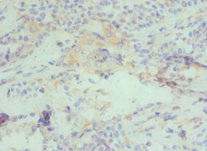
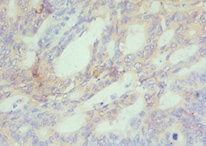
CBX 4 antibody; CBX4 antibody; Cbx4 chromobox homolog 4 (Drosophila Pc class) antibody; CBX4_HUMAN antibody; Chromobox homolog 4 (Pc class homolog; Drosophila) antibody; Chromobox homolog 4 antibody; Chromobox protein homolog 4 antibody; E3 SUMO protein ligase CBX 4 antibody; E3 SUMO protein ligase CBX4 antibody; E3 SUMO-protein ligase CBX4 antibody; hPc 2 antibody; hPc2 antibody; NBP 16 antibody; NBP16 antibody; NS5ATP1 binding protein 16 antibody; Pc 2 antibody; Pc class 2 homolog antibody; Pc class homolog antibody; Pc class homolog Drosophila antibody; PC2 antibody; Polycomb 2 homolog antibody
Raised in
Rabbit
Species Reactivity
Human
Immunogen
Recombinant Human E3 SUMO-protein ligase CBX4 protein (401-560AA)
Immunogen Species
Homo sapiens (Human)
Conjugate
Non-conjugated
Clonality
Polyclonal
Isotype
IgG
Purification Method
Antigen Affinity purified
Concentration
It differs from different batches. Please contact us to confirm it.
Buffer
PBS with 0.02% sodium azide, 50% glycerol, pH7.3.
Form
Liquid
Note: We will preferentially ship the format that we have in stock, however, if you have any special requirement for the format, please remark your requirement when placing the order, we will prepare according to your demand.
Upon receipt, store at -20°C or -80°C. Avoid repeated freeze.
Lead Time
Basically, we can dispatch the products out in 1-3 working days after receiving your orders. Delivery time maybe differs from different purchasing way or location, please kindly consult your local distributors for specific delivery time.
Note: All of our proteins are default shipped with normal blue ice packs, if you request to ship with dry ice, please communicate with us in advance and extra fees will be charged.
Usage
For Research Use Only. Not for use in diagnostic or therapeutic procedures.
E3 SUMO-protein ligase which facilitates SUMO1 conjugation by UBE2I. Involved in the sumoylation of HNRNPK, a p53/TP53 transcriptional coactivator, hence indirectly regulates p53/TP53 transcriptional activation resulting in p21/CDKN1A expression. Monosumoylates ZNF131.; Component of a Polycomb group (PcG) multiprotein PRC1-like complex, a complex class required to maintain the transcriptionally repressive state of many genes, including Hox genes, throughout development. PcG PRC1 complex acts via chromatin remodeling and modification of histones; it mediates monoubiquitination of histone H2A 'Lys-119', rendering chromatin heritably changed in its expressibility. Binds to histone H3 trimethylated at 'Lys-9' (H3K9me3). Plays a role in the lineage differentiation of the germ layers in embryonic development.
Gene References into Functions
Data suggest that CBX4 expression is up-regulated in breast cancer and is correlated with unfavorable overall survival; CBX4 promotes cell growth and migration via transcriptionally suppressing expression of miR137 to trigger Notch1 signaling pathway. (CBX4 = chromobox homolog 4; miR137 = microRNA 137; Notch1 = neurogenic locus notch homolog protein-1)PMID:29229426
Data show that USP26 interacts with PRC1 components chromobox (CBX)-containing proteins CBX4 and CBX6.PMID:28839133
Data show that SUMO E3 ligase CBX4 sumoylates subpopulation of CtIP to regulate recruitment to breaks and resection.PMID:28740167
provide evidence to show that CBX4 may serve as a tumor suppressor in colorectal carcinoma by recruiting HDAC3 to the Runx2 promoter to impede Runx2 expressionPMID:27864346
Cbx4 is an independent prognostic factor for HCC patients, and the patients with high Cbx4 expression should receive postoperative TACE treatment to improve their survivalPMID:25766328
our study demonstrated that miR-195 acts as a tumor suppressor by directly targeting CBX4 in hepatocellular carcinomaPMID:25607636
Role of Cbx4 in migration and metastasis of a metastatic hepatocellular carcinoma cell line. Results show that Cbx4 overexpression increases the in vitro vessel formation of vascular endothelial cells in its SUMO interaction motifs-dependent manner.PMID:24838576
The presence of CBX4-GFP in the same focus had a minor impact on BMI1 and RING1 recovery kinetics.PMID:24460908
High cytoplasmic expression of CBX4 is associated with hepatocellular carcinoma.PMID:23943028
our findings demonstrate that Cbx4 plays a critical role in tumor angiogenesis by governing HIF-1alpha proteinPMID:24434214
ASXL1 associates with the PRC2 and loss of ASXL1 in vivo collaborates with NRASG12D to promote myeloid leukemogenesis.PMID:22897849
High Polycomb repressive complex protein is associated with mesothelioma.PMID:22028491
Pc2, methylation controls the protein's interaction with two distinct ncRNAs, TUG1 and NEAT2, which results in the exclusive subnuclear localization of methylated and unmethylated Pc2 in Polycomb bodies and interchromatin granules, respectively.PMID:22078878
plays role in regulation of epidermal stem cell proliferation and senescencePMID:21885019
Data show that PRC2 can integrate information provided by pre-existing histone modifications to accurately tune its enzymatic activity within a particular chromatin context.PMID:21549310
the hPc2-induced SUMOylation of alpha-synuclein could function as a cytoprotector by increasing alpha-synuclein aggregate formation within fibroblast cells.PMID:21256122
14-3-3 protein binding to chromobox homolog 4 (CBX4) appears to modulate the interaction between CBX4 and the BMI1/PCGF components of polycomb recessive complex 1, but has no effect on CBX4-RING1/RNF2 interactionPMID:21282530
A phage display screen using the N-terminus of JARID1B as bait identified one of the JARID1B interacting proteins, namely PcG protein (Polycomb group) hPc2.PMID:19336002
Huntingtin is a novel stimulator of polycomb repressive complex 2.PMID:19933700
Pc2 dramatically enhances CtBP sumoylation. Pc2 is a SUMO E3, and Polycomb Group bodies may be sumoylation centers.PMID:12679040
polycomb group (PcG) protein HPC2, which functions as a transcriptional suppressor, is a candidate of KyoT2-binding proteinsPMID:15710417
SIP1 sumoylation by Pc2 attenuates transcriptional repression of E-cadherinPMID:16061479
Pc2 binds to and colocalizes with homeodomain interacting protein kinase 2 (HIPK2) and serves as a SUMO E3 ligase for this kinase.PMID:17018294
The Endoplasmic reticulum-associated degradation (ERAD) machinery may thus be important for autosomal dominant polycystic kidney disease pathogenesis because the regulation of PC2 expression by the ERAD pathway is altered by mutations in PC2.PMID:18178578
Results show that DNA methyltransferase 3B enhances polycomb protein 2-mediated transcriptional repression of FGFR3, and suggest that DNMT3B is a co-repressor of hPc2 in inducing transcriptional repression independent of DNA methylation.PMID:18567530