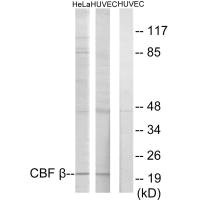
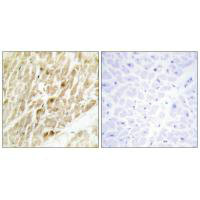
Synthesized peptide derived from internal of Human CBF β.
Immunogen Species
Homo sapiens (Human)
Clonality
Polyclonal
Purification Method
The antibody was affinity-purified from rabbit antiserum by affinity-chromatography using epitope-specific immunogen.
Concentration
It differs from different batches. Please contact us to confirm it.
Form
Rabbit IgG in phosphate buffered saline (without Mg2+ and Ca2+), pH 7.4, 150mM NaCl, 0.02% sodium azide and 50% glycerol.
Note: We will preferentially ship the format that we have in stock, however, if you have any special requirement for the format, please remark your requirement when placing the order, we will prepare according to your demand.
Upon receipt, store at -20°C or -80°C. Avoid repeated freeze.
Lead Time
Basically, we can dispatch the products out in 1-3 working days after receiving your orders. Delivery time maybe differs from different purchasing way or location, please kindly consult your local distributors for specific delivery time.
Note: All of our proteins are default shipped with normal blue ice packs, if you request to ship with dry ice, please communicate with us in advance and extra fees will be charged.
Usage
For Research Use Only. Not for use in diagnostic or therapeutic procedures.
Forms the heterodimeric complex core-binding factor (CBF) with RUNX family proteins (RUNX1, RUNX2, and RUNX3). RUNX members modulate the transcription of their target genes through recognizing the core consensus binding sequence 5'-TGTGGT-3', or very rarely, 5'-TGCGGT-3', within their regulatory regions via their runt domain, while CBFB is a non-DNA-binding regulatory subunit that allosterically enhances the sequence-specific DNA-binding capacity of RUNX. The heterodimers bind to the core site of a number of enhancers and promoters, including murine leukemia virus, polyomavirus enhancer, T-cell receptor enhancers, LCK, IL3 and GM-CSF promoters. CBF complexes repress ZBTB7B transcription factor during cytotoxic (CD8+) T cell development. They bind to RUNX-binding sequence within the ZBTB7B locus acting as transcriptional silencer and allowing for cytotoxic T cell differentiation.
Gene References into Functions
This study investigated the role of circ-CBFB in chronic lymphocytic leukemia. The ID of circ-CBFB in circBase is hsa_circ_0000707, which locates at chromosome 16q22.1 and derived from the back-splicing of CBFB transcript.PMID:29902450
results suggest that CBFbeta-SMMHC has complex actions on human ribosome biogenesis at both the genomic and posttranscriptional levelPMID:28196984
the presented study demonstrates that CBFB-MYH11-based MRD status during the first 3 months after allo-HCT, but not KIT mutations, can be used to identify patients with a high risk of relapse.PMID:27650511
discussion of the role of CBFB in diseases caused by their mutations or deletions (review)PMID:28299663
Both c-kit receptor (KIT) D816V and KIT N822K mutations underwent autophosphorylation in the absence of growth factor in leukemia TF-1 cell line.PMID:28506695
The co-existence of BCR-ABL1 and CBFB rearrangement is associated with poor outcome and a clinical course similar to that of CML-BP, and unlike de novo AML with CBFB rearrangement, suggesting that high-intensity chemotherapy with TKI should be considered in these patients.PMID:28253536
Moreover, using a CBF-beta loss-of-function mutant, the authors demonstrated that the interaction between CBF-beta and Vif was not sufficient for Vif assistance; a region including F68 in CBF-beta was also required for the stability and function of Vif.PMID:28516844
Vif stabilization by CBFbeta is mainly caused by impairing MDM2-mediated degradation.PMID:27758855
Mutational analysis of CBFbeta revealed that F68 and I55 residues are important and participate in a tripartite hydrophobic interaction with W5 of Vif to maintain a stable and functional Vif-CBFbeta complex.PMID:28302150
Our findings demonstrate that HSPCs exposed to non-cytotoxic levels of environmental chemicals and chemotherapeutic agents are prone to topoisomerase II-mediated DNA damage at the leukemia-associated genes MLL and CBFB.PMID:26163765
These results provide important information on the assembly of the Vif-CUL5-E3 ubiquitin ligase and identify a new viV binding interface with CBF-beta at the C-terminus of HIV-1 Vif.PMID:25424878
CBF-beta promoted steady-state levels of HIV-1 Vif by inhibiting the degradation of HIV-1 Vif through the proteasome pathway.PMID:25582776
CBFB contributes to the transcriptional regulation of ribosomal gene expression and provide further understanding of the epigenetic role of CBFB-SMMHC in proliferation and maintenance of the leukemic phenotype.PMID:25079347
we report a novel hypomethylation pattern, specific to CBFB-MYH11 fusion resulting from inv(16) rearrangement in acute myeloid leukemia the expression of which correlated with PBX3 differential methylationPMID:25266220
suggest that a different mechanism exists for the Vif-APOBEC interaction and that non-primates are not suitable animal models for exploring pharmacological interventions that disrupt Vif-CBF-beta interactionPMID:25122780
Suggest that CBFbeta retention in the midbody during cytokinesis reflects a novel function that contributes to epigenetic control.PMID:24648201
Transcriptional analysis revealed that upon fusion protein knockdown, a small subset of the CBFbeta-MYH11 target genes show increased expression, confirming a role in transcriptional repressionPMID:24002588
Authors propose that CBFbeta acts as a chaperone to stabilize HIV-1 Vif during and after synthesis and to facilitate interaction of Vif with cellular cofactors required for the efficient degradation of APOBEC3G.PMID:24522927
In the absence of CBFbeta, Vif does not bind Cul5, thus preventing the assembly of the E3 ligase complex.PMID:24390320
CBF-beta is critical for the formation of the Vif-ElonginB/ElonginC-Cul5 core E3 ubiquitin ligase complex.PMID:24390335
Vif conserved residues E88/W89 are crucial for CBFbeta binding.PMID:24418540
data reveal the structural basis for Vif hijacking of the CBF-beta and CUL5 E3 ligase complex, laying a foundation for rational design of novel anti-HIV drugsPMID:24402281
This report of recurring FLT3 N676 mutations in core-binding factor (CBF) leukemias suggests a defined subgroup of CBF leukemias.PMID:23878140
We conclude that non-type A CBFB-MYH11 fusion types associate with distinct clinical and genetic features, including lack of KIT mutations, and a unique gene-expression profile in acute myeloid leukemiaPMID:23160462
Our data indicate that the CBFbeta-SMMHC's C-terminus is essential to induce embryonic hematopoietic defects and leukemogenesis.PMID:23152542
A comparison of heat capacity changes supports a model in which CBFbeta prestabilizes Vif((1-192)) relative to Vif((95-192))PMID:23098073
Vif proteins of human and simian immunodeficiency viruses require cellular CBFbeta to degrade APOBEC3G.PMID:22205746
Vif and CBF-beta physically interact, and that the amino-terminal region of Vif is required for this interactionPMID:22190036
CBF-beta is required for Vif-mediated degradation of APOBEC3G and therefore for preserving HIV-1 infectivityPMID:22190037
For routine clinical practice, it may be meaningful to screen for C-KIT mutations in AML1/ETO-positive patients, as well as for FLT3(D835) mutations in CBF-AML.PMID:19603346
The expression of Cbfbeta which were the key factors in osteogenic differentiation was also up-regulated.PMID:20433876
conclude that CBFbeta is required for a subset of Runx2-target genes that are sufficient to maintain the invasive phenotype of the cellsPMID:20591170
Data collectively suggest that CBFbeta is required for malignant phenotype in prostate and ovarian cancer cells.PMID:20607802
has a role in hematopoiesis; preturbations result from expression of the leukemogenic fusion gene Cbfb-MYH11PMID:12239155
Expression of CBFB is down regulated in a significant portion of gastric cancer cases; may be involved in gastric carcinogenesisPMID:15386419
Plag1 and Plagl2 are novel leukemia oncogenes that act by expanding hematopoietic progenitors expressing CbF beta-SMMHC.PMID:15585652
Detection of acute myeloid leukemic cells that are characterized by a CBFB-MYH11 gene fusion.PMID:16502584
These observations suggest that when abdominal GS is diagnosed, an analysis of the CBFB/MYH11 fusion gene is necessary to make an appropriate decision regarding treatment options, even if no chromosomal abnormalities are found.PMID:16504290
Agents interacting with the outer surface of the CBFbeta-SMMHC ACD that prevent multimerization may be effective as novel therapeutics in AMLPMID:16767164
Rare fusion transcripts were correlated with an atypical cytomorphology not primarily suggestive for the FAB subtype acute myelocytic leukemia.PMID:17287858
Examine consequences of expression of abnormal chimeric protein CBFbeta-MYH11 in acute myelomonocytic leukemia.PMID:17571080
high CBFB protein level was an independent predictor of survival in colorectal cancerPMID:19156145