Peptide sequence around aa.226~230 (V-K-S-N-N) derived from CARM1
Immunogen Species
Homo sapiens (Human)
Purification Method
Antibodies were produced by immunizing rabbits with synthetic peptide and KLH conjugates. Antibodies were purified by affinity-chromatography using epitope-specific peptide.
Concentration
It differs from different batches. Please contact us to confirm it.
Tested Applications
ELISA,WB,IF
Storage
Upon receipt, store at -20°C or -80°C. Avoid repeated freeze.
Lead Time
Basically, we can dispatch the products out in 1-3 working days after receiving your orders. Delivery time maybe differs from different purchasing way or location, please kindly consult your local distributors for specific delivery time.
Note: All of our proteins are default shipped with normal blue ice packs, if you request to ship with dry ice, please communicate with us in advance and extra fees will be charged.
Usage
For Research Use Only. Not for use in diagnostic or therapeutic procedures.
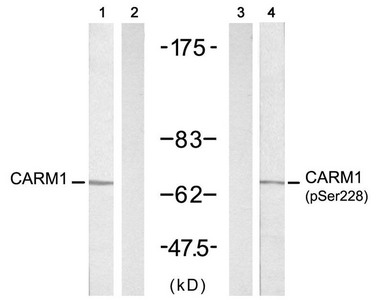
Western blot analysis of extracts from A431 cells untreated or treated with EGF(200ng/ml, 5min), using CARM1(Ab-228) antibody(, Line 1 and 2) and CARM1(Phospho-Ser228) antibody(, Line 3 and 4).
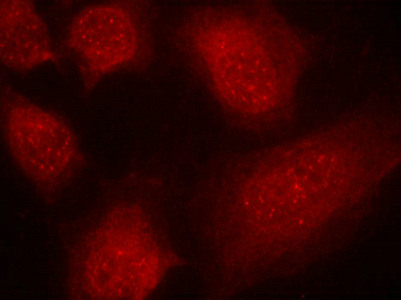
Immunofluorescence staining of methanol-fixed HeLa cells using CARM1(Ab-228) antibody.
Methylates (mono- and asymmetric dimethylation) the guanidino nitrogens of arginyl residues in several proteins involved in DNA packaging, transcription regulation, pre-mRNA splicing, and mRNA stability. Recruited to promoters upon gene activation together with histone acetyltransferases from EP300/P300 and p160 families, methylates histone H3 at 'Arg-17' (H3R17me), forming mainly asymmetric dimethylarginine (H3R17me2a), leading to activate transcription via chromatin remodeling. During nuclear hormone receptor activation and TCF7L2/TCF4 activation, acts synergically with EP300/P300 and either one of the p160 histone acetyltransferases NCOA1/SRC1, NCOA2/GRIP1 and NCOA3/ACTR or CTNNB1/beta-catenin to activate transcription. During myogenic transcriptional activation, acts together with NCOA3/ACTR as a coactivator for MEF2C. During monocyte inflammatory stimulation, acts together with EP300/P300 as a coactivator for NF-kappa-B. Acts as coactivator for PPARG, promotes adipocyte differentiation and the accumulation of brown fat tissue. Plays a role in the regulation of pre-mRNA alternative splicing by methylation of splicing factors. Also seems to be involved in p53/TP53 transcriptional activation. Methylates EP300/P300, both at 'Arg-2142', which may loosen its interaction with NCOA2/GRIP1, and at 'Arg-580' and 'Arg-604' in the KIX domain, which impairs its interaction with CREB and inhibits CREB-dependent transcriptional activation. Also methylates arginine residues in RNA-binding proteins PABPC1, ELAVL1 and ELAV4, which may affect their mRNA-stabilizing properties and the half-life of their target mRNAs.
Gene References into Functions
N-terminal EVH1 domain of CARM1 is necessary and sufficient for substrate recognition and is required for methylation of most CARM1 substrates.PMID:28537268
SKP2 promotes HCC progression and its nuclear functions of autophagy induction with CARM1 and AMPK, which may provide a potential target for HCC therapy.PMID:29991055
The Overexpression of CARM1 Promotes Human Osteosarcoma Cell Proliferation through the pGSK3beta/beta-Catenin/cyclinD1 Signaling PathwayPMID:28924379
The CARM1-PKM2 axis serves as a metabolic reprogramming mechanism in tumorigenesis.PMID:29058718
Arginine (di)methylated human leukocyte antigen class I peptides, which are asymmetrically dimethylated, most likely by CARM1, are favorably presented by HLA-B*07.PMID:27503676
Estrogen receptor recruits steroid receptor coactivator-3 primary coactivator and secondary coactivators, p300/CBP and CARM1 to regulate genetic transcription.PMID:28844863
Arginine methylation of MDH1 by CARM1 regulates cellular redox homeostasis and suppresses glutamine metabolism of pancreatic cancer.PMID:27840030
Here, the crystal structures of human CARM1 with the S-adenosylmethione (SAM) mimic sinefungin and three different peptide sequences from histone H3 and PABP1 are presented, with both nonmethylated and singly methylated arginine residues exemplified.PMID:26551522
CARM1 associates with major nonsense-mediated mRNA decay factor UPF1 and promotes its occupancy on premature terminating codon-containing transcripts in spinal muscular atrophy.PMID:26656492
Monitoring of the CARM1-dependent production of monomethylated and dimethylated peptides over time by self-assembled monolayer and matrix-assisted laser desorption ionization mass spectrometry revealed that methylation by CARM1 is distributive.PMID:26848779
no obvious association of CARM1 isoform expression and clinical correlates in breast cancerPMID:26030442
disruption of CARM1 enhances the nuclear retention of mRNAs containing IRAlusPMID:25792598
Data indicate that coactivator-associated arginine methyltransferase 1 (CARM1) regulates neural differentiation through Nanog homeobox protein and microRNA miR92a.PMID:25392304
Like insulin, CARM1 overexpression increased CDK2 and CDK4 expression. In addition, CARM1 knockdown reduced the number of insulin-induced G2/M phase cellsPMID:25934150
a noncoding variant in the CARM1-promoter functions as a regulator of gene transcription and homocysteine levelsPMID:25064859
O-GlcNAcylation of CARM1 at its C-terminus is an important determinant for CARM1 substrate specificity.PMID:25585345
PRMT4 has a role in arginine methylation, which negatively regulates retinoblastoma tumor suppressor protein and promotes E2F-1 dissociationPMID:25348716
PBMCs from patients with ACS showed higher levels of CARM1 mRNA and protein expression.CARM1 regulated the transcription of IP-10, IL-8, and MCP-1. miR-15a modulated CARM1 expression through targeted binding to CARM1 3'-UTR.PMID:24530761
CARM1 and PRMT1 are dysregulated in lung cancer; only CARM1 expression was found to be correlated with tumor differentiation and neither CARM1 nor PRMT1 expression was correlated with survival.PMID:24211191
Overexpression of PRMT4 represses miR-223 via methylation of RUNX1 and blocks myeloid differentiation.PMID:24332853
CARM1 overexpression was associated with poorly characterized clinicopathologic parameters and HER2 overexpression in invasive breast cancer.PMID:23915145
we identify BAF155 as a substrate for arginine methyltransferase CARM1.PMID:24434208
increased cytoplasmic CARM1, relative to nuclear levels, appear to be associated with self-identified African ethnicity and this result is being further investigated using quantified genetic ancestry measures.PMID:23663560
CARM1 could be a potential marker of luminal class subclassification and for target therapy, particularly in the ER-positive luminal-like subgroup.PMID:23887673
Arginine 42 of histone H3 (H3R42), is dimethylated by the methyltransferases coactivator arginine methyltransferase 1 (CARM1) and protein arginine methyltransferase 6 (PRMT6) in vitro and in vivo.PMID:23980157
Data show the transcriptional regulation of the human ferritin gene by coordinated regulation of Nrf2 and protein arginine methyltransferases PRMT1 and PRMT4.PMID:23699174
CARM1 represses replicative senescence by methylating HuR.PMID:23837869
Inhibition of CARM1 decreases PELP1 oncogenic activity.PMID:23486015
the miR-181c-CARM1 pathway has an important role in regulating the differentiation of human embryonic stem cellsPMID:23301034
These findings reveal an important and so far unknown connection between PRMT4 and the chromatin remodeller Mi2 in c-Myb signalling.PMID:23505388
Findings indicate that expression of PRMT4/CARM1 and PRMT6 is deregulated in melanoma.PMID:23265702
found that CARM1 facilitates Sox2-mediated transactivation and directly methylates Sox2 at arginine 113PMID:22046437
Signal transduction in cell death and survival involves a role for CARM1 in arginine methylation.PMID:21445011
A coactivator role of CARM1 in the dysregulation of beta-catenin activity in colorectal cancer cell growth and gene expressionPMID:21478268
Findings suggest that coexpression of CARM1 and ERalpha may provide a better biomarker of well-differentiated breast cancer.PMID:21282336
CARM1 was particularly overexpressed in colorectal cancers while CARM1 expression was not prevalent in prostate and breast cancers.PMID:20462455
The physical interaction of CARM1 and PCAF is likely pivotal for the activation of PCAF in the downstream of CARM1 pathway for inducing myogenin under Tetradecanoylphorbol Acetate -induced differentiation.PMID:20213728
phosphorylation of CARM1 by PKA at a single serine is necessary and sufficient for direct binding to the unliganded hormone-binding domain of ERalpha, and the interaction is necessary for cAMP activation of ERalphaPMID:20360387
Methylates PAB1 and TARPP, suggesting a role in regulating transcription/translation.PMID:11850402
The CBP/p300 acetylase and the CARM1 methyltransferase can positively regulate the expression of estrogen-responsive genes, there is a crosstalk between lysine acetylation and arginine methylation on chromatinPMID:12498683
CARM1 plays a significant role in promoting the differentiation of early thymocyte progenitors, possibly through its direct action on TARPP.PMID:15096520
overexpression of CARM1 is involved in the development of prostate carcinomaPMID:15221992
results show that CARM1/PRMT4 is a novel transcriptional coactivator of NF-kappaB and functions as a promoter-specific regulator of NF-kappaB recruitment to chromatinPMID:15616592
CARM1 affects pre-mRNA splicing in an isoform-specific mannerPMID:15944154
arginine methylation of CBP is required for IFN-gamma induction of MHC-II. A kinetic analysis shows that CIITA, CARM1, and H3-R17 methylation all precede CBP loading on the MHC-II promoter during IFN-gamma treatment.PMID:16254053
CARM1 has a role in signal-dependent control of gluconeogenic key enzyme genesPMID:16330542
CARM1 participates in NF-kappaB-mediated transcription through H3-R17 methylation and support a nonnuclear receptor-associated function for CARM1.PMID:16497732
CARM1 is essential for androgen receptor (AR) function and may play a role in prostate cancer progression.PMID:16705743
Results suggest that members of the SRC coactivator family, such as SRC-3, serve as substrates for the enzymatic coactivator coactivator-associated arginine methyltransferase 1 (CARM1).PMID:16923966
Show
More
Hide
All
Subcellular Location
Nucleus. Cytoplasm. Note=Mainly nuclear during the G1, S and G2 phases of the cell cycle. Cytoplasmic during mitosis, after breakup of the nuclear membrane.
Protein Families
Class I-like SAM-binding methyltransferase superfamily, Protein arginine N-methyltransferase family
Tissue Specificity
Overexpressed in prostate adenocarcinomas and high-grade prostatic intraepithelial neoplasia.