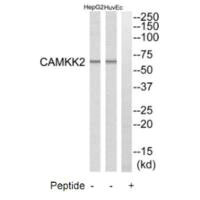
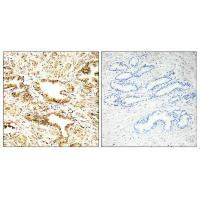
Synthesized peptide derived from internal of Human CAMKK2.
Immunogen Species
Homo sapiens (Human)
Purification Method
The antibody was affinity-purified from rabbit antiserum by affinity-chromatography using epitope-specific immunogen.
Concentration
It differs from different batches. Please contact us to confirm it.
Tested Applications
ELISA,WB,IHC
Storage
Upon receipt, store at -20°C or -80°C. Avoid repeated freeze.
Lead Time
Basically, we can dispatch the products out in 1-3 working days after receiving your orders. Delivery time maybe differs from different purchasing way or location, please kindly consult your local distributors for specific delivery time.
Note: All of our proteins are default shipped with normal blue ice packs, if you request to ship with dry ice, please communicate with us in advance and extra fees will be charged.
Usage
For Research Use Only. Not for use in diagnostic or therapeutic procedures.
Calcium/calmodulin-dependent protein kinase belonging to a proposed calcium-triggered signaling cascade involved in a number of cellular processes. Isoform 1, isoform 2 and isoform 3 phosphorylate CAMK1 and CAMK4. Isoform 3 phosphorylates CAMK1D. Isoform 4, isoform 5 and isoform 6 lacking part of the calmodulin-binding domain are inactive. Efficiently phosphorylates 5'-AMP-activated protein kinase (AMPK) trimer, including that consisting of PRKAA1, PRKAB1 and PRKAG1. This phosphorylation is stimulated in response to Ca(2+) signals. Seems to be involved in hippocampal activation of CREB1. May play a role in neurite growth. Isoform 3 may promote neurite elongation, while isoform 1 may promoter neurite branching.
Gene References into Functions
Silencing of TRPC5 and inhibition of autophagy reverses adriamycin drug resistance in breast carcinoma via CaMKKbeta/AMPKalpha/mTOR pathway.PMID:28600513
results demonstrated that SSd induces autophagy through the CaMKKbeta-AMPK-mTOR signalling pathway in Autosomal dominant polycystic kidney disease (ADPKD) cells, indicating that SSd might be a potential therapy for ADPKD and that SERCA might be a new target for ADPKD treatment.PMID:29675630
Three single nucleotide polymorphisms (SNPs) within P2X4R and two SNPs within CAMKK2 influenced concentrations of TNFalpha in peripheral blood mononuclear cells, but these SNP did not associate with risk for HIV-associated sensory neuropathy in South Africans.PMID:29428485
Serum CAMKK2 was downregulated in female schizophrenic patients compared with female healthy individuals.PMID:29992499
This study provides insight into functionally disruptive, rare-variant mutations in human CaMKK2, which have the potential to influence risk and burden of disease associated with aberrant CaMKK2 activity in human populations carrying these variants.PMID:28230171
14-3-3gamma protein directly interacts with the kinase domain of CaMKK2 and the region containing the inhibitory phosphorylation site Thr(145) within the N-terminal extension. CaMKK isoforms differ in their 14-3-3-mediated regulations and the interaction between 14-3-3 protein and the N-terminal 14-3-3-binding motif of CaMKK2 might be stabilized by small-molecule compounds.PMID:29649512
CAMKK2 exhibited the strongest associations with HIV-associated sensory neuropathy (HIV-SN), with two SNPs and six haplotypes predicting SN status in black Southern Africans.PMID:26785644
Study used three cognitive tasks and fMRI to provide convergent evidence of a link between the rs1063843 SNP of CAMKK2 and the function of the dorsolateral prefrontal cortex. In addition, this polymorphism was associated with the function of the striatum during a working memory task.PMID:27004598
Data suggest that CAMKK2 is highly expressed in high-grade ovarian cancer and ovarian cancer cell lines; CAMKK2 directly activates Akt1 by phosphorylation at Thr-308 in a Ca2+/calmodulin-dependent manner; CAMKK2 knockdown or inhibition decreases Akt1 phosphorylation at Thr-308 and Ser-473. (CAMKK2 = calcium/calmodulin dependent protein kinase kinase 2; AKT1 = AKT serine/threonine kinase 1)PMID:28634229
Single nucleotide polymorphism in CAMKK2 gene is associated with pulmonary non-tuberculous mycobacterial disease.PMID:28233049
This study showed that the expression level of CAMKK2 could be regulated by promoter methylation. CAMKK2 serves as a prognostic marker in gliomas and could be a potential therapeutic target in gliomas.PMID:27012733
For the first time, we showed that rs1063843, a single nucleotide polymorphism located in the CAMKK2 gene, is highly associated with bipolar disorderPMID:26354101
Site-directed mutagenesis analysis revealed that Leu(358) in CaMKKbeta/Ile(322) in CaMKKalpha confer, at least in part, a distinct recognition of AMPK but not of CaMKIalpha.PMID:27151216
Clopidogrel diminishes TNFalpha-stimulated VCAM-1 expression at least in part via HO-1 induction and CaMKKbeta/AMPK/Nrf2 pathway in endothelial cells.PMID:26824050
CaMKK2 (and Nup62) are required for optimal androgen receptor transcriptional activity in castrate resistant prostate cancer cells.PMID:26552607
Silencing of CAMKK2 using siRNA significantly reduced cell proliferation, colony formation and invasion of gastric cancer cells.PMID:25756516
CaMKKbeta-AMPKalpha2 signaling contributes to mitotic Golgi fragmentation and the G2/M transition in mammalian cells.PMID:25590814
CAMKK2 protein is highly up regulated in hepatocellular carcinoma.PMID:25847065
CaMKK2 plays a pivotal role in the calcium signaling cascade regulating adrenal aldosterone production.PMID:25679868
PCa patients with miR-224-low/CAMKK2-high expression more frequently had shorter overall survival.PMID:25394900
evidence supports that CAMKK2 is a novel schizophrenia susceptibility gene.PMID:23958956
CaMKIIalpha phosphorylation was enhanced by S-Allyl cysteine treatment in a concentration- and time-dependent manner, which paralleled AMPK activation.PMID:23465592
Pulsatile shear stress mimicking atheroprotective flow increases the level of sirtuin (SIRT)1 in cultured endothelial cells by enhancing its stability, an effect abolished by inhibition or knockdown of CaMKKbeta.PMID:23754392
CaMKKbeta is involved in AMP-activated protein kinase activation by baicalin in LKB1 deficient cell lines.PMID:23110126
amino acid starvation regulates autophagy in part through an increase in cellular Ca(2+) that activates a CaMKK-beta-AMPK pathway and inhibits mTORC1, which results in ULK1 stimulationPMID:23027865
Calcium/calmodulin-dependent protein kinase kinase 2 has roles in signaling and pathophysiology [review]PMID:22778263
Results suggest that in PCa progression, CaMKK2 and the AR are in a feedback loop in which CaMKK2 is induced by the AR to maintain AR activity, AR-dependent cell cycle control, and continued cell proliferation.PMID:22654108
Data show that protein kinase A (PKA) regulates the alternative splicing of Ca(2)/calmodulin-dependent protein kinase kinase 2 (CaMKK2) to produce variants that differentially modulate neuronal differentiation.PMID:21957496
phosphorylation of CaMKKbeta regulates its half-life.PMID:21669867
Our results demonstrate that CaMKKbeta and AMP-activated protein kinase form a unique signaling complexPMID:21807092
Findings reveal that hypoxia can trigger AMPK activation in the apparent absence of increased [AMP] through ROS-dependent CRAC channel activation, leading to increases in cytosolic calcium that activate the AMPK upstream kinase CaMKKbeta.PMID:21670147
These results suggest that CaMKK is an important factor for human cytomegalovirus replication and human cytomegalovirus-mediated glycolytic activation.PMID:21084482
CaMKK is involved in both S1P receptor- and SR-BI-mediated phosphorylation of AMPK, Akt, and eNOS.PMID:20018878
ERK activation and cell growth require CaM kinases in MCF-7 breast cancer cellsPMID:19763792
Calmodulin-dependent protein kinase kinase-beta activates AMPK without forming a stable complex. There is a synergistic effects of Ca2+ and AMP.PMID:19958286
There is a significant basal activity and phosphorylation of AMPK in LKB1-deficient cells that can be stimulated by Ca2+ ionophores, and studies using the CaMKK inhibitor STO-609 and isoform-specific siRNAs show that CaMKKbeta is required for this effectPMID:16054095
Overexpression of CaMKKbeta in mammalian cells increases AMPK activity, whereas pharmacological inhibition of CaMKK, or downregulation of CaMKKbeta using RNA interference, almost completely abolishes AMPK activationPMID:16054096
Endothelial cells possess two pathways to activate AMPK, one Ca2+/CaMKKbeta dependent and one AMP/LKB1 dependent.PMID:16880506
a prominent association found between severity of panic- and agoraphobia symptoms and an exonic SNP (rs3817190) in the CaMKKb gene and a trend for association with an exonic SNP in P2RX7 (rs1718119) with severity scores in the panic- and agoraphobia scalePMID:17197037
modulating basal AMPK and CAMKKB activity in the hypothalamus is essential for maintaining tight regulation of pathways contributing to food intakePMID:18436530
Growth of cervical cancer cells was inhibited through activation of CAMKK2 and LBK1.PMID:19407487
Data show that that the prototypical CaM target sequence skMLCK, a fragment from skeletal muscle myosin light chain kinase, binds to CaM in a highly cooperative way, while only a lower degree of interdomain binding cooperativity emerges for CaMKK.PMID:19667195
Protein kinase superfamily, Ser/Thr protein kinase family
Tissue Specificity
Ubiquitously expressed with higher levels in the brain. Intermediate levels are detected in spleen, prostate, thyroid and leukocytes. The lowest level is in lung.