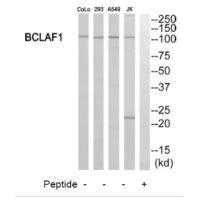
Synthesized peptide derived from internal of Human BCLAF1.
Immunogen Species
Homo sapiens (Human)
Purification Method
The antibody was affinity-purified from rabbit antiserum by affinity-chromatography using epitope-specific immunogen.
Concentration
It differs from different batches. Please contact us to confirm it.
Tested Applications
ELISA,WB
Storage
Upon receipt, store at -20°C or -80°C. Avoid repeated freeze.
Lead Time
Basically, we can dispatch the products out in 1-3 working days after receiving your orders. Delivery time maybe differs from different purchasing way or location, please kindly consult your local distributors for specific delivery time.
Note: All of our proteins are default shipped with normal blue ice packs, if you request to ship with dry ice, please communicate with us in advance and extra fees will be charged.
Usage
For Research Use Only. Not for use in diagnostic or therapeutic procedures.
Death-promoting transcriptional repressor. May be involved in cyclin-D1/CCND1 mRNA stability through the SNARP complex which associates with both the 3'end of the CCND1 gene and its mRNA.
Gene References into Functions
LTBR and BCLAF1 showed higher DNA methylation percentages in the marsupialized OKCs, but this difference did not affect gene expression (P > .05).PMID:28864293
Results indicate a role for the RNA processing factors THRAP3 and BCLAF1 in the regulation of the cellular DNA damage response (DDR) pathway.PMID:29112714
findings link treatment responsiveness to re-instatement of miR-194-5p/BCLAF1 balancePMID:28216661
SMYD3 physically interacts with the promoter of BCLAF1 and upregulates its expression by accumulating di- and trimethylation of H3K4 at the BCLAF1 locus. BCLAF1 depletion inhibits SMYD3-induced autophagy.PMID:26676636
The Bclaf1 can interact with the leucine zipper region of C/EBPbeta and cooperate with C/EBPbeta to upregulate IL-8.PMID:26794446
both cytoplasmic BCLAF1 expression and nuclear BCLAF1 expression are increased in post-neoadjuvant therapy rectal cancer, and that negative and weak nuclear BCLAF1 expression are independently associated with a poor prognosisPMID:26183150
SRSF10 is a key regulator of BCLAF1 pre-mRNA splicing and the maintenance of oncogenic features in human colon cancer cellsPMID:25091051
BTF has functions distinct from TRAP150 in regulating the subcellular distribution of mRNAs in human cells.PMID:23778535
BCLAF1 co-localized with gammaH2AX foci in nuclei and stabilized the Ku70/DNA-PKcs complex therein, facilitating non-homologous end joining (NHEJ)-based DSB repair in surviving cells.PMID:22833098
In the absence of BclAF1 neutralization, viral gene expression and replication are inhibited. These data identify two temporally and mechanistically distinct functions used by human cytomegalovirus to down-regulate a cellular antiviral proteinPMID:22645331
Sirt1 negatively regulates T cell activation via H3K56 deacetylation at the promoter region to inhibit transcription of Bclaf1PMID:21454709
Findings indicate a role for BCLAF1 in post-transcriptional processes that impact mRNA metabolism.PMID:20661537
Two-dimensional differential in-gel electrophoresis (2D-DIGE) revealed the differential expression of 51 proteins in response to C16-ceramide. Cell death-promoting factor Btf was found to be implicated in the apoptotic signal triggered by ceramide.PMID:19705920
These results suggest that Btf localization is regulated by apoptotic signals, and that loss of emerin binding to Btf may be relevant to muscle wasting in Emery-Dreifuss muscular dystrophy.PMID:15009215
These findings provide evidence that activation of TP53 gene transcription by PKCdelta triggers TP53-dependent apoptosis in response to DNA damage.PMID:17938203