Upon receipt, store at -20°C or -80°C. Avoid repeated freeze.
Lead Time
Basically, we can dispatch the products out in 1-3 working days after receiving your orders. Delivery time maybe differs from different purchasing way or location, please kindly consult your local distributors for specific delivery time.
Note: All of our proteins are default shipped with normal blue ice packs, if you request to ship with dry ice, please communicate with us in advance and extra fees will be charged.
Usage
For Research Use Only. Not for use in diagnostic or therapeutic procedures.
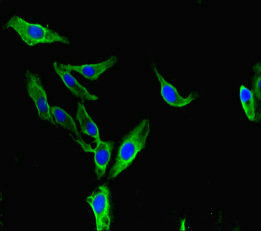
Immunofluorescent analysis of Hela cells using CSB-PA883428HA01HU at dilution of 1:100 and Alexa Fluor 488-congugated AffiniPure Goat Anti-Rabbit IgG(H+L)

Regulatory subunit of the ATP-dependent NoRC-1 and NoRC-5 ISWI chromatin remodeling complexes, which form ordered nucleosome arrays on chromatin and facilitate access to DNA during DNA-templated processes such as DNA replication, transcription, and repair. Both complexes regulate the spacing of nucleosomes along the chromatin and have the ability to slide mononucleosomes to the center of a DNA template. Directly stimulates the ATPase activity of SMARCA5 in the NoRC-5 ISWI chromatin remodeling complex. The NoRC-1 ISWI chromatin remodeling complex has a lower ATP hydrolysis rate than the NoRC-5 ISWI chromatin remodeling complex. Within the NoRC-5 ISWI chromatin remodeling complex, mediates silencing of a fraction of rDNA by recruiting histone-modifying enzymes and DNA methyltransferases, leading to heterochromatin formation and transcriptional silencing. In the complex, it plays a central role by being recruited to rDNA and by targeting chromatin modifying enzymes such as HDAC1, leading to repress RNA polymerase I transcription. Recruited to rDNA via its interaction with TTF1 and its ability to recognize and bind histone H4 acetylated on 'Lys-16' (H4K16ac), leading to deacetylation of H4K5ac, H4K8ac, H4K12ac but not H4K16ac. Specifically binds pRNAs, 150-250 nucleotide RNAs that are complementary in sequence to the rDNA promoter; pRNA-binding is required for heterochromatin formation and rDNA silencing.
Gene References into Functions
the results of the present study demonstrated that TIP5 regulates beta-catenin/TCF7L2 signaling via TIP5 during HCC progression and suggests that TIP5 may be a promising therapeutic target for the treatment of HCC.PMID:29620186
Data suggest that binding of helical tail of histone 3 (H3) with PHD ('plant homeodomain') fingers of BAZ2A or BAZ2B (bromodomain adjacent to zinc finger domain 2A or 2B) requires molecular recognition of secondary structure motifs within H3 tail and could represent an additional layer of regulation in epigenetic processes.PMID:28341809
Data show that SUMOylated BANP, E5R, and Nac1 (BEN) domain 3 (BEND3) stabilizes NoRC component TTF-1-interacting protein 5 (Tip5)via association with ubiquitin specific protease 21 (USP21) debiquitinasePMID:26100909
Crystal structures of PHD zinc finger and bromodomains from human TIP5 and BAZ2B in free form and bound to H3 and/or H4 histones.PMID:25533489
The study showed that the NMR structure of the TAM domain of TIP5 resembles the fold of the MBD domain, found in methyl-CpG binding proteins.PMID:25916849
association with ribosomal DNA is impaired in embryonic stem cells and occurs upon cell differentiationPMID:25479748
BAZ2A is overexpressed in prostate cancer, maintains its cell growth, regulates protein-coding genes, and interacts with EZH2 to silence genes repressed in metastasis. Its overexpression is associated with a CpG island methylator phenotype.PMID:25485837
High BAZ2A expression is associated with pancreatic cancer.PMID:25216700
Data show that MOF acetylates TIP5, the largest subunit of NoRC, at a single lysine residue, K633, adjacent to the TIP5 RNA-binding domain, and that SIRT1 (removes the acetyl group from K633.PMID:19578370
the apparent occurrence of an unusual TG 3' splice site in intron 1 is discussedPMID:17672918
Show
More
Hide
All
Subcellular Location
Nucleus, nucleolus.
Protein Families
WAL family
Tissue Specificity
Expressed at moderate levels in most tissues analyzed, including heart, brain, placenta, lung, skeletal muscle, kidney and pancreas.