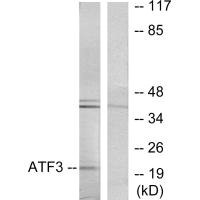
Synthesized peptide derived from internal of Human ATF3.
Immunogen Species
Homo sapiens (Human)
Purification Method
The antibody was affinity-purified from rabbit antiserum by affinity-chromatography using epitope-specific immunogen.
Concentration
It differs from different batches. Please contact us to confirm it.
Tested Applications
ELISA,WB
Storage
Upon receipt, store at -20°C or -80°C. Avoid repeated freeze.
Lead Time
Basically, we can dispatch the products out in 1-3 working days after receiving your orders. Delivery time maybe differs from different purchasing way or location, please kindly consult your local distributors for specific delivery time.
Note: All of our proteins are default shipped with normal blue ice packs, if you request to ship with dry ice, please communicate with us in advance and extra fees will be charged.
Usage
For Research Use Only. Not for use in diagnostic or therapeutic procedures.
This protein binds the cAMP response element (CRE) (consensus: 5'-GTGACGTActivates transcription presumably by sequestering inhibitory cofactors away from the promoters.
Gene References into Functions
Therefore, though ATF3 is activated downstream of the Wnt/beta-catenin pathway, it acts as a negative regulator of the migration and invasion of HCT116 human colon cancer cells exhibiting aberrant Wnt/beta-catenin activity. ATF3 is a candidate biomarker and target for human colorectal cancer treatment and prevention.PMID:29966001
Luciferase reporter assay identified a direct interaction of 3' UTRs of ATF3 and Runx2 with miR-590-3p in these cells. Overexpression of miR-590-3p also decreased proliferation and increased apoptosis of breast cancer cells.PMID:30076901
ATF3 mediates the inhibitory action of TNF-alpha on osteoblast differentiation and that the TNF-alpha-activated JNK pathway is responsible for the induction of Atf3 expression.PMID:29605296
these data indicated that ATF3 might promote intestinal epithelial cell apoptosis in Crohn's disease via up-regulating the stability and transcription activity of p53PMID:29716766
electrophilic properties of itaconate and derivatives regulate the IkappaBzeta-ATF3 inflammatory axis; results demonstrate that targeting the DI-IkappaBzeta regulatory axis could be an important new strategy for the treatment of IL-17-IkappaBzeta-mediated autoimmune diseasesPMID:29670287
High ATF3 expression is associated with breast cancer.PMID:29534690
ATF3 and EGR1 are involved in the beginning of inflammatory processes. Whether these two transcription factors act as tumour suppressors or promoters is context dependent and warrants analysis in further studiesPMID:28803237
ATF3 and PRAP1 play important roles in cisplatin-induced DNA damage repair process.PMID:29886035
Data show that amino acid limitation (amino acid response, AAR) activation of activating transcription factor 3 (ATF3) transcription is transient relative to activation by the unfolded protein response (UPR).PMID:29413899
In patients with NAFLD and/or T2D, a significant positive correlation was observed between hepatic ATF3 expression and surrogate markers of T2D, mitochondrial dysfunction, and macrophage infiltration.PMID:28365312
our results suggest that ATF3 promotes the invasion and proliferation of CRC cells, at least in part, via the regulation of CEACAM1-mediated EMT.PMID:28402947
ATF3 is involved in promoting particulate matter-induced pulmonary inflammation.PMID:29378244
Negative pressure wound therapy exerts an anti-inflammatory effect, possibly through the suppression of proinflammatory enzymes and cytokines resulting from Ik B-alpha inhibition and ATF-3 activation, which may prevent the activation of the NF-kappaB pathway in human diabetic foot wounds.PMID:27883358
ATF3 plays a significant role in regulating human endometrial receptivity and embryo attachment in vitro via up-regulation of leukemia inhibitory factor.PMID:28577574
Upregulation of ATF3 in lung cancer promotes cell proliferation, migration, and invasion, and may represent a novel therapeutic target for lung cancerPMID:28239957
ATF3 is a negative regulator of inflammation in human fetal membranes; in primary amnion cells, ATF3 expression is induced by IL-1beta and fsl-1, and ATF3 silencing further exacerbates the inflammatory response when stimulated with these factors. Subsequently, ATF3 expression is decreased in fetal membranes after term labour and with preterm chorioamnionitis, conditions closely associated with inflammation and infection.PMID:27780541
Altering TR4-ATF3 signaling increases the efficacy of cisplatin to suppress hepatocellular carcinoma growth/progression.PMID:27050071
ATF3 may be a potential early diagnostic biomarker for silicosis and ATF3 acts as a repressor in inflammatory responses induced by silicaPMID:29102675
The analysis showed higher urinary NGAL and urinary ATF3 in patients with sepsis-AKI in comparison with patients with sepsis-non-AKI and healthy volunteers.PMID:28061889
ATF3 mRNA and protein expression was significantly reduced in preterm Preeclamptic placentas. Therefore, reduced ATF3 may be centrally involved in the pathology of Preeclampsia.PMID:28947613
Data suggest that suppression of nonsense-mediated RNA decay due to persistent DNA damage (from exposure to either mutagens, gamma rays, or oxidative stress) requires the activity of p38alpha MAPK (MAPK14, mitogen-activated protein kinase 14, MAP kinase p38 alpha); mRNA of ATF3 (activating transcription factor 3) is stabilized by persistent DNA damage in a p38alpha MAPK-dependent manner.PMID:28765281
The microvascular injury phenotypes observed in vitro and in vivo were similar. ATF3 plays an important role in mediating brain microvascular responses to acute and chronic lipotoxic injury and may be an important preventative and therapeutic target for endothelial dysfunction in vascular cognitive impairment .PMID:27087439
we have identified ATF3 as an important regulator of cisplatin cytotoxicity and that ATF3 inducers in combination with platins are a potential novel therapeutic approach for NSCLC.PMID:27659012
reactivation of ATF3 is an important factor in determining sensitivity to pracinostat treatment, both in vitro and in vivo, and could serve as a potential biomarker of response and provide a rationale for therapeutic utility in HDACi-mediated treatments for bladder cancer.PMID:27196751
these findings support roles for both cFOS (indirect) and ATF3 (direct) in effecting MMP13 transcription in human chondrocytes.PMID:27956552
We functionally validated several elements for metformin-induced promoter and enhancer activity. These include an enhancer in an ataxia telangiectasia mutated (ATM) intron that has SNPs in linkage disequilibrium .Using ChIP-seq and siRNA knockdown, we further show that activating transcription factor 3 (ATF3), our top metformin upregulated AMPK-dependent gene, could have an important role in gluconeogenesis repression.PMID:27902686
ATF3 inhibition significantly increased the expression of proinflammatory cytokines interleukin 6 and interleukin 8 in cigarette smoke extract stimulated human bronchial epithelial cells.PMID:28185985
Ang II-induced upregulation of ATF3 and SUMO1 in vitro and in vivo was blocked by Ang II type I receptor antagonist olmesartan. Moreover, Ang II induced ATF3 SUMOylation at lysine 42, which is SUMO1 dependent.PMID:26850942
As a result, ATF3 rather protected the p53 wild-type cells from UV-induced apoptosis. Our results thus indicate that ATF3 regulates cell fates upon UV irradiation in a p53-dependent manner.PMID:26994140
CARMA1- and MyD88-dependent activation of Jun/ATF-type AP-1 complexes is a hallmark of ABC diffuse large B-cell lymphomas.PMID:26747248
Activating transcription factor 3 represses inflammatory responses by binding to the p65 subunit of NF-kappaBPMID:26412238
TGRL lipolysis products induce stress protein ATF3 via the TGF-beta receptor pathway, resulting in induction of apoptosis in aortic endothelial cellsPMID:26709509
ATF3 regulates canonical TGFbeta and Smad signaling and fibroblast activation in systemic sclerosis.PMID:25589515
ATF3 overexpression leads to an increase of collective cell invasion phenotype in Colorectal Cancer.PMID:26851004
Data suggest that after the expression of activating transcription factor 3 (ATF3) and microRNA miR-30c-2-3p elicited by lysophosphatidic acid, miR-30c-2-3p negatively regulates the expression of ATF3 through post-transcriptional silencing.PMID:26418018
Taken together, these results suggest that ATF3 promotes the progression of human gliomasPMID:25872784
DNA damage-triggered ATF3 controlled p53 accumulation and generation of double-strand breaks may serve as a switch between DNA damage and cell death following TOP2A inhibitor treatment.PMID:25521189
The stress-responsive gene ATF3 regulates the histone acetyltransferase Tip60 stability by promoting USP7-mediated deubiquitination of Tip60.PMID:25865756
ATF3 is inactive in healthy hepatic cells and activated following hepatitis C virus infection.PMID:25816118
The function of ATF3 is to block the reactivation of virus induced by neuronal stress.PMID:26305977
It compared the induction of ATF3 protein as measured by Western blot analysis with single-molecule localization microscopy dSTORM to quantify the dynamics of accumulation of intranuclear ATF3 of triglyceride-rich (TGRL) lipolysis product-treated HAEC.PMID:25189785
SUMO modification of ATF3 influences CCND1/2 activity and cellular proliferation of prostate cancer PC3 and DU145 cells and explains at least in part how ATF3 functions to regulate cancer development.PMID:23591848
Tissue array analysis suggests role for ATF3 in regulating the occurrence of glioma and disease progression.PMID:26051724
Human CHAC1 Protein Degrades Glutathione, and mRNA Induction Is Regulated by the Transcription Factors ATF4 and ATF3 and a Bipartite ATF/CRE Regulatory Element.PMID:25931127
these results suggest that there is a negative feedback expression of pre-mir-590 and its putative target gene, ATF-3 in human breast cancer cells.PMID:25150595
ATF3 is a downstream target of SRC and CaMKII signaling, and may be involved in adrenocortical aldosterone synthesis.PMID:25400120
Urotensin-II induces activating transcription factor 3 (ATF3) at both mRNA and protein levels.PMID:25268131
Suggest critical role for tumor suppressor ATF3 in esophageal squamous cell carcinoma progression.PMID:25149542
ATF-3 was associated with Runx2 promoter in MDA-MB231 cells.PMID:25380580