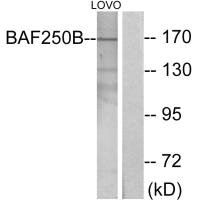
ARID1B antibody; BAF250B antibody; DAN15 antibody; KIAA1235 antibody; OSA2AT-rich interactive domain-containing protein 1B antibody; ARID domain-containing protein 1B antibody; BRG1-associated factor 250b antibody; BAF250B antibody; BRG1-binding protein hELD/OSA1 antibody; Osa homolog 2 antibody; hOsa2 antibody; p250R antibody
Raised in
Rabbit
Species Reactivity
Human,Rat
Immunogen
Synthesized peptide derived from interal of Human BAF250B.
Immunogen Species
Homo sapiens (Human)
Clonality
Polyclonal
Purification Method
The antibody was affinity-purified from rabbit antiserum by affinity-chromatography using epitope-specific immunogen.
Concentration
It differs from different batches. Please contact us to confirm it.
Form
Rabbit IgG in phosphate buffered saline (without Mg2+ and Ca2+), pH 7.4, 150mM NaCl, 0.02% sodium azide and 50% glycerol.
Note: We will preferentially ship the format that we have in stock, however, if you have any special requirement for the format, please remark your requirement when placing the order, we will prepare according to your demand.
Upon receipt, store at -20°C or -80°C. Avoid repeated freeze.
Lead Time
Basically, we can dispatch the products out in 1-3 working days after receiving your orders. Delivery time maybe differs from different purchasing way or location, please kindly consult your local distributors for specific delivery time.
Note: All of our proteins are default shipped with normal blue ice packs, if you request to ship with dry ice, please communicate with us in advance and extra fees will be charged.
Usage
For Research Use Only. Not for use in diagnostic or therapeutic procedures.
Involved in transcriptional activation and repression of select genes by chromatin remodeling (alteration of DNA-nucleosome topology). Component of SWI/SNF chromatin remodeling complexes that carry out key enzymatic activities, changing chromatin structure by altering DNA-histone contacts within a nucleosome in an ATP-dependent manner. Belongs to the neural progenitors-specific chromatin remodeling complex (npBAF complex) and the neuron-specific chromatin remodeling complex (nBAF complex). During neural development a switch from a stem/progenitor to a postmitotic chromatin remodeling mechanism occurs as neurons exit the cell cycle and become committed to their adult state. The transition from proliferating neural stem/progenitor cells to postmitotic neurons requires a switch in subunit composition of the npBAF and nBAF complexes. As neural progenitors exit mitosis and differentiate into neurons, npBAF complexes which contain ACTL6A/BAF53A and PHF10/BAF45A, are exchanged for homologous alternative ACTL6B/BAF53B and DPF1/BAF45B or DPF3/BAF45C subunits in neuron-specific complexes (nBAF). The npBAF complex is essential for the self-renewal/proliferative capacity of the multipotent neural stem cells. The nBAF complex along with CREST plays a role regulating the activity of genes essential for dendrite growth. Binds DNA non-specifically.
Gene References into Functions
We report on a 4-year-old male child who was found to be heterozygous for ARID1B de novo pathogenic NM_020732.3:c.3323_3324delAA; p.(Lys1108Argfs) mutation. The coding region (+/-5 bp) of the SWI/SNF complex genes showed a de novo heterozygous sequence change in the ARID1B gene: NM_020732.3:c.3323_3324delAA; p.(Lys1108Argfs). The variant was confirmed by Sanger sequencing and was not detected in the parental samples.PMID:29864107
the correlation between the loss of ARID1A immunoreactivity and reduced ARID1B levels indicates that ARID1B could be an attractive target for anti-cancer therapy.PMID:29890703
findings establish mutations in ARID1B as the underlying genetic defect in the HHID syndrome in two of three patients.PMID:28323383
The authors find that ARID1A has a dominant role in maintaining chromatin accessibility at enhancers, while the contribution of ARID1B is evident only in the context of ARID1A mutation.PMID:28967863
we identified a subgroup of neuroblastoma with ARID1B mutation shows an aggressive behavior. These findings may provide a new biomarker to identify another subgroup of neuroblastoma with high-risk features.PMID:28521285
these results highlighted the significant genetic contribution of the ARID1B variant, rs73013281, to susceptibility for HCC, especially in interaction with physical activity.PMID:28415691
we identified concurrent ARID1A and ARID1B inactivating mutations with consequent loss of protein expression in the undifferentiated component of approximately one-quarter of dedifferentiated endometrial and ovarian carcinomasPMID:27562491
Of the 34 undifferentiated endometrial carcinomas examined, 17 (50%) exhibited SWI/SNF complex inactivation, with 11 tumors showing complete loss of both ARID1A and ARID1B, 5 showing complete loss of BRG1 and 1 showing complete loss of INI1. Ten of the remaining 17 undifferentiated carcinomas showed the following alterations: 5 tumors (15%) showed loss of ARID1A only with intact ARID1B, BRG1, and INI1 expression.PMID:28863077
We report here the clinical, genetic, and proteomic phenotypes of an individual with a unique apparent de novo mutation of ARID1B due to an intragenic duplicationPMID:28691782
HSCR was observed in a patient with a truncating mutation in ARID1B, further expanding the phenotypic spectrum of Coffin-Siris syndrome. This suggests that the BAF complex does not only play a role in the enteric system of Drosophila, but also in humans.PMID:27511161
Case Report: Melanotic Xp11 renal cell carcinoma with ARID1B-TFE3 gene fusion.PMID:28877054
The clinical features of both patients are felt to be consistent with an ARID1B-related disorder. To our knowledge, this is the first report of a pathogenic mutation in ARID1B being passed from an affected parent to their offspring.PMID:27570168
We report two teenagers with ID whose molecular diagnosis of a SMARC2A or ARID1B mutation, respectively, was established through clinical exome analysis.PMID:27112773
The ARID1B gene, commonly mutated in multiple types of cancer, was identified as an additional ZNF384 gene fusion partner.PMID:27392123
knockdown of the SWI/SNF component ARID1B prevents OIS and cooperates with RAS to induce liver tumorsPMID:27737960
Chromosome analysis by array-CGH revealed a small interstitial 6q deletion spanning approximately 1.1 Mb of DNA and containing only one coding gene, ARID1B. We suggest that ARID1B is the key gene behind 6q microdeletion syndrome, and we discuss its possible role in the phenotypic manifestationsPMID:26754677
Gonadal mosaicism in ARID1B gene causes intellectual disability and dysmorphic features in three siblings.PMID:26395437
ARID1B potentially serves as a valuable prognostic and predictive biomarker as well as a therapeutic target in breast cancer.PMID:25817822
This study demonstrate that ARID1B is required for neuronal differentiation in the developing brain, such as in dendritic arborization and synapse formation.PMID:26937011
De novo mutations in ARID1B associated with both syndromic and non-syndromic short staturePMID:26376624
Results show the crystal structure and binding site of SWI1 protein and identify loop L1 and L2 regions of SWI1 ARID likely play key roles in ARID-DNA interactions.PMID:26223912
ARID1B role in genome-wide transcriptional regulation by SWI/SNF complexes.PMID:26716708
This study provide the evidence ARID1B mutation releate to Autism Spectrum Disorder.PMID:26637798
BAF complex gene ARID1B is mutated in Coffin-Siris syndrome patients.PMID:25081545
Phenotype of Coffin-Siris syndrome patients with ARID1B mutationsPMID:25169814
The most prominent and consistent clinical findings in patients with ARID1B haploinsufficiency are developmental delay, speech impairment and intellectual disability.PMID:25250687
SMARCB1, SMARCA4, or ARID1B were mutated in 20 out of 49 Coffin-Siris syndrome patients.PMID:23815551
Mutations in ARID1B gene is associated with microsatellite unstable colorectal cancer.PMID:24382590
The BAF complex, including both ARID1A and ARID1B, contributes to DNA repair and cellular resistance to ionizing radiation and cisplatin.PMID:24788099
Loss of ARID1B gene is associated with Waldenstrom macroglobulinemia.PMID:24366360
loss of ARID1A and ARID1B alleles cooperatively promotes cancer formation but also results in a unique functional dependencePMID:24562383
associations revealed between genetic polymorphisms located in the flanking region of the ARID1B genes and hypoesthesiaPMID:23834954
A possible tumour-suppressor function for ARID1B in pancreatic cancer.PMID:23660946
ARID1B is important in human brain development and function in general, and in the development of CC and in speech development in particular.PMID:21801163
Identification of recurrent somatic mutations in the chromatin-remodeling gene ARID1B in the childhood cancer neuroblastoma.PMID:23202128
Haploinsufficiency of ARID1B, a member of the SWI/SNF-A chromatin-remodeling complex, is a common cause of ID.PMID:22405089
these results indicate that haploinsufficiency of the ARID1B gene, which encodes an epigenetic modifier of chromatin structure, is an important cause of CSS and is potentially a common cause of intellectual disability and speech impairment.PMID:22426309
For a number of genes affected by de novo copy number variants CNVs in autism (CNTNAP2, ZNF214, ARID1B, Proline Dehydrogenase), reduced transcript expression may be a mechanism of pathogenesis during neurodevelopment.PMID:21448237
Cloning and characterization of hELD/OSA1, a novel BRG1 interacting protein.PMID:11988099
6A3-5 expression is associated with alpha-smooth muscle cell actin in mesangial cells, arteriolar smooth muscle cells, and interstitial myofibroblasts.could potentially be a novel early vascular marker of acute and chronic renal ischemic stressPMID:14633620
Analysis of DNA-binding behaviour indicates that ARID1B binds DNA in a non-sequence-specific manner similar to ARID1APMID:15170388
The chromatin remodeling factor ARID1B had a very similar pattern of expression with an incremental increase in HPFH and decreased expression in deltabeta-thalassemia.PMID:16952470
A subset of mammalian SWI/SNF complexes, specifically including the ARID1B subunit, is required for efficient cell cycle re-entry and for the association of activating factors with the c-myc promoter.PMID:17255939
Show
More
Hide
All
Subcellular Location
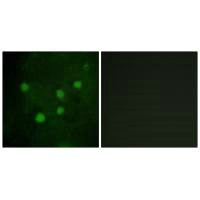
Nucleus.
Tissue Specificity
Widely expressed with high levels in heart, skeletal muscle and kidney.