It differs from different batches. Please contact us to confirm it.
Buffer
-20°C, pH7.4 PBS, 0.05% NaN3, 40% Glycerol
Tested Applications
ELISA,IHC
Storage
Upon receipt, store at -20°C or -80°C. Avoid repeated freeze.
Lead Time
Basically, we can dispatch the products out in 1-3 working days after receiving your orders. Delivery time maybe differs from different purchasing way or location, please kindly consult your local distributors for specific delivery time.
Note: All of our proteins are default shipped with normal blue ice packs, if you request to ship with dry ice, please communicate with us in advance and extra fees will be charged.
Usage
For Research Use Only. Not for use in diagnostic or therapeutic procedures.
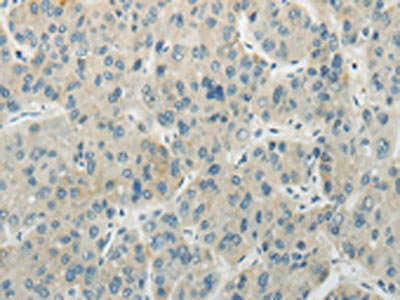
The image on the left is immunohistochemistry of paraffin-embedded Human liver cancer tissue using CSB-PA212701(AICDA Antibody) at dilution 1/35, on the right is treated with synthetic peptide. (Original magnification: ×200)
this study reports the clinical and AID genetic features of six Iranian hyper IgM syndrome patientsPMID:30081731
induction of AID expression would result in chromosomal translocations in the process of differentiation from B cell derived induced pluripotent stem cells.PMID:28490810
The distribution of AID and A3s in the epithelial cells as well as germinal centres.PMID:29343743
patients with AS expressed significantly higher levels of sv2 than HC. TNFi treatment restored the gene expression of the AID variants (FL, sv1, and sv2) in patients with AS. Therefore pre-existing TNFalpha-induced AID expression in B cells may play a role in the pathogenesis of AS.PMID:28959900
we reported high AID, low miR-181b and high miR-155 expression in de novo adult B-ALL patients. Univariate high AID or low miR-181b expression was an unfavorable prognostic factor. High AID with low miR-181b or with low miR-155 expression is better in predicting unfavorable OS than univariate factor. High AID with low miR-181b and low miR-155 expression confers worst prognosis.PMID:28140712
AID expression was increased in chronic lymphocytic leukemia patients with del17p or del11q who have poor prognosis.PMID:28388279
Results indicate activation-induced cytidine deaminase (AICDA) as a driver of epigenetic heterogeneity in B-cell lymphomas with potential significance for other tumors with aberrant expression of cytidine deaminases.PMID:29335468
The binding and catalytic behavior of purified AID was tested on DNA/RNA hybrid substrates bearing either random sequences or GC-rich sequences simulating Ig S regions. AID exhibited a higher affinity for binding DNA/RNA hybrid substrates made of S region sequences, than any other DNA substrates. In the absence of any other cellular processes or factors, AID itself favors binding and mutating S-region DNA/RNA hybrids.PMID:29161581
Expression of human AID or increased oxidative stress induces DNA breaks within human chromosomal translocation fragile zones.PMID:29220655
Data implicate intrinsic preference of AID for structured substrates and uncover the importance of G4 recognition and oligomerization of AID in class switch recombination.PMID:28757211
the His130Pro mutation allows the enzyme to retain its mutagenic activity and would prevent the interaction of AID with specific cofactors required for class switch recombination but not for somatic hypermutation. Thus, there would be no contradiction between maintaining the catalytic and mutagenic activity of AID and the presence of function defects at the genomic level.PMID:27716525
The authors found that the viral epsilon RNA and C-terminus of AID are required for AID-mediated hepatitis B virus RNA reduction.PMID:28779685
silencing of AID in human bone marrow cells skews differentiation toward myelomonocytic lineage. However, in contrast to Tet2 loss, Aid loss does not contribute to enhanced HSC self-renewal or cooperate with Flt3-ITD to induce myeloid transformation. Genome-wide transcription and differential methylation analysis uncover the critical role of Aid as a key epigenetic regulatorPMID:28077417
AID protein is expressed in a large proportion of Philadelphia chromosome-positive B-cell acute lymphoblastic leukemia cases at levels detectable by immunohistochemistry.PMID:26980048
These data, showing the direct targeting and induction of functional AID by EBNA3C, suggest a novel role for EBV in the etiology of B cell cancers, including endemic Burkitt lymphomaPMID:27217538
These findings indicated that TNF-alpha-induced AID expression is involved with class switch recombination in cancer.PMID:25849121
Structural analysis of AID protein required in immunoglobulin diversification has been reported.PMID:27258794
this study reports a case of growth hormone deficiency with an autosomal recessive Hyper-immunoglobulin M syndrome by phenotype and genotype, with a novel mutation in AICDA that has not been reported formerlyPMID:27789066
We also report that AID activity results in epigenetic, genetic and genomic damage in fallopian tube epithelial cellsPMID:26936395
AICDA/APOBEC family of cytidine deaminases is significant in innate immunity, as it restricts numerous viruses, including HBV, through hypermutationdependent and independent mechanisms. (Review)PMID:26398702
DNA methylation dynamics of germinal center B cells are mediated by AID.PMID:26365193
Mutations in activation-induced cytidine deaminase is associated with indolent chronic lymphocytic leukaemia.PMID:26638776
Data suggest novel mechanism in innate immunity allows cytokine TGF-beta to restrict viral circular DNA in hepatocyte nuclei via innate immunity; AID deaminates circular DNA of hepatitis B virus leading to DNA degradation; mechanism depends on UNG.PMID:26867650
The high levels of memory and activated B cells and follicular helper T cells were positively associated with the progression of immunoglobulin A nephropathy. This may be mediated by the overexpression of AID, which is potentially regulated by IL21.PMID:26166388
identify AID derivatives that accelerate somatic hypermutation with minimal impact on viability, which will be useful tools for engineering genes and proteins by iterative mutagenesis and selectionPMID:26355458
High expression of activation-induced cytidine deaminase is associated with diffuse large B cell lymphoma.PMID:26077666
AID mutations leading to AID deficiency are the most frequent underlying molecular basis of hyper IgM syndrome in consanguineous Tunisian patients.PMID:26545377
Studies indicate that gene conversion mediated by activation-induced cytidine deaminase (AID) has been found to contribute to generation of the primary antibody repertoire.PMID:26537386
aberrant expression of AID may reflect continuous B cell activation and sustained survival signals in HCV-related CV patients.PMID:26219420
Surges in ERK activity induced by extracellular cues enhance Arp2/3-mediated actin polymerization to generate protrusion power phases sufficient to promote sustained cell motility.PMID:25990957
Data show that microRNAs miR-155 and miR-16 downregulate activation-induced cytidine deaminase (AID) and transcription factor E47 in B Cells through binding of the 3'-untranslated regions.PMID:26223652
Data indicate that both the amount and intensity of the activation-induced cytidine deaminase (AID) protein expression increased with the progression from precancerous to cancerous lesions in pancreatic ductal adenocarcinoma (PDAC) tissues.PMID:26113087
B cells hijack to supply ssDNA substrates for AID to mutate at immunoglobulin V regions during somatic hypermutation.PMID:24923561
HSP90 inhibitors indirectly target AID in vivoPMID:25912253
findings suggest that AID has a role in the development of oral epithelial dysplasia and promotes progression of oral cancerPMID:24351917
hnRNP K and hnRNP L may serve as A1CF-like cofactors in AID-mediated class switch recombination and somatic hypermutationPMID:25902538
Activation-induced cytidine deaminase (AID)-induced mutagenic U:G mismatches in DNA may be a fundamental and common cause of mutations in B-cell malignancies.PMID:25486549
In yeast, AID and the catalytic domain of APOBEC3G preferentially mutate transcriptionally active genes within narrow regions, 110 base pairs in width, fixed at RNA polymerase initiation sites.PMID:25237741
There was no significant association between the previously reported genetic variant of AICDA gene and the development of Common variable immunodeficiency or selective IgA deficiencyPMID:23731676
demonstrates that intensity of malaria transmission correlates with AID expression levels in the presence of Epstein-Barr virusPMID:25099163
Study reports that the majority of detectable AID off-target activity in a variety of mouse and human lymphoid or nonlymphoid cell types occurs within focal regions of overlapping sense/antisense transcription within intragenic super enhancers.PMID:25483776
AID activity and its relationship to chromosome folding and the B cell regulome was studied; find that AID-mediated lesions occur predominantly within B cell super-enhancers and regulatory clusters; further show that the structural and transcriptional features of these domains help explain AID tumorigenic activity in the B cell compartment of mice and humans.PMID:25483777
data demonstrate that AID is active in CLL in vivo and thus, AID likely contributes to clonal evolution of CLL.PMID:25179679
analysis of a possible association between AID expression and BRAF mutation in melanomaPMID:24684646
Results show that both AID mRNA levels and DNA-cytosine deamination activities follow the same general pattern of increase and decline after stimulation in the two genetic backgrounds.PMID:25154417
DNA repair pathways which are in vitro activated by AID-induced lesions are reminiscent of those found during AID-induced in vivo immunoglobulin diversification.PMID:24349193
Results show that activation induced cytidine deaminase (AID) expression may be associated with deletions in patients with chronic lymphocytic leukemia (CLL).PMID:23662991
AID lacking the C terminus is impaired in its ability to recruit nonhomologous end joining repair factors, resulting in accumulation of double-strand breaks that undergo aberrant resection.PMID:24973444
findings reveal additional functions for AID in innate immune defense against KSHV with implications for a broader involvement in innate immunity to other pathogens.PMID:24244169