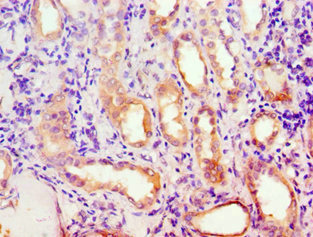
ACAD 1 antibody; ACAD1 antibody; Acadm antibody; ACADM_HUMAN antibody; Acyl coenzyme A dehydrogenase antibody; Acyl coenzyme A dehydrogenase C 4 to C 12 straight chain antibody; FLJ18227 antibody; FLJ93013 antibody; FLJ99884 antibody; MCAD antibody; MCADH antibody; Medium chain acyl CoA dehydrogenase antibody; Medium chain fatty acyl CoA dehydrogenase antibody; Medium chain specific acyl CoA dehydrogenase antibody; Medium chain specific acyl CoA dehydrogenase mitochondrial antibody; Medium-chain specific acyl-CoA dehydrogenase antibody; mitochondrial antibody
Raised in
Rabbit
Species Reactivity
Human
Immunogen
Recombinant Human Medium-chain specific acyl-CoA dehydrogenase, mitochondrial protein (26-421AA)
Immunogen Species
Homo sapiens (Human)
Conjugate
Non-conjugated
Isotype
IgG
Purification Method
Antigen Affinity Purified
Concentration
It differs from different batches. Please contact us to confirm it.
Buffer
PBS with 0.02% sodium azide, 50% glycerol, pH7.3.
Tested Applications
ELISA, IHC
Recommended Dilution
Application
Recommended Dilution
IHC
1:20-1:200
Storage
Upon receipt, store at -20°C or -80°C. Avoid repeated freeze.
Lead Time
Basically, we can dispatch the products out in 1-3 working days after receiving your orders. Delivery time maybe differs from different purchasing way or location, please kindly consult your local distributors for specific delivery time.
Note: All of our proteins are default shipped with normal blue ice packs, if you request to ship with dry ice, please communicate with us in advance and extra fees will be charged.
Usage
For Research Use Only. Not for use in diagnostic or therapeutic procedures.
Medium-chain specific acyl-CoA dehydrogenase is one of the acyl-CoA dehydrogenases that catalyze the first step of mitochondrial fatty acid beta-oxidation, an aerobic process breaking down fatty acids into acetyl-CoA and allowing the production of energy from fats. The first step of fatty acid beta-oxidation consists in the removal of one hydrogen from C-2 and C-3 of the straight-chain fatty acyl-CoA thioester, resulting in the formation of trans-2-enoyl-CoA. Electron transfer flavoprotein (ETF) is the electron acceptor that transfers electrons to the main mitochondrial respiratory chain via ETF-ubiquinone oxidoreductase (ETF dehydrogenase). Among the different mitochondrial acyl-CoA dehydrogenases, medium-chain specific acyl-CoA dehydrogenase acts specifically on acyl-CoAs with saturated 6 to 12 carbons long primary chains.
Gene References into Functions
Our study has revealed the unique genetic backgrounds of MCAD deficiency among Japanese, based on the largest series of non-Caucasian cases.PMID:27856190
17 VUS (37%; 7 in ACADM, 9 in GALT, and 1 in PAH) were reclassified from uncertain (6 to benign or likely benign and 11 to pathogenic or likely pathogenic). We identified common types of missing information that would have helped make a definitive classification and categorized this information by ease and cost to obtainPMID:27308838
Subjects with neonatal symptoms, or neonatal abnormal labs, or neonatal triggers were more likely to have at least one copy of the severe c.985A>G ACADM gene mutationPMID:27477829
Exclusively breastfed neonates with MCAD are at risk for early metabolic decompensation. As breastfeeding rates increase, close management of feeding difficulties is essential for all neonates awaiting newborn screening resultsPMID:27148938
The in silico structural changes in medium-chain acyl-CoA dehydrogenase (hMCAD) p.K329E variant protein affect the disturbed oligomeric profile, thermal stability, and conformational flexibility, with respect to the wild-type.PMID:27976856
LCHAD and MCAD are differentially expressed in maternal and fetal tissues during normal late pregnancy, which may represent a metabolic adaptation in response to physiological maternal dyslipidemia during late pregnancy.PMID:27871288
Study determined three mutations (p.R53C, p.R281S and p.G362E) in MCAD protein predisposing for MCAD deficiency which seems to be unique to Japanese population.PMID:26947917
our study demonstrates that not all mutations identified in children with abnormal NBS profiles suggestive of MCAD deficiency result in a total loss in MCAD activity and functionPMID:24966162
The c.600-18G > A variant activates a cryptic splice site, which competes with the natural splice site.PMID:26223887
mutations in the ACADM gene lower the temperature threshold at which medium-chain acyl-CoA dehydrogenase deficiency loss-of-function occurs.PMID:24718418
Segregation studies in the Gypsy families showed that 93/123 relatives were carriers of the acyl-coenzyme A dehydrogenase G985 allele, suggesting its high prevalence in this ethnic group.PMID:23829193
Identify an ACADM founder mutation for MCADD in Saudi Arabian population.PMID:20567907
This supports that c.1161A>G is a functional SNP, which leads to higher MCAD expression, perhaps due to improved splicing. This study is a proof of principle that synonymous SNPs are not neutral.PMID:23810226
medium chain acyl-CoA dehydrogenase involve in the metabolism of phenylbutyrate.PMID:23141465
Subjects with variant ACADM genotypes and residual MCAD enzyme activities <10% should be considered to have the same risks as patients with classical ACADM genotypesPMID:22630369
The octanoyl-CoA oxidation rate, therefore, allows a risk assessment at birth and the identification of new ACADM genotypes associated with asymptomatic disease variants.PMID:23028790
A novel variant in the Medium-Chain Acyl-CoA Dehydrogenase (MCAD) gene was identified in a Greek cohort of neonates with suspected MCAD deficiency.PMID:22683754
physiological concentrations of flavin adenine dinucleotide resulted in a spectacular enhancement of the thermal stabilities of MCADH and prevented enzymatic activity lossPMID:21968293
The mutation in Medium-chain acyl-CoA dehydrogenase deficiency is the first report of the c.461T>G mutation in the acyl-CoA dehydrogenase gene.PMID:21239873
classification of genotypes with at least one variant of unknown significance in individuals who are carriers of, or affected with, MCAD deficiency of the following genotypes: c.985A>G/wildtype, c.199T>C/c.985A>G and c.985A>G/c.985A>GPMID:20434380
MCAD is induced by PGC-1 in an ERRalpha-dependent mannerPMID:12522104
Interference between PPARA and ERRalpha and RXRA complex heterodimer and the nuclear receptor site of MCADPMID:12914524
single arginine residue is essential for the binding of electron transferring flavoprotein to MCAD, but the single histidine residue, although involved, is notPMID:14692513
first molecular identification of MCADD in an Arab patient and the first reported splice mutation in the MCAD gene that has been functionally characterizedPMID:15171999
Two novel rare mutations, R256T and K364R, have been investigated to assess how far the biochemical properties of the mutant proteins correlate with the clinical phenotype of medium chain acyl-CoA dehydrogenase deficiency.PMID:16128823
analysis of MCAD deficiency (homozygous at c.985A>G (K329E)) complicated by acute liver failure in pregnancy [case report]PMID:17186412
Measurement of MCAD activity in leukocytes or lymphocytes using phenylpropionyl-CoA as a substrate can be regarded as the gold standard to diagnose MCAD deficiency upon initial positive screening test results.PMID:18188679
Six novel and seven previously reported medium chain acyl-CoA dehydrogenase mutations were detected in newborns with medium chain acyl-CoA dehydrogenase deficiency.PMID:18241067
Ethnic-specific homozygous adenin/guanine substitution in an ACADM birth prevalence from a large-scale United Kingdom newborn screening study.PMID:18927092
study indicates that c.449-452delCTGA represents a common mutation in Japanese patients with medium-chain acyl-CoA dehydrogenase deficiency (MCADD)PMID:19064330
Protein misfolding of MCAD protein is the molecular basis in medium-chain acyl-CoA dehydrogenase deficiency.PMID:19224950
In the medium-chain acyl-CoA dehydrogenase, the 985G mutant and 985A normal alleles had allelic frequencies of 0.0020 and 0.9980, respectively.PMID:19551636
Meta-analysis and HuGE review of genotype prevalence, gene-disease association, gene-gene interaction, and healthcare-related. (HuGE Navigator)PMID:11263545