Recombinant Mouse Prolactin receptor (Prlr), partial (Active)

In Stock
Code: CSB-MP018727MO
Size:
20ug
20ug100ug1mg
US$190
Quantity:
Express system: Mammalian cell
Species: Mus musculus (Mouse)
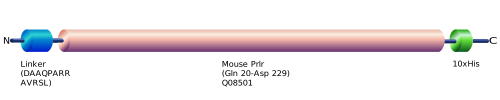
Tag Info: C-terminal 10xHis-tagged
For inquiries on large quantities or another requirements
Send an Inquiry
Start an on-line Chat
Online ordering is currently available for U.S. customers only. For orders outside the U.S., please kindly submit an inquiry or start a chat with us.

Product Details

Abbreviation
Recombinant Mouse Prlr protein, partial (Active)
Purity
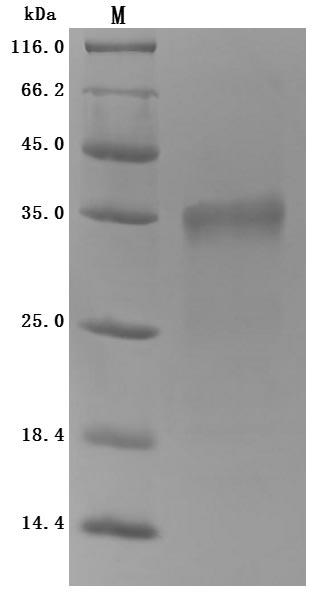
Greater than 95% as determined by SDS-PAGE.
Endotoxin
Less than 1.0 EU/ug as determined by LAL method.
Activity
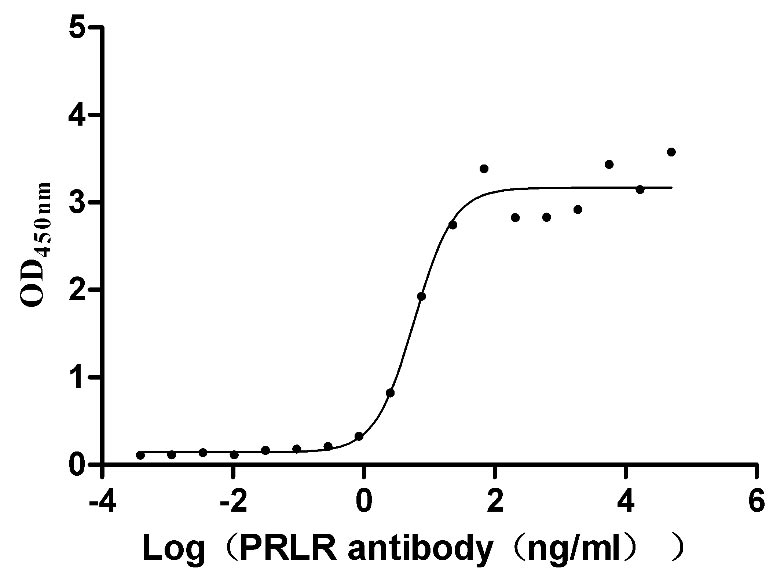
Measured by its binding ability in a functional ELISA. Immobilized Mouse Prlr at 5 μg/mL can bind Anti-PRLR recombinant antibody (CSB-RA018727A0HU), the EC50 is 4.021-8.706 ng/mL.
Target Names
Prlr
Uniprot NO.
Alternative Names
(PRL-R)
Molecular Characterization
Species
Mus musculus (Mouse)
Source
Mammalian cell
Expression Region
20-229aa
Target Protein Sequence
QSPPGKPEIHKCRSPDKETFTCWWNPGSDGGLPTNYSLTYSKEGEKNTYECPDYKTSGPNSCFFSKQYTSIWKIYIITVNATNEMGSSTSDPLYVDVTYIVEPEPPRNLTLEVKQLKDKKTYLWVKWLPPTITDVKTGWFTMEYEIRLKSEEADEWEIHFTGHQTQFKVFDLYPGQKYLVQTRCKPDHGYWSRWGQEKSIEIPNDFTLKD
Note: The complete sequence may include tag sequence, target protein sequence, linker sequence and extra sequence that is translated with the protein sequence for the purpose(s) of secretion, stability, solubility, etc.
If the exact amino acid sequence of this recombinant protein is critical to your application, please explicitly request the full and complete sequence of this protein before ordering.
Mol. Weight
27.3 kDa
Protein Length
Partial
Tag Info
C-terminal 10xHis-tagged
The tag type will be determined during production process. If you have specified tag type, please tell us and we will develop the specified tag preferentially.
Buffer
Lyophilized from a 0.2 μm filtered 20 mM Tris-HCl, 0.5 M NaCl, 6% Trehalose, pH 8
Storage
Store at -20°C/-81°C upon receipt, aliquoting is necessary for mutiple use. Avoid repeated freeze-thaw cycles.
Lead Time
Basically, we can dispatch the products out in 3-7 working days after receiving your orders. Delivery time may differ from different purchasing way or location, please kindly consult your local distributors for specific delivery time.
Note: All of our proteins are default shipped with normal blue ice packs, if you request to ship with dry ice, please communicate with us in advance and extra fees will be charged.
Notes
Repeated freezing and thawing is not recommended. Store working aliquots at 4°C for up to one week.
Shelf Life
The shelf life is related to many factors, storage state, storage temperature and the stability of the product itself. Generally, the shelf life of lyophilized form is 6 months at -20°C/-80°C from the date of receipt.
Troubleshooting and FAQs
Datasheet & COA
Please contact us to get it.
Images
  • (Tris-Glycine gel) Discontinuous SDS-PAGE (reduced) with 5% enrichment gel and 15% separation gel.
  • Activity
    Measured by its binding ability in a functional ELISA. Immobilized Mouse Prlr at 5 μg/ml can bind Anti-PRLR recombinant antibody (CSB-RA018727A0HU), the EC50 is 4.021-8.706 ng/mL.
Description

The extracellular ligand-binding domain of mouse prolactin receptor (aa 20–229) provides the critical region for prolactin engagement, making this construct particularly suited for ligand-binding interaction assays, competitive inhibition studies, and blocking antibody screening. Functional ELISA validation confirms robust binding activity, with immobilized Prlr at 5 μg/mL engaging an anti-PRLR recombinant antibody at an EC50 of 4.021–8.706 ng/mL, supporting its use as a reliable positive control in binding assays or as a target for therapeutic antibody epitope mapping. Mammalian cell expression preserves native glycosylation and conformational integrity of the extracellular domain, which aligns with standards expected in SPR- and BLI-based affinity characterization where proper folding directly impacts kinetic measurements. This C-terminal 10×His-tagged protein meets the quality thresholds commonly required for drug discovery screening workflows, with purity exceeding 95% by SDS-PAGE and endotoxin levels below 1.0 EU/μg by LAL.


Customer Reviews and Q&A

 Customer Reviews

Target Background

Function(From Uniprot)
This is a receptor for the anterior pituitary hormone prolactin.
Gene References into Functions
  1. Study shows prolactin receptors in Rip-cre cells, but not in AgRP neurones, are involved in energy homeostasis. Results indicate that Rip-Cre neurones in the arcuate nucleus are responsive to prolactin and may play a role in the orexigenic effects of prolactin, whereas prolactin does not directly affect Agrp neurones. PMID:28378505
  2. The estrogen-responsive pituitary hormone prolactin (PRL), through specific PRL receptor (PRLR), down-regulates hepatic triglyceride (TG) accumulation. PMID:29524401
  3. Truncating mutations of Prlr promote tumor growth in a model of human ERalpha+ breast cancer. PMID:27681435
  4. This study demonstrated that there are at least two functional subpopulations of dopamine neurons in the arcuate nucleus, with approximately 50% of these neurons expressing GABA. PMID:27581458
  5. Of the four placenta-specific, Prl-related hormones that have been shown to interact with the Prlr, their gene expression localizes to different endocrine cell types PMID:26269505
  6. Prolactin receptor was upregulated in proximal kidney tubule cells of mice with cardiac disease. PMID:23712540
  7. This study showed in knockout mice showed no effect of PRL and PRL-R gene ablation on heat and cold hyperalgesia in male mice, while heat hyperlgesia were reduced 3-72 h post-surgery in female PRL and PRL-R knockout mice PMID:23994182
  8. The in utero environment of the Prlr(+/-) mother confers long-term changes in the pancreatic islets of her offspring such that when the offspring themselves became pregnant, they cannot adapt to the increased insulin demands of their own pregnancy. PMID:23247113
  9. results provide direct genetic evidence that PRLR affects energy balance and metabolic adaptation in rodents via effects on brown adipose tissue differentiation and function PMID:22637534
  10. Germline knockout of prolactin or its receptor has failed to reveal a key role for prolactin signaling in mouse prostate physiology. PMID:21971318
  11. Data suggest that PRL stimulates the Prlr gene expression through the transcriptional activation of mE1(4) first exon, leading to increases in the long- and short-form variants of Prlr mRNA in the murine choroid plexus. PMID:22294444
  12. deactivation of MAPK by PRL/PRL-RS contributes to the severe ovarian defect in PRLR(-/-)RS mice and demonstrate the novel association of PRL-RS with DUPD1 and a role for this phosphatase in MAPK deactivation PMID:21199871
  13. Suggest that replacement of estrogen and progestin may not increase the mRNA of endometrial PRL receptor in metoclopromide-induced hyperprolactinemia in rats after castration. PMID:19304288
  14. Results provide a detailed mapping of the prolactin-responsive neurons in the female mouse forebrain by describing the distribution of prolactin receptor mRNA. PMID:19882722
  15. Pancreatic islets of PRLR-deficient mice were smaller, insulin mRNA levels were lower, glucose levels after an ip glucose load were higher PMID:11897695
  16. developmental defect of PrlR(-/-) mammary epithelium is rescued by an exogenously expressed chimeric receptor (prl-EpoR) containing the PrlR extracellular domain joined to the EpoR transmembrane and intracellular domains PMID:12381781
  17. results suggest that growth hormone can improve mammary development in prolactin receptor(+/-) mice, but that it fails to enhance metabolic activity PMID:12399427
  18. data suggest that CCAAT enhancer binding protein-beta is a master regulator of mammary epithelial cell fate and correct spatial pattern of progesterone receptor and prolactin receptor expression is critical for hormone-regulated cell proliferati PMID:12456789
  19. PR-1, the short form of the PRLR, can improve mammary development in PRLR+/- mice. This effect is probably caused by accelerated proliferation and an activation of the PRLR signaling cascade. PMID:12624115
  20. This protein and its substrates, expressed in murine hair follicle epithelium, show hair cycle-dependent expression, and induce catagen. PMID:12707045
  21. function of the SPRLR and a local and targeted effect of PRL on the mammary gland that are essential for its function, but not for its development. PMID:12746331
  22. results demonstrate that prostaglandin F2alpha inhibits the expression of the prolactin receptor PMID:12865306
  23. the absence of prolactin receptor signaling is not detrimental to male testicular function and to fertility in the mouse. PMID:12933648
  24. the expression of a constitutively active PRL-R by transgenesis induces a premature and abnormal mammary development and impairs terminal differentiation and milk production at the end of pregnancy. PMID:14613905
  25. These findings suggest a complex tissue-specific regulation of prolactin receptor expression in the context of the acute-phase response PMID:15186999
  26. different isoforms of prolactin receptors may be present in the various stages of mouse preimplantation embryo and may play an important role in the control of its growth and development PMID:15820039
  27. Cathepsin D secreted from various tissues is able to process PRL into 16K PRL outside the cell. PMID:16959874
  28. Report is the first in vivo demonstration that the action of pregnancy hormones, acting through Prlr, is required for normal maternal glucose tolerance during pregnancy by increasing beta-cell mass. PMID:19036882
  29. Prolactin independent rescue of mouse corpus luteum life span. PMID:19531635

Show More

Hide All

Subcellular Location
Membrane; Single-pass type I membrane protein.
Protein Families
Type I cytokine receptor family, Type 1 subfamily
Database Links
icon of phone
Call us
301-363-4651 (Available 9 a.m. to 5 p.m. CST from Monday to Friday)
icon of address
Address
No. 269, Shendun 5th Road, Donghu Hi-Tech Development Area, Hubei Province, 430206, P.R.China
icon of social media
Join us with

Subscribe newsletter

Leave a message

* To protect against spam, please pass the CAPTCHA test below.
CAPTCHA verification
© 2007-2025 CUSABIO TECHNOLOGY LLC All rights reserved. 鄂ICP备15011166号-1
Select 0 Products