Recombinant Human Serum amyloid A-1 protein (SAA1) (Active)

Code: CSB-AP000441HU
Size:
10μg
10μg100μg500μg
US$142
Quantity:
Express system: E.Coli
Species: Homo sapiens (Human)
Tag Info: Tag-Free
For inquiries on large quantities or another requirements
Send an Inquiry
Start an on-line Chat
Online ordering is currently available for U.S. customers only. For orders outside the U.S., please kindly submit an inquiry or start a chat with us.

Product Details

Abbreviation
Recombinant Human SAA1 protein (Active)
Purity
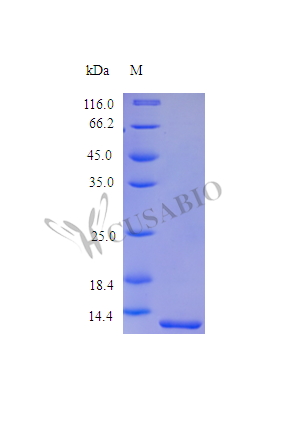
>98% as determined by SDS-PAGE.
Endotoxin
Less than 1.0 EU/μg as determined by LAL method.
Activity
Fully biologically active when compared to standard. The biological activity determined by a chemoattract bioassay using human monocytes is in a concentration range of 10-100 ng/ml.
Target Names
SAA1
Uniprot NO.
Research Area
Immunology
Alternative Names
SAA1; Serum amyloid A-1 protein; SAA) [Cleaved into: Amyloid protein A; Amyloid fibril protein AA); Serum amyloid protein A(2-104); Serum amyloid protein A(3-104); Serum amyloid protein A(2-103); Serum amyloid protein A(2-102); Serum amyloid protein A(4-101)]
Species
Homo sapiens (Human)
Source
E.Coli
Expression Region
19-122aa
Target Protein Sequence
RSFFSFLGEA FDGARDMWRA YSDMREANYI GSDKYFHARG NYDAAKRGPG GVWAAEAISD ARENIQRFFG HGAEDSLADQ AANEWGRSGK DPNHFRPAGL PEKY
Note: The complete sequence may include tag sequence, target protein sequence, linker sequence and extra sequence that is translated with the protein sequence for the purpose(s) of secretion, stability, solubility, etc.
If the exact amino acid sequence of this recombinant protein is critical to your application, please explicitly request the full and complete sequence of this protein before ordering.
Mol. Weight
11.7 kDa
Protein Length
Full Length of Mature Protein
Tag Info
Tag-Free
The tag type will be determined during production process. If you have specified tag type, please tell us and we will develop the specified tag preferentially.
Buffer
Lyophilized from a 0.2 μm filtered concentrated solution in 20 mM Tris-HCl, pH 9.0, 150 mM NaCl
Storage
Store at -20°C/-81°C upon receipt, aliquoting is necessary for mutiple use. Avoid repeated freeze-thaw cycles.
Lead Time
Basically, we can dispatch the products out in 5-10 working days after receiving your orders. Delivery time may differ from different purchasing way or location, please kindly consult your local distributors for specific delivery time.
Note: All of our proteins are default shipped with normal blue ice packs, if you request to ship with dry ice, please communicate with us in advance and extra fees will be charged.
Notes
Repeated freezing and thawing is not recommended. Store working aliquots at 4°C for up to one week.
Shelf Life
The shelf life is related to many factors, storage state, storage temperature and the stability of the product itself. Generally, the shelf life of lyophilized form is 6 months at -20°C/-80°C from the date of receipt.
Troubleshooting and FAQs
Datasheet & COA
Please contact us to get it.
Images
Description

SAA1 functions as an acute-phase reactant and chemoattractant whose plasma concentration can surge 1,000-fold during inflammation, making it a critical mediator in innate immunity and a biomarker for inflammatory disease states. This tag-free preparation spanning residues 19–122 demonstrates full biological activity in a monocyte chemoattraction bioassay at 10–100 ng/ml, providing a quantitative benchmark for cell migration studies and enabling researchers to dissect SAA1-driven recruitment pathways in models of infection, atherosclerosis, and tumor microenvironment biology. The endotoxin level of less than 1.0 EU/μg satisfies the purity and endotoxin criteria typical for immune cell activation assays, ensuring that observed responses—whether in NF-κB or MAPK signaling experiments—are attributable to SAA1 rather than LPS contamination. Purity exceeding 98% by SDS-PAGE, combined with the validated chemotactic potency, supports use in antibody development workflows where a homogeneous immunogen is essential for generating monospecific reagents.


Customer Reviews and Q&A

 Customer Reviews

Target Background

Function(From Uniprot)
Major acute phase protein.
Gene References into Functions
  1. SAA1 can be produced in human fetal membranes, which can be greatly induced in the presence of proinflammatory cytokines and glucocorticoids thereby producing effects associated with parturition PMID:28386088
  2. High SAA1 expression in the stromal component is associated with pancreatic tumors. PMID:29351990
  3. Data suggest that anti-inflammatory capacity of HDL (high-density lipoprotein) from patients with type 2 diabetes and diabetic nephropathy is impaired; this effect might be attributable to SAA enrichment in HDL in these patients; up-regulation of SAA in HDL appears to be associated with increased risk of diabetic angiopathy or vasculitis in such patients. PMID:28760652
  4. The frequencies of the CC genotype and the C allele of SAA rs12218 were higher in participants with ischemic stroke than in the control group. The frequencies of the AG genotype and the G allele of rs2468844 were higher in participants with ischemic stroke than in the control group. Multiple logistic regression analysis revealed the significance of the rs12218 in males and in large-artery atherosclerosis group. PMID:28870546
  5. we show that astrocytoma patients have increased levels of serum SAA and SAA1 is expressed and secreted in glioblastoma, and its co-expression with tumor-related genes supports its involvement in glioblastoma angiogenesis and progression. PMID:28283801
  6. These results suggested that the C-terminal truncation of human SAA accelerates amyloid fibril formation. PMID:29288051
  7. SAA1 can be a potential mediator for UV-induced MMP-1 expression in human skin. PMID:26900010
  8. Data suggest that serum amyloid A (SAA) immunoreactivity in tumor-associated macrophage (TAM) is associated with worse recurrence-free survival, and is perhaps a therapeutic target for breast cancer. PMID:27058895
  9. Findings indicate that in Lyme disease patients, circulating CRP and SAA (Serum Amyloid A) levels are highest when the concentration of spirochetes is greatest in skin and/or blood and that levels decline after the dissemination of the organism to extracutaneous sites in subsequent stages of infection. PMID:27585799
  10. The Serum amyloid A (SAA)/formyl peptide receptor-like 1 (FPRL1) contributed to pathogenesis of psoriasis by promoting keratinocyte proliferation and inflammation, thus providing a potential therapeutic target for disease therapy. PMID:27910163
  11. High SAA expression is associated with lung cancer. PMID:27809798
  12. SAA, PROZ, and C4BPB may serve as new potential biomarkers for TB PMID:28278182
  13. Novel truncated form of serum amyloid A is elevated in the plasma of Kawasaki disease (KD) when compared with Febrile control subjects. Future studies will evaluate its relevance as a diagnostic biomarker and its potential role in the pathophysiology of KD. PMID:27271757
  14. SR-A1 suppresses lung cancer metastasis by downregulating SAA1 production in tumor-associated macrophages (TAM). PMID:28202524
  15. The SAA1.1 allele was found in four familial Mediterranean fever patients, including two with AA amyloidosis. PMID:27150194
  16. genetic variants at the CRP and SAA1 loci independently affect both CRP and SAA levels, and their respective circulating levels act as suppressors. PMID:27313400
  17. Serum amyloid A could represent a novel marker of primary unexplained recurrent early pregnancy loss because affected women exhibited elevated levels of this protein. PMID:28099717
  18. The polymorphism of SAA1 is not associated with susceptibility and severity of Familial Mediterranean Fever in Egyptian children PMID:27300189
  19. The findings identify SR-BII as a functional SAA receptor that mediates SAA uptake and contributes to its proinflammatory signaling via the MAPK-mediated signaling pathways. PMID:28423002
  20. Correlate MEFV genotype and the SAA1 polymorphisms with the clinical manifestations of familial Mediterranean fever and the occurrence of amyloidosis in a large cohort of Armenian patients. PMID:27791951
  21. Study found increased SAA concentration in patients with sarcoidosis. PMID:26919159
  22. the detection of residues 76 and 77 of SAA (AA76) may alter the ability to diagnose AA amyloidosis. PMID:27098620
  23. The results demonstrated that SAA upregulated Visfatin expression in cultured RAW264.7 macrophages and in the primary monocytes. PMID:27006946
  24. Structure, function and SAA1 gene polymorphisms PMID:26945629
  25. Serum Amyloid A induces inflammation, proliferation and cell death in activated hepatic stellate cells. PMID:26937641
  26. Amyloid A overexpressed in renal cell carcinoma patients and can serve as a prognostic marker. PMID:26750935
  27. incorporation of SAA into HDL preparations reduced antiinflammatory properties but not to the same extent as HDL from AgNO3-injected mice PMID:26642365
  28. human SAA is possibly only expressed in a subset of septic patients; SAA induces HMGB1 release via TLR4 and RAGE receptors; SAA supplementation worsens the outcome of lethal endotoxemia PMID:26052716
  29. The SAA1 rs12218 polymorphism was significantly more prevalent in ankylosing spondylitis patients with amyloidosis. PMID:26300108
  30. Autocrine/paracrine and recombinant human SAA1 via TLR4 stimulate a proinflammatory phenotype that is both part of the early phase of osteogenic differentiation and the development of senescence. PMID:26135899
  31. Serum amyloid A1alpha induces paracrine IL-8/CXCL8 via TLR2 and directly synergizes with this chemokine via CXCR2 and formyl peptide receptor 2 to recruit neutrophils. PMID:26297794
  32. These functional properties set SAA apart from well-characterized inflammatory factors, such as LPS and TNF-alpha, suggesting that it may play a homeostatic role during the course of inflammation. PMID:26130702
  33. The detailed analysis of the docking results points to the fact that the best serum amyloid A-Cystatin C (SAA-hCC) binding is achieved by the peptides inclined toward interacting via Lys90 and Arg 96 (with ffhCC Ser98 and Tyr102, respectively). PMID:25736604
  34. Our results showed PCT as a valuable marker of bacterial infections in febrile patients. PCT was superior to CRP, IL-6 or SAA in the early identification of bacterial infection PMID:25963492
  35. Mutations in genetic biomarker SAA1 gene related to amyloidosis processes may play a crucial role in chronic renal failure patients who require long-term hemodialysis. PMID:25394530
  36. The relative abundance of the N-terminal arginine truncation of SAA1.1 is significantly decreased in diabetes and negatively correlates with measures of glycemic and lipid control. PMID:25607823
  37. potential marker for detecting the activity of srcoidosis PMID:25623898
  38. Genetic polymorphisms in SAA1 are associated with coronary artery disease in the Han and Uygur populations in Western China. PMID:25656165
  39. High SAA serum level is associated with hepatocellular carcinoma. PMID:25605163
  40. HDL3 subpopulations in ST segment elevation myocardial infarction were enriched 10 times in SAA patients. PMID:26037829
  41. SAA has a role in activity of rheumatoid arthritis and risk of cardiovascular and renal involvement PMID:25525305
  42. SR-B1 and p38 MAPK are involved in signaling pathway of serum amyloid A-induced angiogenesis in rheumatoid arthritis. PMID:25932604
  43. Although SAA concentrations were elevated in the sera, there was no significant difference in these concentrations between familial Mediterranean fever patients and rheumatoid arthritis patients. PMID:25240611
  44. Zn deficiency enhances the acute phase response and particularly the JAK-STAT3 pathway, resulting in increased serum amyloid A production. PMID:24732911
  45. Serum amyloid A is a retinol binding protein that transports retinol during bacterial infection. PMID:25073702
  46. Data suggest that serum amyloid A (SAA) is a candidate for diabetic kidney disease therapeutic and biomarker discovery. PMID:25531567
  47. The CSF biomarker amyloid 1-42 is important and useful as part of the diagnostic procedure for detecting AD and other dementia in elderly patients displaying psychotic symptoms. PMID:23597931
  48. homozygous SAA1.5/1.5 genotype appears to be a recessive susceptibility gene, which has lost the antiangiogenic function, whereas SAA1.1 and SAA1.3 are the dominant alleles of the tumor suppressor phenotype. PMID:24608426
  49. keratinocyte-derived SAA triggers a key inflammatory mediator, IL-1beta, via NLRP3 inflammasome activation, providing new potential targets for the treatment of this chronic skin disease. PMID:25231464
  50. SAA1 gene expression in COPD patients is responsible for the secretion of this molecule in different cell types. PMID:24884805

Show More

Hide All

Subcellular Location
Secreted.
Protein Families
SAA family
Tissue Specificity
Expressed by the liver; secreted in plasma (at protein level).
Database Links

HGNC: 10513

UNIGENE: Hs.632144

KEGG: hsa:6288

STRING: 9606.ENSP00000348918

OMIM: 104750

icon of phone
Call us
301-363-4651 (Available 9 a.m. to 5 p.m. CST from Monday to Friday)
icon of address
Address
No. 269, Shendun 5th Road, Donghu Hi-Tech Development Area, Hubei Province, 430206, P.R.China
icon of social media
Join us with

Subscribe newsletter

Leave a message

* To protect against spam, please pass the CAPTCHA test below.
CAPTCHA verification
© 2007-2025 CUSABIO TECHNOLOGY LLC All rights reserved. 鄂ICP备15011166号-1
Select 0 Products