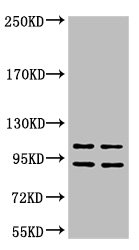
It differs from different batches. Please contact us to confirm it.
Buffer
PBS, pH 7.4, containing 0.5%BSA, 0.02% sodium azide as Preservative and 50% Glycerol.
Form
Liquid
Note: We will preferentially ship the format that we have in stock, however, if you have any special requirement for the format, please remark your requirement when placing the order, we will prepare according to your demand.
Tested Applications
ELISA,WB
Recommended Dilution
Application
Recommended Dilution
WB
1:500-1:5000
Storage
Upon receipt, store at -20°C or -80°C. Avoid repeated freeze.
Lead Time
Basically, we can dispatch the products out in 1-3 working days after receiving your orders. Delivery time maybe differs from different purchasing way or location, please kindly consult your local distributors for specific delivery time.
Note: All of our proteins are default shipped with normal blue ice packs, if you request to ship with dry ice, please communicate with us in advance and extra fees will be charged.
Usage
For Research Use Only. Not for use in diagnostic or therapeutic procedures.
Plays a role in the cellular breakdown of insulin, APP peptides, IAPP peptides, natriuretic peptides, glucagon, bradykinin, kallidin, and other peptides, and thereby plays a role in intercellular peptide signaling. Substrate binding induces important conformation changes, making it possible to bind and degrade larger substrates, such as insulin. Contributes to the regulation of peptide hormone signaling cascades and regulation of blood glucose homeostasis via its role in the degradation of insulin, glucagon and IAPP. Plays a role in the degradation and clearance of APP-derived amyloidogenic peptides that are secreted by neurons and microglia (Probable). Degrades the natriuretic peptides ANP, BNP and CNP, inactivating their ability to raise intracellular cGMP. Also degrades an aberrant frameshifted 40-residue form of NPPA (fsNPPA) which is associated with familial atrial fibrillation in heterozygous patients. Involved in antigen processing. Produces both the N terminus and the C terminus of MAGEA3-derived antigenic peptide (EVDPIGHLY) that is presented to cytotoxic T lymphocytes by MHC class I.; (Microbial infection) The membrane-associated isoform acts as an entry receptor for varicella-zoster virus (VZV).
Gene References into Functions
These results support the hypothesis that IDE gene expression in different areas of Alzheimer's patient's brains.PMID:28164769
People with allelic variation in four genes related to cardiovascular diseases and metabolism were more likely to die: apolipoprotein (APO)C1 GG and AG carriers, APOE varepsilon4 carriers, insulin-degrading enzyme (IDE) TC carriers, and phosphatidylinositol 3-kinase (PI3KCB) GG carriers.PMID:27806189
Data suggest the possibility of development of insulin-degrading enzyme (IDE)-based drugs for the treatment of the late-onset form of Alzheimer's disease (AD).PMID:27982586
the mechanistic and molecular features of IDE-26S proteasome interaction in a cell experimental model, is reported.PMID:26186340
No significant associations have been found between other IDE gene single nucleotide polymorphisms of rs4646953, rs2251101 and rs1544210 with Alzheimer disease.PMID:25105907
results demonstrate that the polymorphisms rs1887922 and rs1999764 of the IDE gene are associated with late-onset Alzheimer disease susceptibility in the Xinjiang Han populationPMID:25414272
Cognitive impairment is more frequent among those exposed to the C allele of the rs2209972 SNP of the insulin degrading enzyme gene.PMID:24355596
IDE does not play a major role in MHC class I antigen processing, confirming the dominant and almost exclusive role of the proteasome in cytosolic production of MHC class I ligands.PMID:24516642
using combinational in silico investigations, study identified that pathogenic nonsynonymous mutations corresponding to p.I54F, p.P122T, p.T533R, p.P581A and p.Y609A have more potential role in structural and functional deviations of IDE activityPMID:24059301
Our study provided evidence to IDE, PON1, WFS1, POU2F1, IL1alpha and IL1beta associated with T2D in Pakistanis.PMID:24477584
An upstream promoter element which blocks the antisense transcription of the human IDE promoter, was identified.PMID:23797320
Both IDE and type 2 diabetes are associated with executive function levels in older adultsPMID:23597493
Conformational changes in IDE, including a swinging-door mechanism that permits the entry of short peptides into the catalytic chamber, governs the selective destruction of amyloidogenic peptides.PMID:23922390
for the rs1832196 polymorphism, significant association with Alzheimer disease was found by the dominant model in overall and subgroup analysis.PMID:23416320
IDE-Met(1) links the mitochondrial biogenesis pathway with mitAbeta levels and organelle functionality.PMID:23525105
Genetic variants for both insulin degrading enzyme (IDE) and angiotensin converting enzyme (ACE) in relation to cognitive phenotype.PMID:21232820
In the context of APOEepsilon4-negative status, insulin-degrading enzyme variants are significantly associated with Alzheimer disease in some genetic models.PMID:22502914
The polymorphism of insulin-degrading enzyme is associated with susceptibility to Alzheimer's disease in Han Chinese.PMID:20880607
Phosphorylation of amyloid-beta peptide at serine 8 attenuates its clearance via insulin-degrading and angiotensin-converting enzymes.PMID:22267728
The upstream polymorphism IDE2 was found to influence AD risk and to trigger the Abeta42 plasma level, whereas the downstream polymorphism IDE7 modified the T2DM risk; no associations were found for the intronic variant IDE9.PMID:22107728
Significant differences were found in the response to induced ketosis among non-carriers of putative gain-of-function polymorphisms in rs1143627 and rs16944 in the IL-1beta gene and among variants of the polymorphism rs2251101 in the insulysin gene.PMID:21992747
BRI2 protein regulates beta-amyloid degradation by increasing levels of secreted insulin-degrading enzyme (IDE).PMID:21873424
Five IDE variants for altered in vitro reporter gene expression, based on their presence on haplotypes (H2, H6 and H9) and their association with altered IDE mRNA transcript levels , were tested.PMID:21731745
dimers of insulin-degrading enzyme reveal a cis activation mechanismPMID:21343292
IDE cleaves ubiquitin in a biphasic mannerPMID:21185309
the evolutionarily conserved IDE may play a key role in modulating and reshaping the strength and duration of NP-mediated signaling.PMID:21098034
IIA(Glc) of the sugar phosphotransferase system regulates the peptidase activity of a mammalian insulysin homolog in V. vulnificus.PMID:20971110
Insulin degrading enzyme is linked with aggregated Abeta40 isoform while neprilysin negatively correlates with amyloid angiopathy.PMID:19019493
IDE is not correlated with amyloig beta or clinical diagnosis Alzheimer diseasePMID:20663017
produce tumor antigenic peptides presented by MHC class I molecules for cytotoxic T lymphocyte recognitionPMID:20364150
the catalytic mechanisms for the hydrolysis of the three different peptide bonds of Alzheimer amyloid beta (Abeta) peptide by insulin-degrading enzyme (IDE)PMID:20033747
this study more generally suggests an interplay between RB and IDE within the proteasome that may have important growth-regulatory consequences.PMID:20362553
Results describe the in vitro degradation of insulin-like peptide 3 by insulin-degrading enzyme.PMID:20082125
In comparison to Abeta40, Abeta42 is more flexible and interacts through a smaller number (17-22) of hydrogen bonds in the catalytic chamber of IDE.PMID:20380468
a previously unreported variant unequivocally associated with increased IDE expression was also associated with reduced plasma Abeta40 and decreased LOAD susceptibilityPMID:20098734
Study verified associations of two IDE polymorphisms (rs1887922 and rs2149632) with type 2 diabetes risk in two independent German cohorts and evaluated in detail the association of common variants with insulin metabolism and glycemic traits.PMID:19809796
structural basis of how the high dipole moment of substrates complements the charge distribution of the IDE catalytic chamber for the substrate selectivityPMID:19896952
IDE protease binds to the 73-kDa gE precursor and that this event occurs in the cytosol but not as a receptor/ligand interaction.PMID:19864391
possible mechanism by which the insulin-degrading enzyme (IDE) zinc-binding protease carries out its catalytic function toward two peptides of different lengthPMID:19785409
Insulin-degrading enzyme rapidly removes the beta-amyloid precursor protein intracellular domain (AICD).PMID:11809755
analysis of over 2,400 samples provides no compelling evidence that variation in IDE contributes to diabetes susceptibility in humansPMID:12716770
when intracellular long-chain fatty acid concentrations are elevated, they may act directly on insulin-degrading enzyme to decrease insulin metabolism and alter insulin action in intact cells and this mechanism may contribute to insulin resistancePMID:12746301
Polymorphism in this enzyme are associated with NIDDM in men.PMID:12765971
IDE gene polymorphisms do not confer susceptibility to early- or late-onset AD at least in a Japanese population.PMID:14755451
Biochemical characteristics of insulin degradation in wound fluid were consistent with characteristics of insulin-degrading enzyme. Reduction in insulin-degrading activity in wound fluid is potential therapeutic target.PMID:14764804
genomic region in the proximity of IDE that may contribute to Alzheimer and Parkinson disease in a similar manner.PMID:15088150
IDE gene promoter region variants are associated with AD in subjects without an epsilon4 allelePMID:15181249
Polymorphism in/near IDE contributes to a large proportion of variance in plasma insulin levels and correlated traits.PMID:15277398
The C allele of single-nucleotide polymorphism IDE2 associated with Alzheimer disease. There may be a possible synergic interaction between IDE & APOE epsilon4.PMID:15277615
a defect in Abeta proteolysis by IDE contributes to the accumulation of this peptide in the cortical microvasculaturePMID:15489232
Show
More
Hide
All
Subcellular Location
Cytoplasm, cytosol. Cell membrane. Secreted. Note=Present at the cell surface of neuron cells. The membrane-associated isoform is approximately 5 kDa larger than the known cytosolic isoform.
Protein Families
Peptidase M16 family
Tissue Specificity
Detected in brain and in cerebrospinal fluid (at protein level).