Rat p53/tumor protein,p53/TP53 ELISA Kit

Promotion
Code: CSB-E08336r
Size:
96T,5×96T,10×96T
96T,5×96T,10×96T
Pls inquire
Quantity:
Sample Types: serum, plasma, tissue homogenates
Detect Range: 12.5 pg/mL-800 pg/mL
Sensitivity: 3.12 pg/mL
Trial Size:
24T ELISA Kit Trial Size (Only USD$150/ kit)
* Sample kit cost can be deducted as a $30 credit for each 96-assay kit of the same analyte and brand you subsequently purchase within six months until depleted. More details >>
Interested in a trial size? Please leave a message below.

For inquiries on large quantities or another requirements
Send an Inquiry
Start an on-line Chat
Online ordering is currently available for U.S. customers only. For orders outside the U.S., please kindly submit an inquiry or start a chat with us.
Promotion

Product Details

Alternative Names
FLJ92943, LFS1, TRP53, p53, p53 antigen|p53 transformation suppressor|p53 tumor suppressor|phosphoprotein p53|transformation-related protein 53
Abbreviation
TP53
Uniprot NO.
Species
Rattus norvegicus (Rat)
Sample Type
serum, plasma, tissue homogenates
Detection Range
12.5 pg/mL-800 pg/mL
Sensitivity
3.12 pg/mL
Assay Time
1-5h
Sample Loading Volume
50-100ul
Detection Wavelength
450 nm
Research Area
Cancer
Assay Principle
quantitative
The tag type will be determined during production process. If you have specified tag type, please tell us and we will develop the specified tag preferentially.
Measurement
Sandwich
Storage
Store at 2-8°C. Please refer to protocol.
Shelf Life
6 months
Lead Time
3-5 working days after you place the order, and it takes another 3-5 days for delivery via DHL or FedEx.
Note: All of our proteins are default shipped with normal blue ice packs, if you request to ship with dry ice, please communicate with us in advance and extra fees will be charged.
Precision
Intra-assay Precision (Precision within an assay): CV%<8%
Three samples of known concentration were tested twenty times on one plate to assess.
Inter-assay Precision (Precision between assays): CV%<10%
Three samples of known concentration were tested in twenty assays to assess.
Linearity
To assess the linearity of the assay, samples were spiked with high concentrations of rat p53/TP53 in various matrices and diluted with the Sample Diluent to produce samples with values within the dynamic range of the assay.
SampleSerum(n=4)
1:1Average %100
Range %95-108
1:2Average %87
Range %82-91
1:4Average %90
Range %85-94
1:8Average %92
Range %88-96
Recovery
The recovery of rat p53/TP53 spiked to levels throughout the range of the assay in various matrices was evaluated. Samples were diluted prior to assay as directed in the Sample Preparation section.
Sample TypeAverage % RecoveryRange
Serum (n=5) 8984-93
EDTA plasma (n=4)9590-100
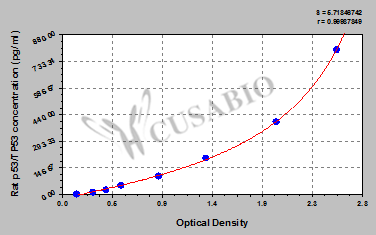
Typical Data
These standard curves are provided for demonstration only. A standard curve should be generated for each set of samples assayed.
pg/ml OD1OD2AverageCorrected
8002.479 2.615 2.547 2.405
4002.009 1.974 1.992 1.850
2001.356 1.330 1.343 1.201
1000.874 0.929 0.902 0.760
500.532 0.571 0.552 0.410
250.401 0.425 0.413 0.271
12.50.297 0.287 0.292 0.150
00.140 0.143 0.142
Troubleshooting and FAQs
Description

This Rat TP53 ELISA Kit was designed for the quantitative measurement of Rat TP53 protein in serum, plasma, tissue homogenates. It is a Sandwich ELISA kit, its detection range is 12.5 pg/mL-800 pg/mL and the sensitivity is 3.12 pg/mL.

Customer Reviews and Q&A

 Customer Reviews
 Q&A
Q:

How can I convert pyggrams per decilitre to picograms per milligram, because your kit is in deciliters and concentrates
picogeram/dl---picogeram/mg.
This kit is according to picogerm/dl, i want according to picogeram /mg.


A:
Thanks for your inquiry. For this kit,convertions are not suggested.We recommend you calculate according to the unit stated in the manual.

Citations

Target Background

Gene References into Functions
  1. These findings reveal a novel regulatory mechanism of ROCK1/p53/NOXA signaling in modulating cardiomyocyte apoptosis in vitro and maternal diabetes-induced congenital heart defects in vivo. PMID:28131915
  2. these findings indicated that miR31a5p is involved in hypertension via the accelerated proliferation of arterial smooth muscle cells and inhibition of apoptosis through targeting TP53. PMID:29620173
  3. Study revealed initial downregulation in the expression of p53 protein during breast cancer development. However, with progression towards malignancy, upregulation of p53 was observed. These changes were associated with polymorphism in p53 gene, which was detected in exon 5. PMID:29498408
  4. Compared with the saline Hepatocellular carcinoma (HCC)-group, transplantation with CD34+ human hematopoietic stem cells produced a further increase in the levels of wnt4 (+19.4%) and p53 gene expression (+53%), a 2-fold increase in the percentage of cancer progenitor cells and increased HCC pathology grading PMID:29429512
  5. The results indicate that the miR-188-3p-MDM2-p53 axis may have a critical role in sevoflurane-induced cognitive dysfunction. PMID:29344658
  6. MiR-31a-5p protects cardiomyocytes against angiotensin II-induced apoptosis by targeting Tp53. PMID:29286111
  7. Results suggest that Delta40p53 can be generated by a 20S proteasome-mediated post-translational mechanism so as to control p53 function. PMID:28885617
  8. The results suggested that caveolin1 may be involved in nucleus pulposus cellular senescence during oxidative stress in vitro, mainly via the p53/p21 signaling pathway. PMID:29039595
  9. our results revealed that the upregulation of p53 and possibly other anti-oncogenes may provide a potential effective therapeutic strategy for malignant pheochromocytoma PMID:29048679
  10. over-expression of p53 could mediate oligodendrocyte apoptosis thus resulting in demyelination in two ways; by enhancing ER-mitochondria interaction and by triggering the E2F1 mediated apoptosis pathway. PMID:28237798
  11. Effect of polydatin on expression of p53 and Notch1 in brain tissue of ischemic cerebrovascular disease. PMID:29504377
  12. pharmacological inhibition of ATM kinase (KU55933) reduced activation of ATM kinase, but not p53, suggesting that HG-mediated activation of p53 and ATM could represent independent pro-apoptotic events..these data indicate that sustained activation of Rac1-p38MAPK signaling axis leads to activation of p53 leading to beta-cell dysfunction under the duress of chronic hyperglycemic conditions PMID:28220272
  13. JNK/p53 pathway might play a critical role in the tubular cell apoptosis induced by -MCPD 1-palmitate. PMID:27008853
  14. the Ras/Raf/Erk signals contribute to neuronal death through the phosphorylation of p53 in hippocampus after subarachnoid hemorrhage. PMID:26497030
  15. Hypoxia and hyperoxia differentially control proliferation of rat neural crest stem cells via distinct regulatory pathways of the HIF1alpha-CXCR4 and TP53-TPM1 proteins PMID:28002632
  16. This study determined if dietary restriction (DR) protects against hypoxic-ischemia (HI) in the neonatal brain via insulin receptor substrate-1 (IRS-1)/Akt pathway-mediated downregulation of p53 in the neurovascular unit. PMID:26111627
  17. Results suggest that the cancer-inhibitory activity of sodium butyrate and its derivatives on liver carcinogenesis may be attributed to retention of p53 and CRM1 proteins in the nucleus, an event that may trigger activation of p53-mediated apoptotic cell death in neoplastic cells. PMID:27013579
  18. The Fischer model is more consistent with the early onset of bone and central nervous system sarcomas found in humans with germline Tp53 mutations. PMID:27528400
  19. findings reveal a novel function of p53 in controlling inflammatory responses and suggest that p53 abnormalities in rheumatoid arthritis could sustain and accelerate synovial inflammation PMID:27881147
  20. mammalian SOS response is characterized by an increase in the p53 gene with activation of multiple DNA repair genes that harbor p53 response elements in their promoters. PMID:28800961
  21. Doxorubicin (Dox)-administration to cardiomyocytes increased the levels of reactive oxygen species (ROS) in a time-dependent manner that followed the activation of stress-induced proteins p53, p38 and JNK MAPKs, culminating in an increase in autophagy and apoptosis markers. PMID:28678856
  22. ANXA1 interacts with p53 and promotes p53 transcriptional activity, which in turn regulates Bid expression. PMID:27584794
  23. transformed MSCs express high levels of a p53 mutant that loses the ability to bind survivin gene PMID:27046449
  24. an Ntv-a transgenic rat colony was established and used to study glial brain tumors driven by two well-characterized oncogenic gene transformations, PDGFA overexpression and p53 depletion. Combined PDGFA and p53 alterations resulted in large, heterogeneous tumors in all affected animals PMID:28358926
  25. MEG3 could interacted with p53 and regulated its expression, and p53 exerted significant binding in the promoters for NOX4, suggesting that MEG3 regulated NOX4 expression via p53. PMID:28634073
  26. The miR-34a/SIRT1/p53 signaling pathway is activated in hepatocytes but not hepatic stellate cells during liver fibrosis PMID:27387128
  27. MDM2 is involved in fibroblast activation, mediating renal tubulointerstitial fibrosis via a p53-independent pathway dependant on Notch1 ubiquitination and proteasome degradation. PMID:28100501
  28. These data indicates that Drp1 mediates compression-induced programmed necrosis of NP cells by promoting mitochondrial translocation of p53 and nuclear translocation of AIF. PMID:28411026
  29. Formononetin prevents cisplatin-induced acute kidney injury by targeting Oct2/TP53 in the kidney. PMID:28414026
  30. Alloxan-induced renal damage is associated with alterations of p53, TGF-beta1, and extracellular matrix metalloproteinases. PMID:28220578
  31. Taken together, these results indicated that ALA protected dopaminergic neurons against MPP+induced neurotoxicity through its ability to upregulate the DNA repair protein, PCNA, via the P53 pathway. PMID:27665784
  32. SIRT1 attenuates cerebral ischemia/reperfusion-induced injury by targeting the p53/microRNA-22 axis. PMID:27878231
  33. Cholesterol regulates bone marrow mesenchymal stem cell senescence by modulating cell cycle, autophagy, and the ROS/p53/p21(Cip1/Waf1) signaling pathway. PMID:27703600
  34. results suggest that dysregulation of miR-30c and miR-181a may be involved in upregulation of p53-p21 pathway in diabetes induced cardiac hypertrophy. PMID:27221738
  35. miR-449 regulates the SIRT1/p53/BAX pathway, which may be its possible mechanism in modulating cell apoptosis of cisplatin-induced Acute kidney injury. PMID:26968221
  36. In conclusion, Cabin1 expression significantly increases during podocyte injury. Knockdown of Cabin1 induces p53 expression decrease in cultured podocyte. Cabin1 may provide a new target to investigate podocyte injury. PMID:26400065
  37. p53 regulates autophagic activity in senescent rat mesenchymal stromal cells. PMID:26792455
  38. This indicates that MPP+-induced oxidative damage is mediated by the downregulation of PCNA through the p53 pathway in a cellular model of Parkinson's disease . PMID:26677001
  39. The results of the present study therefore indicated that resveratrol protected H9c2 cells from DOX-induced apoptosis via the AMPK/P53 pathway PMID:26675978
  40. Hypoxia response element Bcl2 inhibition can effectively attenuate hypoxia-induced apoptosis resistance in pulmonary microvascular endothelial cells by downregulating Bcl2 expression and upregulating caspase-3 and P53 expression. PMID:26456506
  41. Study suggested that neonatal bronchopulmonary dysplasia caused impaired cognitive function and neuron apoptosis in hippocampus via p53 and HIF-1alpha PMID:26431790
  42. miR-23a binds to p53 and enhances its association with miR-128 promoter PMID:26553132
  43. Hydrogen-rich saline is able to protect against AKI after liver transplantation partly by reducing apoptosis, which is possibly involved in the modulation of p53-mediated autophagy. PMID:26714124
  44. These results suggest the existence of a causal link between Cox-2 and p53, which may represent a toxic mechanism of electrophilic lipid peroxidation products. PMID:25506925
  45. Autoimmune Optic Neuritis Is Associated with Altered APP Cleavage in Neurons and Up-Regulation of p53 PMID:26426258
  46. findings show p53 is activated in astrocytes during ischemia and that inhibition of the activity of this molecule prevents not only oxygen-glucose deprivation-induced neuronal and astrocytic death but also astrocyte activation and impaired glutamate uptake PMID:26302161
  47. CHIP stabilizes amyloid precursor protein via proteasomal degradation and p53-mediated trans-repression of BACE1. PMID:25773675
  48. Phosphorylation of p53 by LRRK2 induces p21(WAF1/CIP1) expression and apoptosis. PMID:26384650
  49. Diabetes upregulates p21(CIP1/Waf1) signaling in testicular germ cells in association with alteration in p-p53ser315 expression, probably to counteract DNA damage-induced cell death. PMID:24828139
  50. Our results also suggest that chromothripsis primarily occurs under p53 heterozygous rather than p53 null conditions. PMID:25811670

Show More

Hide All

icon of phone
Call us
301-363-4651 (Available 9 a.m. to 5 p.m. CST from Monday to Friday)
icon of address
Address
No. 269, Shendun 5th Road, Donghu Hi-Tech Development Area, Hubei Province, 430206, P.R.China
icon of social media
Join us with

Subscribe newsletter

Leave a message

* To protect against spam, please pass the CAPTCHA test below.
CAPTCHA verification
© 2007-2025 CUSABIO TECHNOLOGY LLC All rights reserved. 鄂ICP备15011166号-1
Select 0 Products