* Sample kit cost can be deducted as a $30 credit for each 96-assay kit of the same analyte and brand you subsequently purchase within six months until depleted. More details >>
Interested in a trial size? Please leave a message below.


| Intra-assay Precision (Precision within an assay): CV%<15% | ||||||
| Three samples of known concentration were tested twenty times on one plate to assess. | ||||||
| Inter-assay Precision (Precision between assays): CV%<15% | ||||||
| Three samples of known concentration were tested in twenty assays to assess. | ||||||
| To assess the linearity of the assay, samples were spiked with high concentrations of pig INS in various matrices and diluted with the Sample Diluent to produce samples with values within the dynamic range of the assay. | ||||||
| Sample | Serum(n=4) | |||||
| 1:1 | Average % | 96 | ||||
| Range % | 84-105 | |||||
| 1:2 | Average % | 93 | ||||
| Range % | 89-99 | |||||
| 1:4 | Average % | 95 | ||||
| Range % | 89-101 | |||||
| 1:8 | Average % | 95 | ||||
| Range % | 83-103 | |||||
| The recovery of pig INS spiked to levels throughout the range of the assay in various matrices was evaluated. Samples were diluted prior to assay as directed in the Sample Preparation section. | ||||||
| Sample Type | Average % Recovery | Range | ||||
| Serum (n=5) | 96 | 91-101 | ||||
| EDTA plasma (n=4) | 98 | 92-104 | ||||
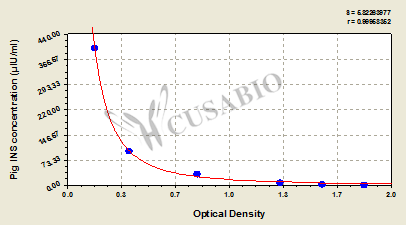
| These standard curves are provided for demonstration only. A standard curve should be generated for each set of samples assayed. | |||||||||||||||||||||||||||||||||||||||||||||||||
|
|||||||||||||||||||||||||||||||||||||||||||||||||
Insulin is a peptide hormone produced by pancreatic beta cells that regulates glucose homeostasis by promoting cellular glucose uptake and glycogen synthesis. This hormone also affects lipid and protein metabolism. Its dysregulation leads to diabetes mellitus and other metabolic disorders. Insulin signaling pathways are fundamental to understanding energy metabolism, making it a key target for research in endocrinology, diabetes, and metabolic disease studies.
The Pig Insulin INS ELISA Kit (CSB-E06828p) is designed for quantitative measurement of insulin in Sus scrofa samples. This competitive assay accommodates serum, plasma, and tissue homogenates with a detection range of 2-400 μIU/mL and sensitivity of 1 μIU/mL. The assay requires 50-100 μL sample volume, operates at 450 nm detection wavelength, and can be completed within 1-5 hours.
Application Examples
Note: The following application examples are drawn from a selection of publications citing this product. For additional applications, please refer to the full list of references in the "Citations" section.
This ELISA kit has been used in metabolic research studies to measure insulin concentrations in pig plasma and serum samples. The kit supports studies of glucose homeostasis and insulin resistance. Researchers use insulin measurements alongside other biochemical parameters to evaluate metabolic status and calculate insulin resistance indices.
• Metabolic profiling: Used to quantify plasma insulin levels as part of comprehensive biochemical parameter analysis including lipid profiles, glucose, and liver enzyme activities
• Insulin resistance evaluation: Applied in studies calculating homeostasis model assessment of insulin resistance using fasting insulin and glucose measurements
• Endocrine research: Used alongside other hormone measurements including growth hormone, progesterone, and insulin-like growth factor to evaluate hormonal profiles
• Nutritional studies: Applied to evaluate metabolic responses in dietary intervention research examining the effects of different nutritional treatments on insulin levels


Email: support@cusabio.com
Distributors Worldwide



