Mouse cyclooxygenase-2,COX-2 ELISA Kit

Promotion
Code: CSB-E12910m
Size:
96T,5×96T,10×96T
96T,5×96T,10×96T
Pls inquire
Quantity:
Sample Types: serum, plasma, tissue homogenates, cell lysates
Detect Range: 31.25 pg/mL-2000 pg/mL
Sensitivity: 7.8 pg/mL
Trial Size:
24T ELISA Kit Trial Size (Only USD$150/ kit)
* Sample kit cost can be deducted as a $30 credit for each 96-assay kit of the same analyte and brand you subsequently purchase within six months until depleted. More details >>
Interested in a trial size? Please leave a message below.

For inquiries on large quantities or another requirements
Send an Inquiry
Start an on-line Chat
Online ordering is currently available for U.S. customers only. For orders outside the U.S., please kindly submit an inquiry or start a chat with us.
Promotion

Product Details

Alternative Names
Ptgs2 ELISA Kit; Cox-2 ELISA Kit; Cox2 ELISA Kit; Pghs-b ELISA Kit; Tis10 ELISA Kit; Prostaglandin G/H synthase 2 ELISA Kit; EC 1.14.99.1 ELISA Kit; Cyclooxygenase-2 ELISA Kit; COX-2 ELISA Kit; Glucocorticoid-regulated inflammatory cyclooxygenase ELISA Kit; Gripghs ELISA Kit; Macrophage activation-associated marker protein P71/73 ELISA Kit; PES-2 ELISA Kit; PHS II ELISA Kit; Prostaglandin H2 synthase 2 ELISA Kit; PGH synthase 2 ELISA Kit; PGHS-2 ELISA Kit; Prostaglandin-endoperoxide synthase 2 ELISA Kit; TIS10 protein ELISA Kit
Abbreviation
PTGS2
Uniprot NO.
Species
Mus musculus (Mouse)
Sample Type
serum, plasma, tissue homogenates, cell lysates
Detection Range
31.25 pg/mL-2000 pg/mL
Sensitivity
7.8 pg/mL
Assay Time
1-5h
Sample Loading Volume
50-100ul
Detection Wavelength
450 nm
Research Area
Metabolism
Assay Principle
quantitative
The tag type will be determined during production process. If you have specified tag type, please tell us and we will develop the specified tag preferentially.
Measurement
Sandwich
Storage
Store at 2-8°C. Please refer to protocol.
Shelf Life
6 months
Lead Time
3-5 working days after you place the order, and it takes another 3-5 days for delivery via DHL or FedEx.
Note: All of our proteins are default shipped with normal blue ice packs, if you request to ship with dry ice, please communicate with us in advance and extra fees will be charged.
Precision
Intra-assay Precision (Precision within an assay): CV%<8%
Three samples of known concentration were tested twenty times on one plate to assess.
Inter-assay Precision (Precision between assays): CV%<10%
Three samples of known concentration were tested in twenty assays to assess.
Linearity
To assess the linearity of the assay, samples were spiked with high concentrations of mouse COX-2 in various matrices and diluted with the Sample Diluent to produce samples with values within the dynamic range of the assay.
 SampleSerum(n=4)
1:1Average %88
Range %80-92
1:2Average %98
Range %91-105
1:4Average %100
Range %92-110
1:8Average %93
Range %86-98
Recovery
The recovery of mouse COX-2 spiked to levels throughout the range of the assay in various matrices was evaluated. Samples were diluted prior to assay as directed in the Sample Preparation section.
Sample TypeAverage % RecoveryRange
Serum (n=5) 9689-98
EDTA plasma (n=4)9690-100
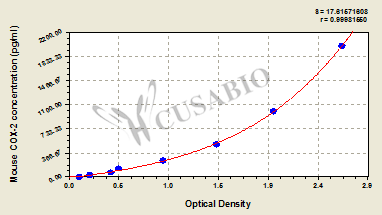
Typical Data
These standard curves are provided for demonstration only. A standard curve should be generated for each set of samples assayed.
pg/mlOD1OD2AverageCorrected
20002.660 2.654 2.657 2.547
10002.107 2.046 1.994 1.884
5001.494 1.385 1.440 1.330
2500.932 0.911 0.922 0.812
1250.502 0.489 0.496 0.386
62.50.403 0.398 0.415 0.305
31.250.223 0.207 0.215 0.105
00.114 0.106 0.110  
Troubleshooting and FAQs
Description

This Mouse PTGS2 ELISA Kit was designed for the quantitative measurement of Mouse PTGS2 protein in serum, plasma, tissue homogenates, cell lysates. It is a Sandwich ELISA kit, its detection range is 31.25 pg/mL-2000 pg/mL and the sensitivity is 7.8 pg/mL.


Customer Reviews and Q&A

 Customer Reviews

Citations

Target Background

Function(From Uniprot)
Dual cyclooxygenase and peroxidase in the biosynthesis pathway of prostanoids, a class of C20 oxylipins mainly derived from arachidonate, with a particular role in the inflammatory response. The cyclooxygenase activity oxygenates arachidonate (AA, C20:4(n-6)) to the hydroperoxy endoperoxide prostaglandin G2 (PGG2), and the peroxidase activity reduces PGG2 to the hydroxy endoperoxide PGH2, the precursor of all 2-series prostaglandins and thromboxanes. This complex transformation is initiated by abstraction of hydrogen at carbon 13 (with S-stereochemistry), followed by insertion of molecular O2 to form the endoperoxide bridge between carbon 9 and 11 that defines prostaglandins. The insertion of a second molecule of O2 (bis-oxygenase activity) yields a hydroperoxy group in PGG2 that is then reduced to PGH2 by two electrons. Similarly catalyzes successive cyclooxygenation and peroxidation of dihomo-gamma-linoleate (DGLA, C20:3(n-6)) and eicosapentaenoate (EPA, C20:5(n-3)) to corresponding PGH1 and PGH3, the precursors of 1- and 3-series prostaglandins. In an alternative pathway of prostanoid biosynthesis, converts 2-arachidonoyl lysophopholipids to prostanoid lysophopholipids, which are then hydrolyzed by intracellular phospholipases to release free prostanoids. Metabolizes 2-arachidonoyl glycerol yielding the glyceryl ester of PGH2, a process that can contribute to pain response. Generates lipid mediators from n-3 and n-6 polyunsaturated fatty acids (PUFAs) via a lipoxygenase-type mechanism. Oxygenates PUFAs to hydroperoxy compounds and then reduces them to corresponding alcohols. Plays a role in the generation of resolution phase interaction products (resolvins) during both sterile and infectious inflammation. Metabolizes docosahexaenoate (DHA, C22:6(n-3)) to 17R-HDHA, a precursor of the D-series resolvins (RvDs). As a component of the biosynthetic pathway of E-series resolvins (RvEs), converts eicosapentaenoate (EPA, C20:5(n-3)) primarily to 18S-HEPE that is further metabolized by ALOX5 and LTA4H to generate 18S-RvE1 and 18S-RvE2. In vascular endothelial cells, converts docosapentaenoate (DPA, C22:5(n-3)) to 13R-HDPA, a precursor for 13-series resolvins (RvTs) shown to activate macrophage phagocytosis during bacterial infection. In activated leukocytes, contributes to oxygenation of hydroxyeicosatetraenoates (HETE) to diHETES (5,15-diHETE and 5,11-diHETE). During neuroinflammation, plays a role in neuronal secretion of specialized preresolving mediators (SPMs) 15R-lipoxin A4 that regulates phagocytic microglia.
Gene References into Functions
  1. These results suggest a crucial role for the COX-2 signaling pathway in the intermittent hypoxia-exacerbated malignant processes, and designate macrophages and lung adenocarcinoma cells, as potential sources of prostaglandin E2. PMID:28300223
  2. Neuronal SphK1 acetylates COX2 and contributes to pathogenesis in Alzheimer's disease patients and in a transgenic mouse model. PMID:29662056
  3. Results demonstrate that neither the basal nor seizure-induced expression profiles of COX-2 were altered in mice lacking a functional TIA-1 gene suggesting that TIA-1 does not contribute to regulation of COX-2 protein expression in neurons. Induced seizure threshold was also unchanged in mice lacking TIA-1 protein, indicating that this RNA binding protein does not influence the innate seizure threshold. PMID:29337236
  4. The kidney is the principle site in the body where local COX-2 controls blood flow via PPARbeta/delta-mediated renal vasodilator pathway. PMID:29295852
  5. COX-2 is an important factor for Dengue virus replication. PMID:28317866
  6. The COX2-dependent lipid inflammatory pathway is responsible for lethality in F. novicida infection due to overproduction of proinflammatory effectors including prostaglandin E2. PMID:29109289
  7. PTGS2 deletion changes the natural distribution of ANXA2 in monocytes/macrophages, increasing TF expression and activity predisposing to venous thrombosis. PMID:28536720
  8. Study suggest that amyloid beta-protein increase the expression of TRPC6 via NF-kappaB in BV-2 microglia and promotes the production of COX-2, which induces hippocampus neuron damage. PMID:28458019
  9. Data show that patients with high cyclooxygenase-2 (COX2) gene expression who received celecoxib had a significantly higherpathological complete response (pCR) rate compared with patients with low COX2 gene expression. PMID:29491076
  10. COX-2/mPGES-1/PGE2 cascade activation mediates uric acid-induced glomerular mesangial cell proliferation. PMID:28052039
  11. Cobalt protoporphyrin induces COX-2 expression through activating P2X7 receptors and ASK1/MAP kinases as well as PIAS1 degradation signaling pathways. PMID:26255181
  12. sUV activated the transcription factors nuclear factor-kappaB and activator protein-1 which, in turn, induces COX-2 expression. PMID:28409880
  13. Results indicate that Cox-2 promotes Col10a1 expression and chondrocyte hypertrophy in vitro. PMID:27121205
  14. These data reveal important structure-function and signaling differences between the two FFA4 isoforms, and for the first time link FFA4 to modulation of ROS in macrophages. PMID:28943238
  15. Our data suggest that there are physiologically important gender differences in hypoxic acclimatization in COX-2-deficient mice. The COX-2 signaling pathway appears to be required for acclimatization in oxygen-limiting environments only in males, whereas female COX-2-deficient mice may be able to access COX-2-independent mechanisms to achieve hypoxic acclimatization. PMID:28242826
  16. increased COX2 expression has an impact on the aging process PMID:27750221
  17. Angiotensin II-AT1-receptor signaling is necessary for COX-2-dependent normal postnatal nephrogenesis and maturation. PMID:28040266
  18. AhR controls COX-2 protein via mRNA stability. PMID:28749959
  19. Podocyte-specific knockout of COX2 enhanced albuminuria and did not attenuate the histologic features of diabetic kidney disease. PMID:28490532
  20. Salt supplementation during the COX-2-dependent time frame of nephrogenesis partly reverses renal morphological defects in COX-2(-/-) mice and improves kidney function. PMID:28274925
  21. Data suggest that induction of Ptgs2 expression in preimplantation uterus may be earliest positive embryo/blastocyst signal for implantation and pregnancy recognition in mice. PMID:28215431
  22. the bone regeneration capacity of Cox-2KO MDSCs was impaired because of a reduction in cell proliferation and survival capacities, reduction in osteogenic differentiation and a decrease in the ability of the cells to recruit host cells to the injury site. PMID:27354351
  23. Data (including data from studies using knockout/mutant mice) suggest that Mir200c (microRNA 200c) is involved in endothelial function/dysfunction via regulation of Cox2 (cyclooxygenase-2) expression; overexpression of Mir200c impairs endothelium-dependent vascular relaxation (EDVR) in non-diabetic mouse aorta, whereas suppression of Mir200c by anti-Mir200c enhances EDVR in diabetic mouse aorta. PMID:26822089
  24. data indicate that excessive adipocyte lipolysis activates the JNK/NFkappaB pathway leading to the up-regulation of COX-2 expression and recruitment of inflammatory macrophages. PMID:27246851
  25. results suggest that Cox-2 is involved in the pathogenesis of noise-induced hearing loss; and pharmacological inhibition of Cox-2 has considerable therapeutic potential in noise-induced hearing loss. PMID:26934825
  26. COX-2 and EP1 receptors participate in the increased extracellular matrix deposition and vascular stiffness, the impaired vascular function and inflammation in hypertension. Targeting PGE2 receptors might have benefits in hypertension-associated vascular damage. PMID:26856544
  27. these results not only provide a dataset of protein expression change in FA treatment but also suggest that Cox-2 and lipid droplets (LDs) are potential players in PA- and OA-mediated cellular processes PMID:26899878
  28. prostaglandin E2 (PGE2) as a damage-associated molecular pattern that negatively regulates immune responses. The production of PGE2 is augmented under cell death-inducing conditions via the transcriptional induction of the cyclooxygenase 2 gene and cell-released PGE2 suppresses the expression of genes associated with inflammation, thereby limiting the cell's immunostimulatory activities. PMID:27001836
  29. DHA and celecoxib diminished the COX-2 and iNOS expression in the cells. This was associated with increased PPARgamma activity, supressed NF-kappaB activity in the nucleus. PMID:26954392
  30. Tat-SOD inhibited SNP-induced COX-2 expression similarly to celecoxib and prevented the formation of peroxynitrite as 2-phenyl-4,4,5,5-tetramethylimidazoline-1-oxyl-3-oxide. PMID:26786970
  31. Glucose-related hyperosmolarity seems to be able to promote angiogenesis and retinopathy through activation of TonEBP and possibly increasing expression of AQP1 and COX-2. PMID:26822858
  32. COX-2 has a direct role in modulating tumor progression in tumors arising within collagen-dense microenvironments, and suggest that COX-2 may be an effective therapeutic target for women with dense breast tissue and early-stage breast cancer. PMID:27000374
  33. COX-2 deletion delays BM megakaryopoiesis promoting compensatory splenic MK hyperplasia, releasing hyper-responsive platelets increasing thrombogenicity. COX-2 contributes to MK maturation and pro-platelet formation. PMID:26272103
  34. Ptgs2 mRNAs increased within 5 h after injury in mouse cortical slices. PMID:25895671
  35. Modulation of COX-2-driven metabolization of 2-AG may provide a novel physiological concept allowing the specific targeting of HSCs in liver fibrosis. PMID:26801558
  36. alveolar type II cell-derived COX-2 plays an important role in regulating basal airway function and LPS-induced lung inflammation PMID:26396235
  37. COX2 is involved in hypoxia-induced TNF-alpha expression in osteoblast. PMID:26066979
  38. The ERK5 pathway is essential in the induction of COX-2 gene. PMID:25976667
  39. 11betaHSD2 inhibition suppressed lung tumor growth and invasion in association with increased tissue active glucocorticoid levels, decreased COX-2 expression, inhibition of ERK and mTOR signaling pathways. PMID:26011146
  40. COX-2 and EP-2 signaling contribute significantly to the heart leukocyte infiltration and to the release of chemokines and inflammatory cytokines in the heart of T. cruzi infected mice. PMID:26305786
  41. Results suggest that substrates interact with cyclooxygenase-2 (COX-2) via multiple potential complexes involving binding to both the catalytic and allosteric sites. PMID:26392530
  42. canolol could inhibit the gastritis-related tumor initiation and progression, and the suppression effect was correlated with the blocking up of canonical COX-2/PGE2 signaling pathway and might be regulated by miR-7. PMID:25781635
  43. These data suggest that the bone loss with continuously infused PTH in mice is due largely to suppression of bone formation and that this suppression is mediated by Cox2. PMID:25781979
  44. COX2 may be involved in the expression of HSP47 and type IV collagen through the phosphorylation of ERK and JNK, accelerating renal interstitial fibrosis. PMID:24975097
  45. SHH-responsive 5-lipoxygenase, 15-lipoxygenase and COX-2 modulate Dectin-1-induced inflammatory cytokines. PMID:26432261
  46. Co-exposure to arsenic and ethanol increased COX-2 expression in mice. PMID:26220687
  47. these results demonstrate that during acute inflammation Atf3 negatively regulates Ptgs2 PMID:25619459
  48. our results reveal a previously unrecognized non-cell-autonomous mechanism in TDP-43-mediated neurodegeneration, identifying COX-2-PGE2 as the molecular events of microglia- but not astrocyte-initiated neurotoxicity PMID:25811799
  49. Increased endoplasmic reticulum stress in mouse osteocytes with aging alters Cox-2 response to mechanical stimuli PMID:25539857
  50. data suggests that an as yet unidentified prostaglanind E synthase but not mPGES-1 may couple with COX-2 to mediate increased renal PGE2 sythsesis in DN. PMID:24984018

Show More

Hide All

Subcellular Location
Microsome membrane; Peripheral membrane protein. Endoplasmic reticulum membrane; Peripheral membrane protein. Nucleus inner membrane; Peripheral membrane protein. Nucleus outer membrane; Peripheral membrane protein.
Protein Families
Prostaglandin G/H synthase family
Tissue Specificity
Following colon injury, expressed in the wound bed mesenchyme during the first phase of repair, probably by colonic mesenchymal stem cells (at protein level).
Database Links
icon of phone
Call us
301-363-4651 (Available 9 a.m. to 5 p.m. CST from Monday to Friday)
icon of address
Address
No. 269, Shendun 5th Road, Donghu Hi-Tech Development Area, Hubei Province, 430206, P.R.China
icon of social media
Join us with

Subscribe newsletter

Leave a message

* To protect against spam, please pass the CAPTCHA test below.
CAPTCHA verification
© 2007-2025 CUSABIO TECHNOLOGY LLC All rights reserved. 鄂ICP备15011166号-1
Select 0 Products