* Sample kit cost can be deducted as a $30 credit for each 96-assay kit of the same analyte and brand you subsequently purchase within six months until depleted. More details >>
Interested in a trial size? Please leave a message below.


| Intra-assay Precision (Precision within an assay): CV%<8% | ||||||
| Three samples of known concentration were tested twenty times on one plate to assess. | ||||||
| Inter-assay Precision (Precision between assays): CV%<10% | ||||||
| Three samples of known concentration were tested in twenty assays to assess. | ||||||
| To assess the linearity of the assay, samples were spiked with high concentrations of mouse RIPK3 in various matrices and diluted with the Sample Diluent to produce samples with values within the dynamic range of the assay. | ||||||
| Sample | Serum(n=4) | |||||
| 1:1 | Average % | 91 | ||||
| Range % | 86-96 | |||||
| 1:2 | Average % | 97 | ||||
| Range % | 92-102 | |||||
| 1:4 | Average % | 90 | ||||
| Range % | 87-97 | |||||
| 1:8 | Average % | 92 | ||||
| Range % | 85-96 | |||||
| The recovery of mouse RIPK3 spiked to levels throughout the range of the assay in various matrices was evaluated. Samples were diluted prior to assay as directed in the Sample Preparation section. | ||||||
| Sample Type | Average % Recovery | Range | ||||
| Serum (n=5) | 93 | 89-98 | ||||
| EDTA plasma (n=4) | 98 | 95-102 | ||||
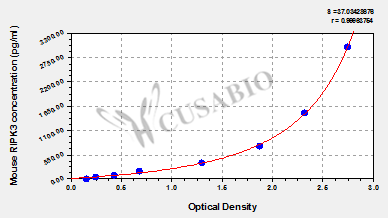
| These standard curves are provided for demonstration only. A standard curve should be generated for each set of samples assayed. | |||||||||||||||||||||||||||||||||||||||||||||||||||||||||||||||
|
|||||||||||||||||||||||||||||||||||||||||||||||||||||||||||||||
Receptor-interacting serine/threonine-protein kinase 3 (RIPK3) is a regulatory enzyme in programmed cell death pathways, particularly necroptosis. This kinase acts as a mediator in the necroptotic signaling cascade, where it forms complexes with other death domain proteins to execute regulated necrosis. RIPK3 plays roles in inflammatory responses, immune system regulation, and tissue homeostasis. Understanding this enzyme helps researchers study cell death mechanisms and their implications in various disease states.
The Mouse Receptor-interacting serine/threonine-protein kinase 3 ELISA kit (CSB-EL019737MO) uses a quantitative sandwich measurement principle for detecting RIPK3 in Mus musculus samples. This assay works with serum, plasma, tissue homogenates, and cell lysates with a detection range of 46.88 pg/mL to 3000 pg/mL and sensitivity of 11.72 pg/mL. The protocol requires 50-100 μL sample volume, operates with 1-5 hour assay time, and uses 450 nm detection wavelength for reliable quantification.
Application Examples
Note: The following application examples are drawn from a selection of publications citing this product. For additional applications, please refer to the full list of references in the "Citations" section.
This ELISA kit has been used in research studying necroptosis and inflammatory responses across both clinical and experimental settings. Studies have applied the kit to measure receptor-interacting serine-threonine kinase 3 levels in plasma samples from trauma patients and surgical patients, as well as in mouse models of endotoxin-induced inflammation.
• Trauma research: Measuring necroptosis biomarkers in emergency department patients with trauma injuries, examining changes in plasma levels over time during illness
• Surgical studies: Monitoring receptor-interacting serine-threonine kinase 3 concentrations in perioperative patients to study acute kidney injury development
• Experimental inflammation models: Studying necroptosis pathway activation in mouse models using endotoxin challenge combined with apoptosis inhibition
• Biomarker correlation studies: Analyzing relationships between plasma and tissue levels of necroptosis markers in experimental settings





