* Sample kit cost can be deducted as a $30 credit for each 96-assay kit of the same analyte and brand you subsequently purchase within six months until depleted. More details >>
Interested in a trial size? Please leave a message below.


| Intra-assay Precision (Precision within an assay): CV%<8% | ||||||
| Three samples of known concentration were tested twenty times on one plate to assess. | ||||||
| Inter-assay Precision (Precision between assays): CV%<10% | ||||||
| Three samples of known concentration were tested in twenty assays to assess. | ||||||
| To assess the linearity of the assay, samples were spiked with high concentrations of mouse WNT5A in various matrices and diluted with the Sample Diluent to produce samples with values within the dynamic range of the assay. | ||||||
| Sample | Serum(n=4) | |||||
| 1:1 | Average % | 92 | ||||
| Range % | 86-98 | |||||
| 1:2 | Average % | 98 | ||||
| Range % | 92-106 | |||||
| 1:4 | Average % | 94 | ||||
| Range % | 88-98 | |||||
| 1:8 | Average % | 88 | ||||
| Range % | 83-94 | |||||
| The recovery of mouse WNT5A spiked to levels throughout the range of the assay in various matrices was evaluated. Samples were diluted prior to assay as directed in the Sample Preparation section. | ||||||
| Sample Type | Average % Recovery | Range | ||||
| Serum (n=5) | 95 | 87-98 | ||||
| EDTA plasma (n=4) | 98 | 95-101 | ||||
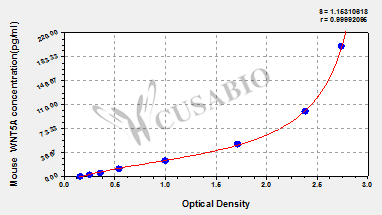
| These standard curves are provided for demonstration only. A standard curve should be generated for each set of samples assayed. | |||||||||||||||||||||||||||||||||||||||||||||||||||||||||||||||
| |||||||||||||||||||||||||||||||||||||||||||||||||||||||||||||||
Wingless-type MMTV integration site family, member 5A (WNT5A) is a secreted signaling glycoprotein that plays important roles in embryonic development, cell fate determination, and tissue homeostasis. As a member of the Wnt signaling pathway, WNT5A primarily activates non-canonical Wnt signaling cascades, including the planar cell polarity pathway and the Wnt/Ca2+ pathway, which regulate cell polarity, migration, and differentiation. WNT5A signaling is necessary for proper skeletal development, limb formation, and various morphogenetic processes. This makes it an important target for developmental biology and regenerative medicine research.
The Mouse Protein Wnt-5a (WNT5A) ELISA kit (CSB-EL026138MO) is designed for quantitative measurement of WNT5A in Mus musculus samples. This sandwich ELISA works with serum, plasma, cell culture supernatants, and tissue homogenates. The detection range spans 3.12 pg/mL to 200 pg/mL with sensitivity of 0.78 pg/mL. The assay requires 50-100 μL sample volume, operates with detection at 450 nm wavelength, and can be completed within 1-5 hours.
Application Examples
Note: The following application examples are drawn from a selection of publications citing this product. For additional applications, please refer to the full list of references in the "Citations" section.
This ELISA kit has been used in research examining Wnt signaling pathways across diverse biological contexts. Studies have applied the kit to quantify wingless-type MMTV integration site family member 5A protein levels in both cell culture systems and clinical samples, supporting research into developmental biology and cardiovascular studies.
• Developmental biology research: Quantification of Wnt protein secretion from neural stem cell lines and lens explant cultures to study signaling pathway activity during tissue development
• Cardiovascular biomarker studies: Measurement of plasma levels in clinical samples from patients to examine potential associations with cardiac conditions and disease progression
• Cell culture applications: Analysis of protein secretion from cultured cell lines with normalization to total protein content for comparative analysis
• Clinical sample analysis: Analysis of protein levels in plasma samples collected from patient cohorts for biomarker research applications
Does this Elisa kit CSB-EL026139MO, does this only show reactivity with mouse and not humans?





