* Sample kit cost can be deducted as a $30 credit for each 96-assay kit of the same analyte and brand you subsequently purchase within six months until depleted. More details >>
Interested in a trial size? Please leave a message below.


| Intra-assay Precision (Precision within an assay): CV%<8% | ||||||
| Three samples of known concentration were tested twenty times on one plate to assess. | ||||||
| Inter-assay Precision (Precision between assays): CV%<10% | ||||||
| Three samples of known concentration were tested in twenty assays to assess. | ||||||
| To assess the linearity of the assay, samples were spiked with high concentrations of human cTn-Ⅰ in various matrices and diluted with the Sample Diluent to produce samples with values within the dynamic range of the assay. | ||||||
| Sample | Serum(n=4) | |||||
| 1:1 | Average % | 94 | ||||
| Range % | 90-100 | |||||
| 1:2 | Average % | 92 | ||||
| Range % | 83-101 | |||||
| 1:4 | Average % | 93 | ||||
| Range % | 85-103 | |||||
| 1:8 | Average % | 95 | ||||
| Range % | 90-102 | |||||
| The recovery of human cTn-Ⅰ spiked to levels throughout the range of the assay in various matrices was evaluated. Samples were diluted prior to assay as directed in the Sample Preparation section. | ||||||
| Sample Type | Average % Recovery | Range | ||||
| Serum (n=5) | 97 | 84-110 | ||||
| EDTA plasma (n=4) | 96 | 89-103 | ||||
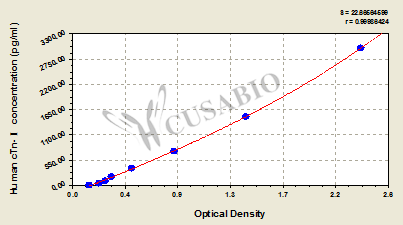
| These standard curves are provided for demonstration only. A standard curve should be generated for each set of samples assayed. | |||||||||||||||||||||||||||||||||||||||||||||||||||||||||||||||
| |||||||||||||||||||||||||||||||||||||||||||||||||||||||||||||||
Cardiac troponin I (TNNI3) is a regulatory protein component of the thin filament in cardiac muscle that plays a key role in calcium-mediated contraction. As a highly specific biomarker for myocardial injury, troponin I is released into circulation following cardiomyocyte damage and has become the gold standard for diagnosing acute myocardial infarction. Its cardiac-specific isoform distinguishes it from skeletal muscle troponins. This makes it an important tool in clinical cardiology and cardiovascular research for measuring heart muscle damage and monitoring therapeutic interventions.
The Human cardiac troponin I ELISA Kit (CSB-E05139h) uses a quantitative sandwich measurement principle for detecting TNNI3 in human serum, plasma, and urine samples. This assay offers a detection range of 47 pg/mL to 3000 pg/mL with a sensitivity of 11.75 pg/mL, requiring 50-100 μL sample volume. The assay can be completed within 1-5 hours with detection at 450 nm wavelength. This gives researchers a reliable method for quantifying cardiac troponin I levels in various biological specimens.
Application Examples
Note: The following application examples are drawn from a selection of publications citing this product. For additional applications, please refer to the full list of references in the "Citations" section.
This ELISA kit has been used in cardiovascular research to measure cardiac troponin I levels as a biomarker of myocardial injury. The kit supports studies examining heart damage in both clinical patient populations and experimental cell culture models. Applications span from coronary artery disease research to cellular injury studies in laboratory settings.
• Cardiovascular disease research: Used in clinical studies comparing patients with coronary artery disease, including chronic coronary syndrome and acute coronary syndrome groups, against healthy control participants
• Myocardial injury measurement: Applied to detect cardiac damage markers in experimental models, including co-culture systems with cardiac cells to evaluate myocardial injury responses
• Biomarker profiling: Used alongside other cardiac injury markers to provide comprehensive analysis of heart damage in both human plasma samples and cell culture supernatants
• Clinical biomarker studies: Applied in hospital-based patient cohorts to measure cardiac troponin I concentrations as part of cardiovascular disease characterization and research





