* Sample kit cost can be deducted as a $30 credit for each 96-assay kit of the same analyte and brand you subsequently purchase within six months until depleted. More details >>
Interested in a trial size? Please leave a message below.


| Intra-assay Precision (Precision within an assay): CV%<8% | ||||||
| Three samples of known concentration were tested twenty times on one plate to assess. | ||||||
| Inter-assay Precision (Precision between assays): CV%<10% | ||||||
| Three samples of known concentration were tested in twenty assays to assess. | ||||||
| To assess the linearity of the assay, samples were spiked with high concentrations of human REST in various matrices and diluted with the Sample Diluent to produce samples with values within the dynamic range of the assay. | ||||||
| Sample | Serum(n=4) | |||||
| 1:1 | Average % | 87 | ||||
| Range % | 80-92 | |||||
| 1:2 | Average % | 96 | ||||
| Range % | 90-105 | |||||
| 1:4 | Average % | 100 | ||||
| Range % | 91-110 | |||||
| 1:8 | Average % | 92 | ||||
| Range % | 86-98 | |||||
| The recovery of human REST spiked to levels throughout the range of the assay in various matrices was evaluated. Samples were diluted prior to assay as directed in the Sample Preparation section. | ||||||
| Sample Type | Average % Recovery | Range | ||||
| Serum (n=5) | 93 | 89-98 | ||||
| EDTA plasma (n=4) | 99 | 92-105 | ||||
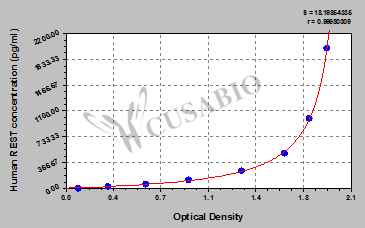
| These standard curves are provided for demonstration only. A standard curve should be generated for each set of samples assayed. | |||||||||||||||||||||||||||||||||||||||||||||||||||||||||||||||
| |||||||||||||||||||||||||||||||||||||||||||||||||||||||||||||||
RE1-silencing transcription factor (REST) is a master transcriptional repressor that regulates neuronal gene expression and development. This zinc finger transcription factor binds to RE1 silencing elements in target gene promoters, recruiting chromatin-modifying complexes to silence neuronal genes in non-neuronal cells. REST maintains the balance between neuronal and non-neuronal cell identity, and its dysregulation has been linked to various neurological disorders, cancer, and aging processes.
The Human RE1-silencing transcription factor (REST) ELISA kit (CSB-EL019571HU) provides quantitative measurement of REST in human samples. This sandwich ELISA works with serum, plasma, tissue homogenates, and cell lysates with a detection range of 31.25 pg/mL to 2000 pg/mL and sensitivity of 7.81 pg/mL. The assay requires 50-100 μL sample volume, operates at 450 nm detection wavelength, and can be completed within 1-5 hours.
Application Examples
Note: The following application examples are drawn from a selection of publications citing this product. For additional applications, please refer to the full list of references in the "Citations" section.
This ELISA kit has been applied in neurological research to quantify RE1-silencing transcription factor levels in plasma samples and neuronal-derived exosomes. Applications include biomarker studies examining extracellular vesicle cargo proteins and plasma protein quantification in clinical research contexts.
• Exosome research: Quantification of RE1-silencing transcription factor in neuronal-derived exosomes isolated from plasma, supporting studies of extracellular vesicle cargo proteins and their potential as biomarkers
• Plasma biomarker studies: Direct measurement of RE1-silencing transcription factor levels in plasma samples with specialized sample pretreatment protocols to release protein from extracellular vesicles
• Clinical research: Application in controlled studies comparing different cohorts, with blinded analysis protocols to evaluate protein levels across various clinical conditions and intervention groups
• Neurological research: Integration with panels of other neurological markers to profile protein expression patterns in both plasma and exosome fractions
Regarding your ELISA kit CSB-EL019571HU, can you please provide the following details:
1) Is the standard natural material or recombinant? And if recombinant, what kind of cell or living material is it used for expression?
2) Does the standard include additive agent such as antiseptic or preservative? If including, what is composition of additive agent?
3) Material name and concentration of Stop Solution.
4) Do these kits include hazardous substance such as azide, thimerosal, 2-ME, etc?


Email: support@cusabio.com
Distributors Worldwide



