* Sample kit cost can be deducted as a $30 credit for each 96-assay kit of the same analyte and brand you subsequently purchase within six months until depleted. More details >>
Interested in a trial size? Please leave a message below.


| Intra-assay Precision (Precision within an assay): CV%<8% | ||||||
| Three samples of known concentration were tested twenty times on one plate to assess. | ||||||
| Inter-assay Precision (Precision between assays): CV%<10% | ||||||
| Three samples of known concentration were tested in twenty assays to assess. | ||||||
| To assess the linearity of the assay, samples were spiked with high concentrations of human PTHrP in various matrices and diluted with the Sample Diluent to produce samples with values within the dynamic range of the assay. | ||||||
| Sample | Serum(n=4) | |||||
| 1:1 | Average % | 94 | ||||
| Range % | 90-99 | |||||
| 1:2 | Average % | 87 | ||||
| Range % | 82-92 | |||||
| 1:4 | Average % | 96 | ||||
| Range % | 90-102 | |||||
| 1:8 | Average % | 90 | ||||
| Range % | 85-96 | |||||
| The recovery of human PTHrP spiked to levels throughout the range of the assay in various matrices was evaluated. Samples were diluted prior to assay as directed in the Sample Preparation section. | ||||||
| Sample Type | Average % Recovery | Range | ||||
| Serum (n=5) | 89 | 84-94 | ||||
| EDTA plasma (n=4) | 100 | 95-105 | ||||
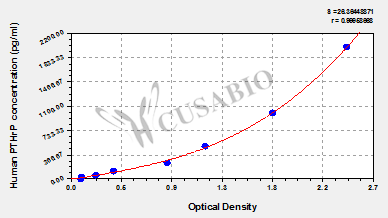
| These standard curves are provided for demonstration only. A standard curve should be generated for each set of samples assayed. | |||||||||||||||||||||||||||||||||||||||||||||||||||||||||||||||
|
|||||||||||||||||||||||||||||||||||||||||||||||||||||||||||||||
The human PTHrP ELISA Kit is used to quantitatively measure PTHrP concentrations in human serum, plasma, or tissue homogenates. It performs well in important characteristics, including sensitivity, specificity, precision, recovery, linearity, and lot-to-lot consistency. This assay is based on the sandwich ELISA mechanism and enzyme-substrate chromogenic reaction. The solution color develops proportionally to the amount of PTHrP in the sample. And the intensity of the color can be measured at 450 nm via a microplate reader.
PTHrP (PTHLH) is expressed in a board of normal tissues and organs and exerts different functions on them. PTHrP and its receptor PTHR1 interaction are involved in a multitude of biological processes, including bone formation, bone remodeling, osteoblast apoptosis inhibition, regulation of calcium transport from blood to milk, regulation as well as of maternal calcium transport to the fetus, and reabsorption of calcium in kidneys. PTHrP modulates dental formation and mandibular development, relaxes the smooth muscle of the gastric fundus, stimulates insulin production, and regulates pancreatic cell proliferation, apoptosis, and differentiation.





