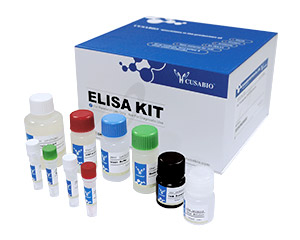
Dog Interferon γ,IFN-γ ELISA Kit

Promotion
Code: CSB-E11262c-IS
Size:
96T,5×96T,10×96T
Pls inquire
Quantity:
Sample Types: serum, plasma, tissue homogenates
Detect Range: 3.12pg/mL-200pg/mL
Sensitivity: 1.56pg/mL
Trial Size:
24T ELISA Kit Trial Size (Only USD$150/ kit)
* Sample kit cost can be deducted as a $30 credit for each 96-assay kit of the same analyte and brand you subsequently purchase within six months until depleted. More details >>
Interested in a trial size? Please leave a message below.

For inquiries on large quantities or another requirements
Send an Inquiry
Start an on-line Chat
Online ordering is currently available for U.S. customers only. For orders outside the U.S., please kindly submit an inquiry or start a chat with us.
Promotion

Product Details

Alternative Names
IFNGInterferon gamma ELISA Kit; IFN-gamma ELISA Kit
Abbreviation
IFNG
Uniprot NO.
Species
Canis lupus familiaris (Dog) (Canis familiaris)
Sample Type
serum, plasma, tissue homogenates
Detection Range
3.12pg/mL-200pg/mL
Sensitivity
1.56pg/mL
Assay Time
1-5h
Sample Loading Volume
50-100ul
Detection Wavelength
450 nm
Research Area
Immunology
Assay Principle
quantitative
The tag type will be determined during production process. If you have specified tag type, please tell us and we will develop the specified tag preferentially.
Measurement
Sandwich
Storage
Store at 2-8°C. Please refer to protocol.
Shelf Life
6 months
Lead Time
3-5 working days
Note: All of our proteins are default shipped with normal blue ice packs, if you request to ship with dry ice, please communicate with us in advance and extra fees will be charged.
Troubleshooting and FAQs
Description

This ELISA kit provides quantitative measurement of interferon-gamma (IFNG) in canine samples, supporting immunological research where this pivotal Th1 cytokine drives cell-mediated immune responses in dogs. Because IFNG is often present at low baseline concentrations and rises sharply during infection or immune activation, accurate quantification across both resting and stimulated states is essential.

Detection Range: The 3.12–200 pg/mL range spans the concentrations typically observed from baseline circulating IFNG in healthy dogs through the elevated levels seen during active infections such as leishmaniasis or ehrlichiosis, minimizing the need for extensive sample dilution in most disease-monitoring studies.

Sensitivity: At 1.56 pg/mL, the kit detects IFNG in unstimulated canine plasma and resting-state tissue homogenates, where this cytokine is often near the lower limit of conventional assays — critical for establishing true baseline values before antigen challenge.

Sample Compatibility: Validation across serum, plasma, and tissue homogenates (50–100 µL per well) enables researchers to correlate systemic IFNG responses with localized tissue inflammation, supporting paired designs common in canine dermatology and organ-specific immunity studies.

Assay Efficiency: The 1–5 hour protocol and low sample volume accommodate limited-volume veterinary blood draws and time-sensitive ex vivo stimulation experiments using canine PBMCs.

This kit is well-suited for canine leishmaniasis immunomonitoring, vaccine immunogenicity assessment, and atopic dermatitis research.


Customer Reviews and Q&A

 Customer Reviews

Target Background

Function(From Uniprot)
Type II interferon produced by immune cells such as T-cells and NK cells that plays crucial roles in antimicrobial, antiviral, and antitumor responses by activating effector immune cells and enhancing antigen presentation. Primarily signals through the JAK-STAT pathway after interaction with its receptor IFNGR1 to affect gene regulation. Upon IFNG binding, IFNGR1 intracellular domain opens out to allow association of downstream signaling components JAK2, JAK1 and STAT1, leading to STAT1 activation, nuclear translocation and transcription of IFNG-regulated genes. Many of the induced genes are transcription factors such as IRF1 that are able to further drive regulation of a next wave of transcription. Plays a role in class I antigen presentation pathway by inducing a replacement of catalytic proteasome subunits with immunoproteasome subunits. In turn, increases the quantity, quality, and repertoire of peptides for class I MHC loading. Increases the efficiency of peptide generation also by inducing the expression of activator PA28 that associates with the proteasome and alters its proteolytic cleavage preference. Up-regulates as well MHC II complexes on the cell surface by promoting expression of several key molecules such as cathepsins B/CTSB, H/CTSH, and L/CTSL. Participates in the regulation of hematopoietic stem cells during development and under homeostatic conditions by affecting their development, quiescence, and differentiation.
Gene References into Functions
  1. IL-17A gene transcription level was positively correlated with mRNA expression for iNOS and IFN-gamma PMID:26590047
  2. In dogs with leishmaniasis, there was high expression of interferon gamma in lymph nodes. PMID:21511273
  3. These findings suggest that polyunsaturated fatty acids are able to influence proliferation of peripheral blood mononuclear cells in healthy and atopic dogs but do not seem to influence cytokine transcription. PMID:20187917

Show More

Hide All

Subcellular Location
Secreted.
Protein Families
Type II (or gamma) interferon family
Tissue Specificity
Released primarily from activated T lymphocytes.
Database Links
icon of phone
Call us
301-363-4651 (Available 9 a.m. to 5 p.m. CST from Monday to Friday)
icon of address
Address
No. 269, Shendun 5th Road, Donghu Hi-Tech Development Area, Hubei Province, 430206, P.R.China
icon of social media
Join us with

Subscribe newsletter

Leave a message

* To protect against spam, please pass the CAPTCHA test below.
CAPTCHA verification
© 2007-2025 CUSABIO TECHNOLOGY LLC All rights reserved. 鄂ICP备15011166号-1
Select 0 Products