Liquid
Note: We will preferentially ship the format that we have in stock, however, if you have any special requirement for the format, please remark your requirement when placing the order, we will prepare according to your demand.
Upon receipt, store at -20°C or -80°C. Avoid repeated freeze.
Lead Time
Basically, we can dispatch the products out in 1-3 working days after receiving your orders. Delivery time maybe differs from different purchasing way or location, please kindly consult your local distributors for specific delivery time.
Note: All of our proteins are default shipped with normal blue ice packs, if you request to ship with dry ice, please communicate with us in advance and extra fees will be charged.
Usage
For Research Use Only. Not for use in diagnostic or therapeutic procedures.
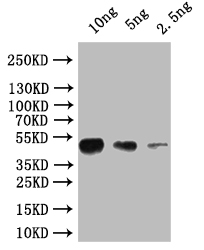
Western Blot
Positive WB detected in: recombinant protein
All lanes: osk Antibody at 1:1000
Secondary
Goat polyclonal to rabbit IgG at 1/50000 dilution
Predicted band size: 45 kDa
Observed band size: 45 kDa
Organizes the germ plasm and directs localization of the posterior determinant nanos. Oskar protein is required to keep nos RNA and staufen protein at the posterior pole.
Gene References into Functions
A missense mutation in the dynactin Arp1 subunit causes most oskar mRNA to localise in the posterior cytoplasm rather than cortically.PMID:29035202
oskar transport signals are weak by necessity; their weakness facilitates transfer of the oskar mRNA from the oocyte transport machinery to the machinery for posterior localization.PMID:28760927
The long isoform of the protein Oskar regulates the maternal inheritance of mitochondria. Long Oskar traps and maintains mitochondria at the posterior at the site of primordial germ cell (PGC) formation through an actin-dependent mechanism. Mutating long oskar strongly reduces the number of mtDNA molecules inherited by PGCs. Therefore, Long Oskar ensures germline transmission of mitochondria to the next generation.PMID:27923120
Crystal structure identifies OSK domain as RNA-binding domain and LOTUS domain as Vasa-binding domain.PMID:26190108
Osk has a role in the regulation of stability, regulation of translation, and localization of relevant mRNAs through direct interaction with their 3'UTRsPMID:26324911
The study determined the SOLE structure formed after alternative splicing of Oskar mRNA as an helical structure with few noncanonical base pairs, capped by a pentanucleotide loop that seems could accommodate a protein partner.PMID:26089324
results therefore suggest that efficient posterior localization of oskar mRNA requires the concerted activities of both Dynein and Kinesin-1.PMID:24244700
These results reveal that Par-1 controls the timing of pole plasm assembly by promoting the localization of oskar mRNA but inhibiting the accumulation of Short Oskar protein.PMID:23948254
Oskar protein was required for recruiting EB1 and CLIP-190 to the oocyte posterior; posterior enrichment of EB1 and CLIP-190 is necessary for high levels of endocytosis in this region of the cell; therefore a functional link between dynamic oocyte microtubules and endocytosis.PMID:22561189
The study demonstrates that the exon junction complex associates with oskar mRNA upon splicing in vitro and that Drosophila exon junction complex deposition is constitutive and conserved.PMID:22426546
report that a Golgi-endosomal protein, Mon2, acts downstream of Osk to remodel cortical actin and to anchor the pole plasmPMID:21610029
osk was independently lost in multiple holometabolous insect lineages and that these losses are phylogenetically correlated with changes in germline determination strategies in these species.PMID:21552321
Translational repression is mediated by BREs, regulatory elements positioned in two clusters near both ends of the oskar mRNA 3' UTR.PMID:20230756
Data indicate that posteriorly localized Par-1 regulates posterior patterning by stabilizing Osk.PMID:11951092
Data show that cortical anchoring of the posterior determinant Oskar is a crucial step in pole plasm assembly and restriction, required for proper development of Drosophila melanogaster.PMID:12117819
Kinesin restricts pole plasm formation to the posterior by moving oskar mRNA away from microtubule-rich lateral and anterior cortical regions.PMID:12134163
MOESIN crosslinks actin and cell membrane in Drosophila oocytes and is required for anchoring of this protein.PMID:12477397
Data suggest that Orb-mediated cytoplasmic polyadenylation stimulates oskar translation to achieve the high levels of Oskar protein necessary for posterior patterning and germline differentiation.PMID:12538512
We conclude that Bruno plays similar roles in translational regulation of gurken and oskarPMID:12591598
Cup is a translational repressor of oskar that is required to assemble the oskar mRNA localization machinery. We propose that Cup coordinates localization with translation.PMID:14691132
splicing at the first exon-exon junction of oskar RNA is essential for oskar mRNA localization at the posterior polePMID:15118729
Hrp48 colocalizes with oskar mRNA throughout oogenesis, and interacts with its 5' and 3' regulatory regions, suggesting that it binds directly to oskar mRNA to mediate its posterior transport.PMID:15130488
The mechanisms that prevent accumulation of Oskar protein until it can be secured at the posterior pole of the oocyte include regulated degradation or inhibition of translational elongation.PMID:15239960
The vlsnull mutant shows that valois+ is required for high levels of Oskar protein to accumulate during oogenesisPMID:15634703
link between oskar translation control and localization in oogenesisPMID:16715044
oskar RNA acts as a scaffold or regulatory RNA essential for development of the oocyte.PMID:16835436
Oskar allows nanos mRNA translation in Drosophila embryos by preventing its deadenylation by Smaug/CCR4.PMID:17050620
An oskar-dependent positive feedback loop maintains the polarity of the Drosophila oocyte.PMID:17275299
A late phase in accumulation of Osk protein, typically not monitored because of imperviousness of late stage oocytes to antibodies, is crucial for body patterning.PMID:17359300
We propose that Oskar maintains its localization at the posterior pole through dual functions in regulating endocytosis and F-actin dynamics.PMID:17419993
Osk stimulates endosomal cycling, which in turn promotes F-actin reorganization to anchor the pole plasm components to the oocyte cortex.PMID:18272590
By following oskar mRNA particles in living oocytes, study shows that the mRNA is actively transported along microtubules in all directions, with a slight bias toward the posterior.PMID:18775316
We observe oskar mRNA to oligomerize as hundreds of copies forming large particles which are necessary for its long range transport and localization. We show the formation of these particles occurs in the nurse cell nucleus in an Hrp48-dependent mannerPMID:19597554
Show
More
Hide
All
Tissue Specificity
Begins to accumulate at the posterior pole of the oocyte from stage 8 onwards.