Liquid
Note: We will preferentially ship the format that we have in stock, however, if you have any special requirement for the format, please remark your requirement when placing the order, we will prepare according to your demand.
Upon receipt, store at -20°C or -80°C. Avoid repeated freeze.
Lead Time
Basically, we can dispatch the products out in 1-3 working days after receiving your orders. Delivery time maybe differs from different purchasing way or location, please kindly consult your local distributors for specific delivery time.
Note: All of our proteins are default shipped with normal blue ice packs, if you request to ship with dry ice, please communicate with us in advance and extra fees will be charged.
Usage
For Research Use Only. Not for use in diagnostic or therapeutic procedures.
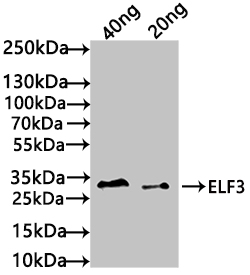
Western Blot
Positive WB detected in: recombinant protein
All lanes: ELF3 Antibody at 1:1000
Secondary
Goat polyclonal to rabbit IgG at 1/50000 dilution
Predicted band size: 33 kDa
Observed band size: 34 kDa
May be a transcription factor part of a circadian clock input pathway. Acts within a 'zeitnehmer' feedback loop and is involved in its own circadian regulation. Has no role in regulating circadian clock function in the dark. Part of a corepressor complex consisting of ELF4, ELF3, and LUX involved in the transcriptional regulation of APRR9. The activity of the protein may be decreased in long day conditions due to its interaction with phytochrome B (phyB). Can regulate the initiation of flowering independently of phyB. Also involved in responses to nematode parasitism, like the formation of the nematode feeding structure.
Gene References into Functions
Based on our results, the authors propose that ELF3 modulates key regulatory components in salt stress response pathways at the transcriptional and post-translational levels.PMID:29032592
PIF4 and ELF3 have roles in Arabidopsis thermoresponsive floweringPMID:27564448
Data identified proteins that associate with the evening complex composed of EARLY FLOWERING 4 (ELF4), EARLY FLOWERING 3 (ELF3), and LUX ARRHYTHMO (LUX).PMID:26545401
Data show that natural variation in EARLY FLOWERING3 (ELF3) controls the link between root constraint and altered shoot growth. ThisPMID:26243313
This work establishes the role of ELF3 in the ambient temperature signaling network. Natural variation of ELF3-mediated gating of PIF4 expression during nightly growing periods seems to be affected by a coding sequence quantitative trait nucleotide.PMID:26269119
The Transcriptional Regulator BBX19 Promotes Hypocotyl Growth by Facilitating COP1-Mediated EARLY FLOWERING3 Degradation in ArabidopsisPMID:25841036
The transcriptional regulator EARLY FLOWERING3 (ELF3) controls elongation growth in response to temperature. High temperature relieves the gating of growth at night, highlighting the importance of temperature-dependent repressors of growth.PMID:25557663
This study shows that ELF3 and PIF4 proteins interact in an EC-independent manner, and that this interaction prevents PIF4 from activating its transcriptional targets. It also shows that PIF4 overexpression leads to ELF3 protein destabilization.PMID:25557667
allele originated in Central Asia; Collectively, we showed that ELF3 protein plays a vital role in defining its light-repressor action in the circadian clock and its functional abilities are largely dependent on its cellular localizationPMID:24867215
The evening loop of the circadian clock is represented by ELF3 and ELF4.PMID:24267177
The phenotypic consequences of natural variation in the polyQ tract encoded by EARLY FLOWERING 3 (ELF3), was investigated.PMID:23129635
The ELF4 recognition site of ELF3 is required for sustaining circadian rhythm. ELF3 and ELF4 directly repress the morning clock gene PPR9.PMID:22327739
show that CCA1 represses ELF3 by associating with its promoter, completing a CCA1-ELF3 negative feedback loop that places ELF3 within the oscillatorPMID:22190341
The mutant elf3-12 is attenuated in its capacity for repressive light input signaling to the circadian clock while maintaining its capacity to sustain oscillator function.PMID:21908721
The results define a new cell-autonomous role for FT and demonstrate that the flowering time genes ELF3 and FT are involved in the regulation of H(+)-ATPase by blue light in guard cells.PMID:21737277
sel20, suppressor of elf3, was a new deletion allele of a mutation in the blue light receptor, CRY2.PMID:21296763
identification of a protein complex composed of the proteins encoded by EARLY FLOWERING 3 (ELF3), ELF4 and the transcription-factor-encoding gene LUX ARRHYTHMO (LUX; also known as PHYTOCLOCK 1)--that directly regulates plant growthPMID:21753751
The mechanism of action of ELF3 in the activation and repression of the circadian clock is reported.PMID:21236675
ELF3 is proposed as a component of the shade avoidance signalling pathway.PMID:20713464
ELF3 has been implicated in the shade avoidance response and different natural alleles of this gene are shown to have phenotypic effects.PMID:20838594
ELF3 is broadly required for circadian clock function regardless of light conditions.PMID:20133619
The function of ELF3 and ELF4 in their light-regulated expression associated with CCA1, LHY, and TOC1 as part of the central oscillator of the circadian clock in Arabidopsis is reported.PMID:16212608
We show that the effects of ZTL and ELF3 on circadian clock function and early photomorphogenesis are additive.PMID:16258016
ELF3 acts as a substrate adaptor, enabling COP1 to modulate light input signal to the circadian clock through targeted destabilization of GI.PMID:19061637
Ambient temperature regulates flowering by two genetic pathways: one that is closely associated with the photoperiod pathway and requires ELF3, and another that requires TFL1 and is related to the autonomous pathway.PMID:19187043