
Call us
301-363-4651 (Available 9 a.m. to 5 p.m. CST from Monday to Friday)

| Application | Recommended Dilution |
|---|---|
| ELISA | 1:4000-1:8000 |
| WB | 1:1000-1:320000 |
| IP | 1μg-5μg |
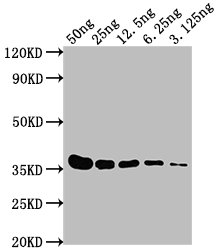
Western Blot
Positive WB detected in: E-tagged fusion protein at 50ng, 25ng, 12.5ng, 6.25ng, 3.125ng
All lanes: E-Tag antibody at 1:1000
Secondary
Goat polyclonal to Mouse IgG at 1/10000 dilution
Predicted band size: 36 kDa
Observed band size: 36 kDa
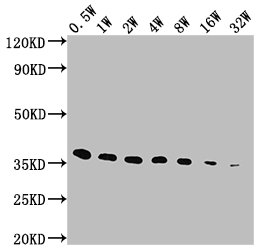
Western Blot
Positive WB detected in: E-tagged fusion protein
All lanes: E-Tag antibody at 1:5000, 1:10000, 1:20000, 1:40000, 1:80000, 1:160000, 1:320000
Secondary
Goat polyclonal to Mouse IgG at 1/10000 dilution
Predicted band size: 36 kDa
Observed band size: 36 kDa
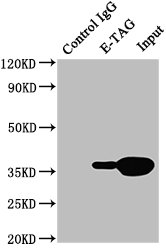
Immunoprecipitating E-Tag in 293F transfected whole cell lysate
Lane 1: Mouse control IgG (1µg) instead of CSB-MA000151M0m in 293F transfected whole cell lysate. For western blotting, a HRP-conjugated Protein G antibody was used as the secondary antibody (1/2000)
Lane 2: CSB-MA000151M0m (5µg) + 293F transfected whole cell lysate (500µg)
Lane 3: 293F transfected whole cell lysate (20µg)
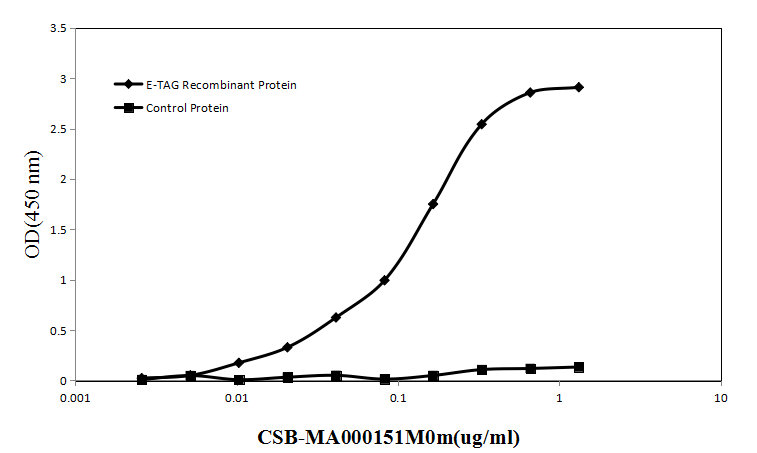
ELISA E-Tag antibody in E-tagged fusion protein and Control protein (no E-tag)
Antigen at dilution of 1µg/ml
E-Tag antibody at (0-0.15µg)
Goat polyclonal to Mouse IgG at 1/50000 dilution
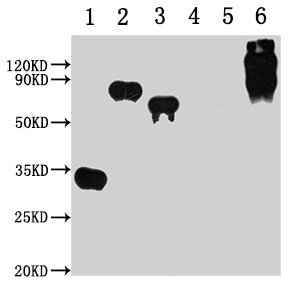
Western Blot
Positive WB detected in: 1-3 lanes: E‐tagged fusion protein, 4-5 lanes: Recombinant protein without E-tagged, 6 lane: BSA-E-Tag
All lanes: E-Tag antibody at 1:1000
Secondary
Goat polyclonal to Mouse IgG at 1/10000 dilution
Predicted band size: 30, 68, 55, 67-157kDa
Observed band size: 30, 68, 55, 67-157kDa
The monoclonal anti-E-Tag (IgG1 isotype) antibody is produced from the hybridomas fused by the myeloma cells and mouse splenocytes. The splenocytes are isolated from the mouse immunized with the E-tag synthetic peptide conjugated to KLH. This unconjugated E-Tag monoclonal antibody is purified through protein G with a purity of more than 95%. It can react with all E-Tag-fused proteins. And it is amenable to ELISA, WB, and IP applications.
E-Tag is a short amino acid sequence (GAPVPYPDPLEPR) that is frequently used as an epitope tag in molecular biology experiments to facilitate the detection and purification of recombinant proteins. The E-Tag sequence is genetically fused to the protein of interest, and antibodies or affinity resins that specifically recognize the E-Tag can be used to detect or purify the tagged protein. This allows researchers to study the expression, localization, and function of the protein in cells or tissues.


Email: support@cusabio.com
Distributors Worldwide



