Peptide sequence around phosphorylation site of tyrosine 807 (G-D-Y(p)-E-N) derived from Human BL-CAM.
Immunogen Species
Homo sapiens (Human)
Purification Method
Antibodies were produced by immunizing rabbits with synthetic phosphopeptide and KLH conjugates. Antibodies were purified by affinity-chromatography using epitope-specific phosphopeptide. Non-phospho specific antibodies were removed by chromatogramphy usi
Concentration
It differs from different batches. Please contact us to confirm it.
Tested Applications
ELISA,WB
Storage
Upon receipt, store at -20°C or -80°C. Avoid repeated freeze.
Lead Time
Basically, we can dispatch the products out in 1-3 working days after receiving your orders. Delivery time maybe differs from different purchasing way or location, please kindly consult your local distributors for specific delivery time.
Note: All of our proteins are default shipped with normal blue ice packs, if you request to ship with dry ice, please communicate with us in advance and extra fees will be charged.
Usage
For Research Use Only. Not for use in diagnostic or therapeutic procedures.
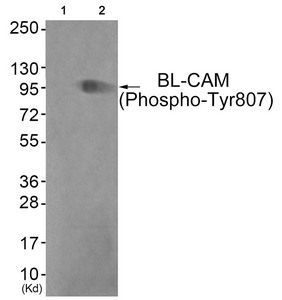
Western blot analysis of extracts from COS7 cells (Lane 2), using BL-CAM (Phospho-Tyr807) Antibody.The lane on the left is treated with antigen-specific peptide.
Mediates B-cell B-cell interactions. May be involved in the localization of B-cells in lymphoid tissues. Binds sialylated glycoproteins; one of which is CD45. Preferentially binds to alpha-2,6-linked sialic acid. The sialic acid recognition site can be masked by cis interactions with sialic acids on the same cell surface. Upon ligand induced tyrosine phosphorylation in the immune response seems to be involved in regulation of B-cell antigen receptor signaling. Plays a role in positive regulation through interaction with Src family tyrosine kinases and may also act as an inhibitory receptor by recruiting cytoplasmic phosphatases via their SH2 domains that block signal transduction through dephosphorylation of signaling molecules.
Gene References into Functions
Conjugates of these multivalent ligands with auristatin and saporin toxins are efficiently internalized via hCD22 resulting in killing of B-cell lymphoma cellsPMID:28829594
This is the first time a NMR-based binding study of high affinity Siglec-2 (CD22) ligands in complex with whole Burkitt's lymphoma Daudi cells has been described.PMID:27808110
Here the authors structurally characterize the ectodomain of CD22 and present its crystal structure with the bound therapeutic antibody epratuzumab, which gives insights into the mechanism of inhibition of B-cell activation.PMID:28970495
hCD22 transgenic mice develop normal humoral responses in a peanut allergy oral sensitization model. Homing of B cells to Peyer's patches was partially rescued by expression of hCD22 compared with CD22(-/-) B cells, although not to wild-type levels.PMID:28972089
Diabody-based (177)Lu-radioimmunoconjugate for CD22-directed radioimmunotherapy reduced disease burden in a non-Hodgkin lymphoma mouse model.PMID:27524505
Siglec-1 and Siglec-2 are potential biomarkers in autoimmune disease. (Review)PMID:26752092
We aimed to screen exons 9-14 of the CD22 gene, which is a mutational hot spot region in B-precursor acute lymphoblastic leukemia (pre-B ALL) patients. Nine variants, of which two novel, were found. Novel variants were in introns 10 and 13. Gly745Asp (rs10406069) variant was missense and Cys790Arg (rs79438722) variant was silent.PMID:27486888
Anti-CD22-magnetic nanoparticles-doxorubicin inhibited the proliferation of Raji cells, significantly increased the uptake of doxorubicin, and induced apoptosis.PMID:26379425
results demonstrate that loss of high affinity CD22 ligands on GC B-cells occurs in both mice and humans through alternative mechanisms, unmasking CD22 relative to naive and memory B-cellsPMID:26507663
MicroRNA-19a and CD22 Comprise a Feedback Loop for B Cell Response in Sepsis.PMID:26017478
These results suggest that the in vivo mechanism of non-ligand-blocking epratuzumab may, in part, involve the unmasking of CD22 to facilitate the trans-interaction of B cells with vascular endothelium.PMID:25484043
By using integrative genomics and analysing the relationships of COPD phenotypes with SNPs and gene expression in lung tissue, we identified CST3 and CD22 as potential causal genes for airflow obstruction.PMID:25182044
study detected the expression of CD22 and CD72 on B cells of myasthenia gravis, compared to multiple sclerosis patient controls and healthy controls yPMID:23184497
In the absence of functional CD22, B cells have a "hyperactivated" phenotype, CD22 dysfunction could contribute to the pathogenesis of autoimmune diseases. (Review)PMID:23083346
The finding that CD22 is expressed on lung cancer cells is significant in revealing a heretofore unknown mechanism of tumorigenesis and metastasisPMID:22986740
Anti-CD22 recombinant immunotoxin moxetumomab pasudotox has activity in relapsed/refractory hairy cell leukemia.PMID:22355053
Our study implicates the CD22DeltaE12 genetic defect in the aggressive biology of relapsed or therapy-refractory paediatric B-lineage ALL.PMID:22017452
This CD22-targeted polymer carrier may be useful for siRNA delivery to lymphoma cells.PMID:21629223
Taken together, these results suggest that negative regulation of TLR signaling of B cells is an intrinsic property of CD22.PMID:21178327
The efficacy of a ligand-targeting approach to B cell-specific depletion therapy for cancer may be the ability of CD22 to recycle and accumulate ligand-decorated cargo intracellularly, as an endocytic receptor.PMID:21178016
These striking findings implicate CD22DeltaE12 as a previously undescribed pathogenic mechanism in human B-precursor leukemia.PMID:20841423
B cell surface receptors CD20 and CD22 are significantly affected in patients with SLE, pointing to their possible involvement in the aetiopathogenesis of the disease and in the regulatory mechanisms in response to the immune disturbance.PMID:20726320
The B-cell receptor IgM was found to be a major in situ trans ligand of CD22.PMID:20172905
Data show that anti-CD22 autoantibodies were positive in 80% of TSK/+ mice and in 22% of SSc patients.PMID:19919568
The Lyn/CD22/SHP-1 pathway is important in autoimmunity. Naive and tolerant B-cells differ in their calcium signaling in response to antigenic stimulation.PMID:11826756
Disulfide bonds and the resulting 3D conformation of the CD22 molecules may have important roles in the difference of antigenicity of CD22 beta in B cells and basophilsPMID:11882357
ligand-binding of CD22 influences its intracellular signaling domain and is needed for inhibition of the B cell receptor signalPMID:11994426
masking of the alpha2-6-linked sialic acid binding site of CD22 involves many cell surface sialoglycoproteins, without requiring specific ligand(s) and/or is mediated by secondary interactions with Sias on CD45 and sIgMPMID:15240561
Aberrant CD22 expression is a useful marker for detection of monoclonal B cells admixed with numerous benign polyclonal B cellsPMID:15899772
decreased CD22 expression may be associated with the activation of B cells in Bullous pemphigoid (BP), but not associated with BP-specific antibody productionPMID:17055225
study showed that a synonymous SNP in CD22, c.2304C > A, was significantly associated with susceptibility to limited cutaneous systemic sclerosisPMID:17493148
The results suggest that these two siglec proteins have evolved distinct endocytic mechanisms consistent with roles in cell signaling and innate immunity.PMID:17562860
These results indicate that the alpha2-6-sialylated 6-sulfo-LacNAc determinant serves as an endogenous ligand for human CD22 and suggest the possibility that 6-GlcNAc sulfation as well as alpha2-6-sialylation may regulate Siglec-2 functions in humans.PMID:17728258
SAP is inducibly expressed in the human BJAB cells, and co-localizes and interacts with CD22. SAP binding to the inhibitory immunoreceptor CD22 regulates calcium mobilization in B cells.PMID:19150402
Show
More
Hide
All
Subcellular Location
Cell membrane; Single-pass type I membrane protein.
Protein Families
Immunoglobulin superfamily, SIGLEC (sialic acid binding Ig-like lectin) family