CD365 antibody; HAVCR 1 antibody; HAVCR antibody; HAVcr-1 antibody; Havcr1 antibody; Hepatitis A virus cellular receptor 1 antibody; Kidney injury molecule 1 antibody; KIM 1 antibody; KIM-1 antibody; T cell immunoglobin domain and mucin domain protein 1 antibody; T cell immunoglobulin mucin family member 1 antibody; T cell immunoglobulin mucin receptor 1 antibody; T-cell immunoglobulin and mucin domain-containing protein 1 antibody; T-cell membrane protein 1 antibody; TIM antibody; TIM-1 antibody; TIM1 antibody; TIMD 1 antibody; TIMD-1 antibody; TIMD1 antibody; TIMD1_HUMAN antibody
Raised in
Rabbit
Species Reactivity
Human
Immunogen
Synthetic peptide of Human HAVCR1
Immunogen Species
Homo sapiens (Human)
Conjugate
Non-conjugated
Isotype
IgG
Purification Method
Antigen affinity purification
Concentration
It differs from different batches. Please contact us to confirm it.
Buffer
-20°C, pH7.4 PBS, 0.05% NaN3, 40% Glycerol
Form
Liquid
Note: We will preferentially ship the format that we have in stock, however, if you have any special requirement for the format, please remark your requirement when placing the order, we will prepare according to your demand.
Upon receipt, store at -20°C or -80°C. Avoid repeated freeze.
Lead Time
Basically, we can dispatch the products out in 1-3 working days after receiving your orders. Delivery time maybe differs from different purchasing way or location, please kindly consult your local distributors for specific delivery time.
Note: All of our proteins are default shipped with normal blue ice packs, if you request to ship with dry ice, please communicate with us in advance and extra fees will be charged.
Usage
For Research Use Only. Not for use in diagnostic or therapeutic procedures.
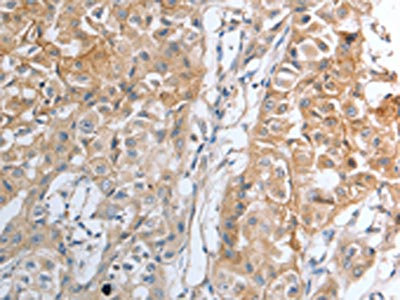
The image on the left is immunohistochemistry of paraffin-embedded Human lung cancer tissue using CSB-PA090386(HAVCR1 Antibody) at dilution 1/25, on the right is treated with synthetic peptide. (Original magnification: ×200)
May play a role in T-helper cell development and the regulation of asthma and allergic diseases. Receptor for TIMD4. May play a role in kidney injury and repair.; (Microbial infection) Acts as a receptor for Hepatitis A virus.; (Microbial infection) Acts as a receptor for Ebolavirus and Marburg virus by binding exposed phosphatidyl-serine at the surface of virion membrane. Serves as a dual receptor for Ebolavirus by also interacting with envelope glycoprotein GP.; (Microbial infection) Acts as a receptor for Dengue virus by binding exposed phosphatidyl-serine at the surface of virion membrane.; (Microbial infection) Acts as a receptor for Zika virus by binding to envelope protein E.
Gene References into Functions
neither the inflammatory biomarker calprotectin, nor the tubular biomarkers NGAL and KIM-1, provide robust prognostic information on the loss of renal function in a heterogeneous CKD population. All of them, however, are candidate prognostic biomarkers in primarily inflammatory renal diseases.PMID:30078006
High KIM1 expression is associated with Clear Cell Renal Cell Carcinoma.PMID:29295730
Human oligodendrocytes undergo apoptosis when exposed to Sema4A and take up H-ferritin for meeting iron requirements and that these functions are mediated via the Tim-1 receptor. H-ferritin can block Sema4A-mediated cytotoxicity. Sema4A is detectable in the CSF of multiple sclerosis patients and HIV-seropositive persons and can induce oligodendrocyte cell death.PMID:29457657
Elevated plasma NT-proBNP and KIM-1 in patients with stage 5 chronic kidney disease (CKD5) undergoing maintenance hemodialysis (HD) and HF (+) (heart failure)CKD5-HD patients suggest that natriuretic peptides and KIM-1 may contribute to the pathogenesis of HF in CKD5-HD patients.PMID:28990414
These findings suggest that the TIMD4-HAVCR1 variants may be the genetic risk factors for coronary heart disease and ischemic strokPMID:29208769
These studies provide evidence that, in the absence of a functional alpha-dystroglycan, TIM-1 mediates the entry of Lassa virus pseudoviral particles through interactions of virions with the IgV PtdSer-binding pocket of TIM-1.PMID:29875238
total flavone of Desmodium styracifolium inhibited HK-2 cell apoptosis and autophagy by regulating KIM-1 via p38/MAPK pathway.PMID:29071538
Polymorphism +4259A>C in exon 3 of the TIM-3 gene is associated with susceptibility to multiple sclerosis but polymorphism -1637C>T in the promoter region of TIM-1 is not.PMID:29141799
High KIM1 expression is associated with decreased proximal tubular epithelial cell function.PMID:29045706
findings show that TIM1 is not an essential cellular receptor for hepatitis A virus entry into cultured cellsPMID:28874468
Urinary excretion of KIM-1 correlates with blood lead levels better than other traditional renal injury biomarkers, including N-acetyl-beta-(D)-glucosaminidase, alpha1-microglobulin, and beta2-microglobulin.PMID:27966578
promising results were obtained for circulating KIM-1 prediction of renal outcomes in type 1 diabetes--{REVIEW}PMID:27771693
data show that in addition to the phospholipid-binding function of HAVCR1, the enhancement of HCV infection involves other determinants in the IgV domain of HAVCR1. These findings expand the repertoire of molecules that HCV uses for cell entry, adding to the already complex mechanism of HCV infection and pathogenesis.PMID:29321304
Review/Meta-analysis: suggest that TIM-1-416G[C single nucleotide polymorphism is associated with the risk of asthma for the Asian ethnicity in the codominant (G/G vs. G/C) and dominant (G/G vs. G/C + C/C) genetic models.PMID:28434117
Urinary NGAL is a good predictor of mortality in established pediatric acute kidney injury (AKI) of heterogeneous etiology and outperforms calprotectin and KIM-1. Urinary calprotectin and KIM-1 predict renal replacement therapy requirement in pediatric AKI.PMID:28409285
A panel consisting of IGFBP1, KIM1, GCLC and GSTM1 genes could be used in combination for early screening of CKDu, whereas these genes in addition with FN1, IGFBP3 and KLK1 could be used to monitor progression of CKDu. The regulation of these genes has to be studied on larger populations to validate their efficiency for further clinical use.PMID:28103909
Quantification of TIM-3 and KIM-1 mRNA expressions, along with KIM-1 protein measurements in urine and blood could be employed as promising tools for noninvasive diagnosis of allograft dysfunction.PMID:28757398
Report detection of drug-induced acute kidney injury in humans by combining the sensitivity of urinary KIM-1 along with urinary miR-21, -200c, and -423.PMID:27122240
measurement of urinary and renal KIM-1 level may be helpful to evaluate severity of renal pathological damage and prognosis in adult Henoch-Schonlein purpura patients with nephritisPMID:29122357
Urine KIM-1 level in acute kidney injury patients was significantly higher than that in the healthy controls.PMID:28212617
PCNSL is characterized by frequent Tim-1 expression, and its soluble form in CSF may become a useful biomarker for PCNSL.PMID:27709813
TIM-1 is a unique marker for the identification of a human IL-10(+) Breg subpopulation which is partially superimposed with transitional B cellsPMID:28103916
in the current meta-analysis, based on ten prospective studies involving 29366 participants, we evaluated the role of urinary tubular injury markers (NGAL, KIM-1 and NAG) in predicting clinical outcomes including CKD stage 3, end stage renal disease and mortality.PMID:27907168
Urinary KIM-1 levels in the acute kidney injury (AKI) preterm infant group were not significantly higher than in no-AKI group on day of life 1, 3 and 7.PMID:27020372
We conclude that KIM-1 might serve as a sensitive biomarker to screen children for kidney damage induced by environmental toxic agents, such as chromium and arsenicPMID:27431456
These results suggest that a 6-amino acid deletion polymorphism in the mucin domain of TIM-1 protects from HIV-1 infection with a recessive effect.PMID:27652980
The present study shows that serum and urine levels of NGAL and KIM-1 are higher in patients with acute kidney injury than in those without acute kidney injury, and that serum NGAL and the presence of chronic kidney disease are significant predictors of acute kidney injury in scrub typhus.PMID:28419138
KIM-1 increases albumin endocytosis in renal tubule epithelial cells.PMID:26332568
preliminary data indicates that KIM-1 expression may be associated with stage in Wilms TumorPMID:27562389
Urinary KIM-1 and NAG levels were positively correlated.PMID:27272162
TLR2, Tim1, Tim3, TNF-alpha, IgE and EOS play a role in Mycoplasma pneumoniae Pneumonia-related wheezing in children.PMID:27185658
The results of our study showed that there is no significant association between TIM-1 5383-5397ins/del and Multiple sclerosis (MS) (P = 0.38); however, the frequency of CT genotype of TIM-3 -1541C>T in patient group was significantly higher than the control group, and there was a significant association between CT genotype and MSPMID:27091308
Study emphasizes a strong association of the tubular biomarker KIM-1 with chronic kidney disease progression in chronic heart failure and suggests usefulness as cardiorenal marker.PMID:26422793
KIM-1 expression also enhances ERK MAPK activation, and the modulatory effect of KIM-1 on cellular repair process is likely mediated via ERK MAPK signaling pathway.PMID:27084535
KIM-1 may mediate high glucose-induced autophagy and apoptosis in renal tubular epithelial cells.PMID:27310004
Study suggests that TIM1 -416G>C and -1454G>A single nucleotide polymorphisms are associated with dilated cardiomyopathy susceptibility and prognosis in this Han Chinese population.PMID:27818477
elevated baseline plasma KIM-1 strongly associated with risk of early progressive renal decline in type 1 diabetesPMID:26509588
Urinary KIM-1 levels increased significantly in patients with contrast-induced nephropathy.PMID:26474236
Data show that kidney injury molecule (KIM)-1 and neutrophil gelatinase-associated lipocalin (NGAL), were significantly elevated in welding workers post-exposure.PMID:26673824
High NGAL and KIM-1 levels may indicate early diabetic kidney injury; however, we did not observe any relationship between these markers and diabetic indicesPMID:26393328
Kidney injury molecule-1 and neutrophil gelatinase-associated lipocalin excretion rates correlated with excretion rates of other tubular damage markers and predicted outcome in patients with idiopathic membranous nephropathyPMID:25762211
The aim of this review article is to summarize the literature data concerning KIM-1 as a potential novel marker in the early diagnosis and prediction of clinical outcome of certain cardiovascular diseases.PMID:26697493
Activation of TIM1 by exposing the cells to TIM4 significantly increased the frequency of apoptotic colon cancer cells. The expression of FasL was increased in the cancer cells after treating by TIM4.PMID:26921445
Urine KIM1 level was higher in kidney stone patients before lithotripsy than in healthy controls.PMID:26407192
Urinary levels of NGAL are more sensitive than uKIM-1 and uL-FABP levels in predicting renal scarring in vesicoureteral reflux.PMID:26324091
TIM-1 ligands increase the amount of cell surface protein, preventing its traffic to the immune synapsePMID:26332704
Urinary KIM-1 measured 24 h after the start of drug infusion has the potential to detect early AKI in pediatric patients treated with MTX or platinum-class drugsPMID:26248472
Urinary KIM-1 is a significant predictor of death in extremely low-birth-weight neonates.PMID:26107391
Urinary KIM1 is significantly higher in patients with clear cell renal carcinoma than in controls. Urinary KIM1 decreases after nephrectomy in clear cell renal carcinoma patients.PMID:27295912
decreased serum TIM-1 and TIM-3 levels and association of TIM-3 with nephritis suggest their possible role in the development and pathogenesis of systemic lupus erythematosus.PMID:27049082
Show
More
Hide
All
Subcellular Location
Membrane; Single-pass type I membrane protein.
Protein Families
Immunoglobulin superfamily, TIM family
Tissue Specificity
Widely expressed, with highest levels in kidney and testis. Expressed by activated CD4+ T-cells during the development of helper T-cells responses.