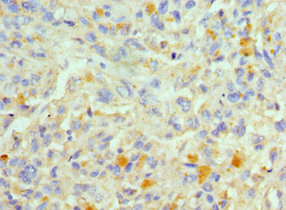
FADD antibody; FADD protein antibody; FADD_HUMAN antibody; Fas (TNFRSF6) associated via death domain antibody; Fas associated via death domain antibody; Fas associating death domain containing protein antibody; Fas associating protein antibody; Fas associating protein with death domain antibody; Fas TNFRSF6 associated via death domain antibody; FAS-associated death domain protein antibody; FAS-associating death domain-containing protein antibody; GIG 3 antibody; GIG3 antibody; Growth inhibiting gene 3 protein antibody; Growth-inhibiting gene 3 protein antibody; H sapiens mRNA for mediator of receptor induced toxicity antibody; Mediator of receptor induced toxicity antibody; MGC8528 antibody; MORT 1 antibody; MORT1 antibody; Protein FADD antibody
Raised in
Rabbit
Species Reactivity
Human
Immunogen
Recombinant Human FAS-associated death domain protein (1-208AA)
Immunogen Species
Homo sapiens (Human)
Conjugate
Non-conjugated
Isotype
IgG
Purification Method
Antigen Affinity Purified
Concentration
It differs from different batches. Please contact us to confirm it.
Buffer
PBS with 0.02% sodium azide, 50% glycerol, pH7.3.
Tested Applications
ELISA, IHC
Recommended Dilution
Application
Recommended Dilution
IHC
1:20-1:200
Storage
Upon receipt, store at -20°C or -80°C. Avoid repeated freeze.
Lead Time
Basically, we can dispatch the products out in 1-3 working days after receiving your orders. Delivery time maybe differs from different purchasing way or location, please kindly consult your local distributors for specific delivery time.
Usage
For Research Use Only. Not for use in diagnostic or therapeutic procedures.
Apoptotic adaptor molecule that recruits caspase-8 or caspase-10 to the activated Fas (CD95) or TNFR-1 receptors. The resulting aggregate called the death-inducing signaling complex (DISC) performs caspase-8 proteolytic activation. Active caspase-8 initiates the subsequent cascade of caspases mediating apoptosis. Involved in interferon-mediated antiviral immune response, playing a role in the positive regulation of interferon signaling.
Gene References into Functions
Overexpression of FADD and Caspase-8 suppresses proliferation whilst promoting the apoptosis of human GBM cells.PMID:28618251
FADD expression and its phosphorylation can be reliable biomarkers with prognostic value for T-cell lymphoblastic lymphoma stratification.PMID:27556297
FADD interference down-regulated Rheb expression and repressed mTORC1 activity in breast cancer cell lines. The autophagy was induced by FADD deficiency in MCF7 or MDA-231 cells but rescued by recovering Rheb expression.PMID:27013580
The present data suggests FADD as a putative biomarker for pathological processes associated with the course of clinical dementia.PMID:28320441
at normal levels of expression during bacterial infection, NleB1/NleB(CR) antagonizes death receptor-induced apoptosis of infected cells by modifying FADD in an irreversible manner.PMID:28860194
Using the tDED filament structure as a template, structural analyses reveal the interaction surfaces between FADD and caspase-8 and the distinct mechanisms of regulation by cFLIP and MC159 through comingling and capping, respectively.PMID:27746017
In myelodysplastic syndrome, FADD expression is regulated by SPAG6 which influences its interaction with TRAIL death receptors.PMID:28393201
High levels of FADD and caspase-8, but not caspase-3, were associated with increased incidence of coronary events in subjects from the general population.PMID:28302628
Both Fas associated via death domain gene copy number amplification and high protein expression were significantly associated with lymph node metastasis and had the shortest disease-free survival and overall survival.PMID:27764170
autoinflammation-associated H443P nlrc4 mutant is altered in interaction with SUG1 and ubiquitinated proteins, triggering constitutive caspase-8-mediated cell death dependent on FADD but independent of Ser(533) phosphorylation.PMID:27974463
this study shows that C5a signaling induces apoptosis in brain vascular endothelial cells in experimental lupus through activation of FADDPMID:27213693
Authors identify non-canonical nuclear factor-kappaB (NF-kappaB) signaling up regulated and it was directly linked with the tumor necrosis with MT2A and pFADD genes. pFADD with MT2A can inhibit the apoptosis and promote proliferation, of colorectal cancer cells.PMID:28061540
knockdown of cFLIPL and induced expression of FADD rapidly accumulate intracellular ROS accompanied by JNK1 activation to substantiate apoptosis.PMID:27619661
Data indicate that FADD mediated apoptotic cell death was directed by ubiquitination of cFLIPL and inhibition of NF-kappaB activation.PMID:26972597
Structural analysis for the roles of DR5 death domain mutations on oligomerization of DR5 death domain-FADD complex in the death-inducing signaling complex formation has been presented.PMID:26995783
A20 targets caspase-8 and FADD to protect HTLV-I-infected cells.PMID:26437781
TCGA analysis showed that ANO1 and FADD, located at 11q13, were co-expressed at transcript level and significantly associated with overall and disease-free survivalPMID:26808319
Data (including data obtained in transgenic mice) suggest FADD is key in genesis of neural tube defects in pups of diabetic mice; unfolded protein response/endoplasmic reticulum stress was prevented by over-expression of human dominant negative FADD.PMID:26419589
multifaceted kinase, CK2, phosphorylates FADD and is involved in its sub-cellular localization.PMID:26253696
The gene expression analysis showed statistically significant difference between cases and healthy controls for both FADD (p<0.02) and FAS (p<0.007) genesPMID:25129245
Observed upregulation of cortical p-194 FADD and p-FADD/FADD ratio (higher pro-survival index) in major depression; could play a major role to counteract the known activation of the intrinsic (mitochondrial) apoptotic pathway in the brainPMID:25075716
FADD death effector domain and c-FLIP death effector domain structures, the binding activity of FADD DED to the c-FLIP death effector domains, and the protein-protein interactions involving the regulation of both apoptosis and necrosis.PMID:24355299
The genotype of the promoter SNP (rs10898853) of FADD was found to be significantly associated with papillary thyroid cancer in a South Korean case control study.PMID:24434721
These results indicate that FADD, as a host pro-apoptotic protein, plays important roles in regulating HIV-1 replication and production in several ways, and apoptotic pathway inhibition is able to decrease HIV-1 replication and productionPMID:24752353
depletion of alphaNAC in multiple types of cancer cells induce typical apoptotic cell death. This anti-apoptotic function is mediated by the FADD/c-Jun N-terminal kinase pathway.PMID:24901053
high expression of FADD may be an independent biomarker for poor prognosis in nasopharyngeal carcinoma.PMID:25305096
Combined FADD, TMEM16A, and PPFIA1 gene expressions are associated with invasive ductal carcinoma of the breast.PMID:24886289
FADD elevation in leukocytes might be interpreted as the molecular equivalent of an elevated general inflammatory activity in relapsing remitting multiple sclerosisPMID:24603611
Antagonizing miR-128a expression sensitized Jurkat/R cells to the Fas-mediated apoptosis through derepression of FADD expression.PMID:24316133
association between FADD protein expression in advanced-stage head and neck squamous cell carcinoma and clinicopathological features and outcomePMID:23763459
Data show that calmodulin (CaM) binds to the death domain of Fas (FasDD) with an apparent dissociation constant (Kd) of ~2 muM and 2:1 CaM:FasDD stoichiometry.PMID:23760276
data show that Pin1 prevents Fas-mediated apoptosis in activated eosinophils via interactions with phospho-FADDPMID:23606538
Kashin-Beck disease patients have significant increased FADD expression in the middle layer but decreased FLIP expression in the upper layer of the cartilage.PMID:22126763
Ubiquitination and degradation of the FADD adaptor protein regulate death receptor-mediated apoptosis and necroptosis.PMID:22864571
The FADD gene amplification was not useful for the predictive marker of cancerization but is possibly related to the malignancy of oral squamous cell carcinoma.PMID:22838074
This review discusses the possible link that could exist between the adenosine-dependent regulation of FADD in the inflammatory context of rheumatoid arthritis.PMID:22253026
FADD cleavage by NK cell granzyme M enhances its self-association to facilitate procaspase-8 recruitment for auto-processing leading to caspase cascade.PMID:21979465
formation of hydrogen-bonded secondary structure in the C-terminal domain of the Fas-associated death domainPMID:22130896
DJ-1 protects against TRAIL-induced apoptosis through the regulation of death-inducing signaling complex (DISC) formation.PMID:21785459
Polo-like kinase 1 (Plk1) failed to phosphorylate the Aur-A-unphosphorylatable FADD substitution mutant S203A.PMID:21978935
an essential role of calmodulin in mediating Fas-induced FADD-independent activation of Src-ERK signaling pathways, which promote survival signaling in pancreatic cancer cells.PMID:21613217
FADD: an endogenous inhibitor of RIP3-driven regulated necrosisPMID:21894190
Our results suggest that deregulated miR-155 promotes Fas-mediated apoptosis in human intervertebral disc degeneration by targeting FADD and caspase-3PMID:21706480
These data provide evidence that serine 194 phosphorylated Fas-associated death domain protein is involved in the proliferation of normal and neoplastic B cells and has features of a novel proliferation marker.PMID:21315423
FADD and TRIM21 together negatively regulate the late IFN-alpha pathway in response to viral infection.PMID:21183682
our data demonstrate that in response to taxol, Plk1 endows death-promoting and tumor-suppressor functions to its substrate, FADDPMID:20890306
Results suggest that the CD95-DD+CT:FADD-DD complex formed in solution is dissociated at the lower pH.PMID:20947025
findings show that the Fas-FADD death domain (DD) complex forms an asymmetric oligomeric structure composed of 5-7 Fas DD and 5 FADD DD, whose interfaces harbor associated autoimmune lymphoproliferative syndrome mutationsPMID:20935634
FADD is essential at early stages of hematopoiesis; its deletion with the Mx1-cre transgene in bone marrow cells leads to impairment of peripheral lymphoid, myeloid, and erythroid cell lineages.PMID:21115735
describe here a complex clinical disorder, its genetic basis, and some of the key mechanisms underlying its pathogenesis. Our findings highlight the key role of FADD in Fas-dependent and Fas-independent signaling pathways in humansPMID:21109225
Show
More
Hide
All
Tissue Specificity
Expressed in a wide variety of tissues, except for peripheral blood mononuclear leukocytes.