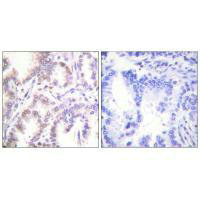
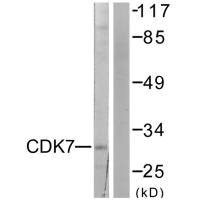
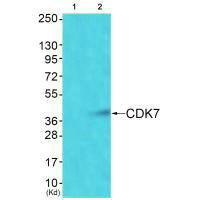
Synthesized peptide derived from Internal of Human CDK7.
Immunogen Species
Homo sapiens (Human)
Clonality
Polyclonal
Purification Method
The antibody was affinity-purified from rabbit antiserum by affinity-chromatography using epitope-specific immunogen.
Concentration
It differs from different batches. Please contact us to confirm it.
Form
Rabbit IgG in phosphate buffered saline (without Mg2+ and Ca2+), pH 7.4, 150mM NaCl, 0.02% sodium azide and 50% glycerol.
Note: We will preferentially ship the format that we have in stock, however, if you have any special requirement for the format, please remark your requirement when placing the order, we will prepare according to your demand.
Upon receipt, store at -20°C or -80°C. Avoid repeated freeze.
Lead Time
Basically, we can dispatch the products out in 1-3 working days after receiving your orders. Delivery time maybe differs from different purchasing way or location, please kindly consult your local distributors for specific delivery time.
Note: All of our proteins are default shipped with normal blue ice packs, if you request to ship with dry ice, please communicate with us in advance and extra fees will be charged.
Usage
For Research Use Only. Not for use in diagnostic or therapeutic procedures.
Serine/threonine kinase involved in cell cycle control and in RNA polymerase II-mediated RNA transcription. Cyclin-dependent kinases (CDKs) are activated by the binding to a cyclin and mediate the progression through the cell cycle. Each different complex controls a specific transition between 2 subsequent phases in the cell cycle. Required for both activation and complex formation of CDK1/cyclin-B during G2-M transition, and for activation of CDK2/cyclins during G1-S transition (but not complex formation). CDK7 is the catalytic subunit of the CDK-activating kinase (CAK) complex. Phosphorylates SPT5/SUPT5H, SF1/NR5A1, POLR2A, p53/TP53, CDK1, CDK2, CDK4, CDK6 and CDK11B/CDK11. CAK activates the cyclin-associated kinases CDK1, CDK2, CDK4 and CDK6 by threonine phosphorylation, thus regulating cell cycle progression. CAK complexed to the core-TFIIH basal transcription factor activates RNA polymerase II by serine phosphorylation of the repetitive C-terminal domain (CTD) of its large subunit (POLR2A), allowing its escape from the promoter and elongation of the transcripts. Phosphorylation of POLR2A in complex with DNA promotes transcription initiation by triggering dissociation from DNA. Its expression and activity are constant throughout the cell cycle. Upon DNA damage, triggers p53/TP53 activation by phosphorylation, but is inactivated in turn by p53/TP53; this feedback loop may lead to an arrest of the cell cycle and of the transcription, helping in cell recovery, or to apoptosis. Required for DNA-bound peptides-mediated transcription and cellular growth inhibition.
Gene References into Functions
Study demonstrate that CDK7 activity is necessary to maintain the transcriptional program induced by STAT proteins that are activated both aberrantly by mutation and by extracellular cues in T-cell lymphomas.PMID:28134252
these results implicate a CDK7-dependent "CTD code" that regulates chromatin marks in addition to RNA processing and pol II pausing.PMID:28768201
Our studies have demonstrated the essential role of endogenous PRL and CDK7 in the upregulation of PRLR by E2 and provide insights for therapeutic approaches that will mitigate the transcription/expression of PRLR and its participation in breast cancer progression fueled by E2 and PRL via their cognate receptors.PMID:28423697
MYC promotes mRNA cap methylation and protein production of Wnt/beta-catenin signaling transcripts through recruitment of cyclin-dependent kinase 7 (CDK7) and consequently RNMT to gene promoters.PMID:27899423
High expression of MMP14 and CDK7 was independent prognostic factors for overall survival in patients with gastric cancer.PMID:27562173
Taken together, these findings elucidated a novel mechanism of prostate cancer progression. Thus, SNHG1 might serve as a potential target for prostate cancer therapies.PMID:28400279
Data indicate that cyclin dependent kinase 7 (CDK7) is overexpressed in gastric cancer cell lines and tissues.PMID:27155449
Cdk7 broadly influences transcription and capping.PMID:26257281
Study shows that triple-negative but not hormone receptor-positive breast cancer cells are exceptionally dependent on CDK7, a transcriptional cyclin-dependent kinase.PMID:26406377
Data suggest a quantitative contribution of CDK7 to mRNA synthesis, which is critical for cellular homeostasis.PMID:25047832
Interaction with cyclin H/cyclin-dependent kinase 7 (CCNH/CDK7) stabilizes C-terminal binding protein 2 (CtBP2) and promotes cancer cell migrationPMID:23393140
three CTD kinases, CDK7, CDK9, and BRD4, engage in cross-talk, modulating their subsequent C-terminal domain phosphorylation, and also phosphorylate TAF7PMID:23027873
Cdk7 thus acts through TFIIE and DSIF to establish, and through P-TEFb to relieve, barriers to elongation: incoherent feedforward that might create a window to recruit RNA-processing machinery.PMID:23064645
glioma cells may be proliferating through a novel PI (3)-kinase-/PKC-iota/Cdk7/cdk2-mediated pathway.PMID:22021906
Our findings suggest that the CDK7 TT genotype and the combined genetic polymorphisms of CDK7 and ESR1P325P are associated with breast cancer in Korean women.PMID:19941161
determined the crystal structure of human CDK7 in complex with ATP at 3 A resolutionPMID:15530371
Cdk7 accomplishes dual functions in cell-cycle control and transcription not through promiscuity but through distinct, stringent modes of substrate recognition.PMID:16327805
Different modes of CDK activation by Cdk7 at two distinct execution points in the cell cycle.PMID:17386261
Data revealed that SF1 and CDK7 reside in the same complex and CDK inhibitor roscovitine blocked phosphorylation of SF1, and an inactive form of CDK7 repressed the phosphorylation level and the transactivation capacity of SF1.PMID:17901130
A role of Cdk7 in regulating elongation is further suggested by enhanced histone H4 acetylation and diminished histone H4 trimethylation on lysine 36-two marks of elongation-within genes when the kinase was inhibited.PMID:19667075