* Sample kit cost can be deducted as a $30 credit for each 96-assay kit of the same analyte and brand you subsequently purchase within six months until depleted. More details >>
Interested in a trial size? Please leave a message below.


| Intra-assay Precision (Precision within an assay): CV%<15% | ||||||
| Three samples of known concentration were tested twenty times on one plate to assess. | ||||||
| Inter-assay Precision (Precision between assays): CV%<15% | ||||||
| Three samples of known concentration were tested in twenty assays to assess. | ||||||
| To assess the linearity of the assay, samples were spiked with high concentrations of rat OT in various matrices and diluted with the Sample Diluent to produce samples with values within the dynamic range of the assay. | ||||||
| Sample | Serum(n=4) | |||||
| 1:1 | Average % | 98 | ||||
| Range % | 95-102 | |||||
| 1:2 | Average % | 93 | ||||
| Range % | 90-96 | |||||
| 1:4 | Average % | 98 | ||||
| Range % | 95-102 | |||||
| 1:8 | Average % | 101 | ||||
| Range % | 98-104 | |||||
| The recovery of rat OT spiked to levels throughout the range of the assay in various matrices was evaluated. Samples were diluted prior to assay as directed in the Sample Preparation section. | ||||||
| Sample Type | Average % Recovery | Range | ||||
| Serum (n=5) | 94 | 90-98 | ||||
| EDTA plasma (n=4) | 92 | 89-94 | ||||
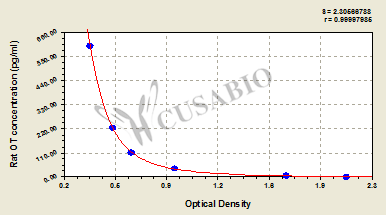
| These standard curves are provided for demonstration only. A standard curve should be generated for each set of samples assayed. | |||||||||||||||||||||||||||||||||||||||||||||||||
|
|||||||||||||||||||||||||||||||||||||||||||||||||
Oxytocin is a neuropeptide hormone synthesized in the hypothalamus and released by the posterior pituitary gland. This nine-amino acid peptide plays important roles in social bonding, maternal behavior, parturition, and lactation. Beyond its classical reproductive functions, oxytocin influences various physiological processes including cardiovascular regulation, stress response, and social cognition. The hormone acts through oxytocin receptors distributed throughout the central nervous system and peripheral tissues, making it an important target for neuroscience and behavioral research.
The Rat oxytocin ELISA Kit (CSB-E14197r) provides quantitative measurement of oxytocin in rat serum and plasma samples using a competitive assay principle. The kit offers a detection range of 7.5 pg/mL to 600 pg/mL with a sensitivity of 9.375 pg/mL. Assays require 50-100 μL sample volume and can be completed within 1-5 hours, with detection performed at 450 nm wavelength.
Application Examples
Note: The following application examples are drawn from a selection of publications citing this product. For additional applications, please refer to the full list of references in the "Citations" section.
This ELISA kit has been used in research examining oxytocin levels across different biological matrices in rat studies. The applications span endocrine research, behavioral studies, and multi-analyte profiling approaches where oxytocin serves as a key biomarker of interest.
• Endocrine profiling: Used alongside other hormone measurements including sex hormones and inflammatory markers to assess comprehensive endocrine status in plasma samples
• Tissue-based studies: Applied to analyze oxytocin concentrations in specialized tissue samples such as scented glands, using tissue homogenate preparation protocols
• Behavioral research: Used in postpartum behavioral studies examining oxytocin levels in plasma following stress testing procedures
• Multi-biomarker approaches: Integrated into broader analytical panels measuring various neurochemicals and inflammatory mediators in both plasma and brain tissue regions
• Sample versatility: Shows utility across multiple sample types including plasma and tissue homogenates with appropriate sample preparation protocols





