* Sample kit cost can be deducted as a $30 credit for each 96-assay kit of the same analyte and brand you subsequently purchase within six months until depleted. More details >>
Interested in a trial size? Please leave a message below.


| Intra-assay Precision (Precision within an assay): CV%<8% | ||||||
| Three samples of known concentration were tested twenty times on one plate to assess. | ||||||
| Inter-assay Precision (Precision between assays): CV%<10% | ||||||
| Three samples of known concentration were tested in twenty assays to assess. | ||||||
| To assess the linearity of the assay, samples were spiked with high concentrations of mouse anti-CCP-antibody in various matrices and diluted with the Sample Diluent to produce samples with values within the dynamic range of the assay. | ||||||
| Sample | Serum(n=4) | |||||
| 1:1 | Average % | 95 | ||||
| Range % | 88-101 | |||||
| 1:2 | Average % | 97 | ||||
| Range % | 91-106 | |||||
| 1:4 | Average % | 95 | ||||
| Range % | 90-106 | |||||
| 1:8 | Average % | 96 | ||||
| Range % | 89-104 | |||||
| The recovery of mouse anti-CCP-antibody spiked to levels throughout the range of the assay in various matrices was evaluated. Samples were diluted prior to assay as directed in the Sample Preparation section. | ||||||
| Sample Type | Average % Recovery | Range | ||||
| Serum (n=5) | 97 | 90-110 | ||||
| EDTA plasma (n=4) | 95 | 83-99 | ||||
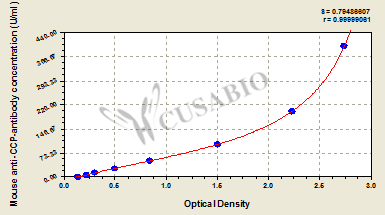
| These standard curves are provided for demonstration only. A standard curve should be generated for each set of samples assayed. | |||||||||||||||||||||||||||||||||||||||||||||||||||||||||||||||
|
|||||||||||||||||||||||||||||||||||||||||||||||||||||||||||||||
Anti-cyclic citrullinated peptide antibodies are autoantibodies that recognize citrullinated proteins, which form through post-translational modification of arginine residues by peptidylarginine deiminase enzymes. These antibodies serve as important biomarkers in autoimmune research, particularly for studying inflammatory conditions and immune system dysfunction. Anti-CCP antibodies indicate an autoimmune response against self-proteins that have undergone citrullination. This makes them valuable tools for studying autoimmune pathogenesis and disease progression in research models.
This Mouse Anti-Cyclic Citrullinated Peptide Antibody ELISA kit (CSB-EQ027743MO) uses a quantitative sandwich assay principle to measure Anti-CCP-Ab levels in mouse serum and plasma samples. The kit provides a detection range of 6.25 U/mL to 400 U/mL with a sensitivity of 1.56 U/mL. The assay requires 50-100 μL sample volume and can be completed within 1-5 hours, with detection at 450 nm wavelength.
Application Examples
Note: The following application examples are drawn from a selection of publications citing this product. For additional applications, please refer to the full list of references in the "Citations" section.
This ELISA kit has been used in research studying autoimmune and inflammatory conditions, particularly in studies examining the relationship between autoantibodies and disease pathogenesis. The kit allows quantification of anti-cyclic citrullinated peptide antibodies in mouse serum samples as part of comprehensive autoimmune profiling approaches.
• Autoimmune research: Measuring anti-CCP antibody levels alongside other autoantibodies such as anti-collagen II antibodies in mouse models to evaluate autoimmune responses
• Inflammatory disease studies: Integration with pro-inflammatory cytokine measurements to provide comprehensive immune system profiling in experimental settings
• Biomarker profiling: Quantification of autoantibody levels as part of multi-parameter immunological studies in serum samples from mouse models
• Disease model characterization: Analysis of autoimmune markers in conjunction with cytokine panels to characterize inflammatory and autoimmune disease progression
Sample species :
Sample type:
Review:
By Anonymous
Sample species :
Sample type:
Review:
By Anonymous





