* Sample kit cost can be deducted as a $30 credit for each 96-assay kit of the same analyte and brand you subsequently purchase within six months until depleted. More details >>
Interested in a trial size? Please leave a message below.


| Intra-assay Precision (Precision within an assay): CV%<15% | ||||||
| Three samples of known concentration were tested twenty times on one plate to assess. | ||||||
| Inter-assay Precision (Precision between assays): CV%<15% | ||||||
| Three samples of known concentration were tested in twenty assays to assess. | ||||||
| To assess the linearity of the assay, samples were spiked with high concentrations of human OT in various matrices and diluted with the Sample Diluent to produce samples with values within the dynamic range of the assay. | ||||||
| Sample | Serum(n=4) | |||||
| 1:1 | Average % | 89 | ||||
| Range % | 85-96 | |||||
| 1:2 | Average % | 95 | ||||
| Range % | 91-99 | |||||
| 1:4 | Average % | 98 | ||||
| Range % | 92-103 | |||||
| 1:8 | Average % | 93 | ||||
| Range % | 87-98 | |||||
| The recovery of human OT spiked to levels throughout the range of the assay in various matrices was evaluated. Samples were diluted prior to assay as directed in the Sample Preparation section. | ||||||
| Sample Type | Average % Recovery | Range | ||||
| Serum (n=5) | 92 | 87-96 | ||||
| EDTA plasma (n=4) | 96 | 90-102 | ||||
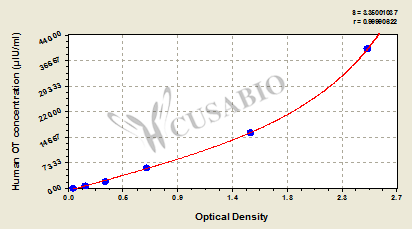
| These standard curves are provided for demonstration only. A standard curve should be generated for each set of samples assayed. | |||||||||||||||||||||||||||||||||||||||||||||||||
|
|||||||||||||||||||||||||||||||||||||||||||||||||
Oxytocin is a neuropeptide hormone synthesized in the hypothalamus and released by the posterior pituitary gland. This nine-amino acid peptide plays important roles in social bonding, maternal behavior, parturition, and lactation. Oxytocin functions through binding to specific G-protein coupled receptors, triggering intracellular signaling cascades that influence smooth muscle contraction and various behavioral responses. Research into oxytocin has expanded significantly due to its involvement in autism spectrum disorders, social cognition, stress response, and cardiovascular regulation. This makes it a valuable biomarker for neurological and endocrinological studies.
The Human oxytocin ELISA Kit (CSB-E08994h) uses a quantitative sandwich immunoassay principle to measure oxytocin levels in human serum, plasma, and tissue homogenates. This assay provides a detection range of 8-400 μIU/mL with a sensitivity of 10 μIU/mL. The protocol requires 50-100 μL sample volumes and can be completed within 1-5 hours. Optical density measurements are taken at 450 nm wavelength to quantify oxytocin concentrations in biological samples.
Application Examples
Note: The following application examples are drawn from a selection of publications citing this product. For additional applications, please refer to the full list of references in the "Citations" section.
This ELISA kit has been used in research investigating oxytocin levels in human serum samples across different clinical contexts. The applications span from cancer research to analytical method development studies examining hormone detection capabilities.
• Cancer research: Measurement of serum oxytocin levels in oral squamous cell carcinoma patients to investigate potential biomarker associations with disease pathology
• Analytical method development: Integration into comparative studies evaluating hydrogen peroxide detection methods and assay optimization protocols for hormone measurement applications
• Endocrine profiling: Quantification of oxytocin concentrations in serum samples as part of broader hormonal panels in clinical research settings
I hope you would be able to advice me if this item would
be suitable for me to purchase in order to conduct human salivary
ELISA assay on oxytocin. Sample size is 60 and running in
duplicates.





