* Sample kit cost can be deducted as a $30 credit for each 96-assay kit of the same analyte and brand you subsequently purchase within six months until depleted. More details >>
Interested in a trial size? Please leave a message below.


| Intra-assay Precision (Precision within an assay): CV%<8% | |||||||||||||
| Three samples of known concentration were tested twenty times on one plate to assess. | |||||||||||||
| Inter-assay Precision (Precision between assays): CV%<10% | |||||||||||||
| Three samples of known concentration were tested in twenty assays to assess. | |||||||||||||
| To assess the linearity of the assay, samples were spiked with high concentrations of human C3b in various matrices and diluted with the Sample Diluent to produce samples with values within the dynamic range of the assay. | |||||||||||||
| Sample | Serum(n=4) | ||||||||||||
| 1:1 | Average % | 87 | |||||||||||
| Range % | 82-92 | ||||||||||||
| 1:2 | Average % | 98 | |||||||||||
| Range % | 92-103 | ||||||||||||
| 1:4 | Average % | 99 | |||||||||||
| Range % | 93-103 | ||||||||||||
| 1:8 | Average % | 94 | |||||||||||
| Range % | 89-98 | ||||||||||||
| The recovery of human C3b spiked to levels throughout the range of the assay in various matrices was evaluated. Samples were diluted prior to assay as directed in the Sample Preparation section. | |||||||||||||
| Sample Type | Average % Recovery | Range | |||||||||||
| Serum (n=5) | 95 | 90-98 | |||||||||||
| EDTA plasma (n=4) | 97 | 91-99 | |||||||||||
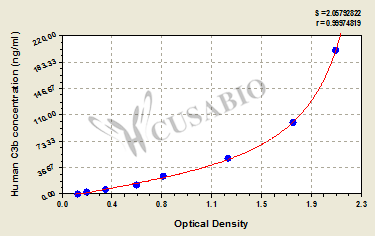
| These standard curves are provided for demonstration only. A standard curve should be generated for each set of samples assayed. | ||||||||||||||||||||||||||||||||||||||||||||||||||||||||||||||||||||||||||||||||||||||||||||||||||||||||||||||||||||||||||||||
| ||||||||||||||||||||||||||||||||||||||||||||||||||||||||||||||||||||||||||||||||||||||||||||||||||||||||||||||||||||||||||||||
Complement fragment 3b (C3b) is a key component of the complement system, an essential part of innate immunity that helps eliminate pathogens and damaged cells. C3b forms when C3 convertases cleave complement component C3. It acts as an opsonin that promotes phagocytosis by binding to microbial surfaces and marking them for destruction. This fragment also plays an important role in C5 convertase formation, amplifying the complement cascade and contributing to membrane attack complex formation. C3b levels serve as clinically relevant biomarkers for monitoring complement system activation in various inflammatory and autoimmune conditions.
The Human Complement fragment 3b,C3b ELISA Kit (CSB-E09303h) provides quantitative measurement of C3b in human samples using a sandwich assay principle. This kit works with multiple sample types including serum, urine, cerebrospinal fluid, and saliva, with a detection range of 3.12 ng/mL to 200 ng/mL and sensitivity of 0.78 ng/mL. The assay requires 50-100 μL sample volume, operates at 450 nm detection wavelength, and can be completed within 1-5 hours.
Application Examples
Note: The following application examples are drawn from a selection of publications citing this product. For additional applications, please refer to the full list of references in the "Citations" section.
This ELISA kit has been used in research examining complement system activation and inflammatory responses across various clinical and experimental contexts. Studies have applied the kit to measure complement fragment levels in human serum and cerebrospinal fluid samples, as well as in experimental models examining neuroinflammation and immune system responses.
• Complement system research: Quantification of complement activation products in serum and cerebrospinal fluid to evaluate immune system activity and inflammatory status
• Neurological studies: Analysis of complement factor levels in brain tissue and cerebrospinal fluid in the context of neuroinflammation and central nervous system disorders
• Care research: Analysis of complement activation markers in cardiac arrest patients during post-resuscitation recovery periods to evaluate immune system responses
• Viral infection models: Evaluation of complement system activation in experimental cell culture systems studying viral pathogenesis and host immune responses
• Biomarker profiling: Integration with multi-analyte panels to comprehensively evaluate inflammatory and immune status alongside other complement factors and cytokines


Email: support@cusabio.com
Distributors Worldwide



